
- DisinfoWatch reviewed 2,917 X posts, which recorded about 32.2 million views.
- Unverified reports spread quickly during the first hours. Claims of explosions and higher casualty figures reached large audiences before officials had confirmed basic facts.
- Sixty-one posts in the sample repeated one or more of six disputed claims. Exaggerated casualty claims drew the most recorded views; cover-up accusations drew the most replies.
- CAF’s October 22 update clarified how the fire spread: it began during routine training on the Automatic Grenade Launcher range, remained in a danger area that limited direct suppression, and intensified after a change in wind. The investigation continues.
- The pipeline and cover-up allegations remain unsupported. The Provost Marshal said there was no indication natural-gas infrastructure was involved or affected. RT and U.S. outlets amplified parts of the story, but the report does not establish coordination or who originated the rumours.
Four Canadian soldiers were killed and 39 others injured when a fire swept through a training area at CFB Wainwright, Alberta, on October 17. The tragedy prompted an outpouring of grief. It also unleashed a rush of rumours on social media, including claims of a gas pipeline explosion, a much higher death toll and suggestions that the federal government was hiding what really happened.
Some of those claims attracted hundreds of thousands of views before military officials had confirmed basic facts. Others appeared after the official briefing, when speculation about the cause of the fire began turning into accusations of a cover-up.
DisinfoWatch reviewed 2,917 Twitter/X posts gathered between October 17 5:36:50 p.m. Mountain Daylight Time (Alberta time), and the evening of October 19. Together, these posts had approximately 32.2 million recorded views. That figure includes original and retweeted posts of basic news coverage, expressions of condolence, conspiracy theories, among others. These figures provide a snapshot of the scale and nature of the online conversation surrounding the Wainwright tragedy. They show which conspiracy theories and unverified claims attracted the most attention, how widely they circulated, and how audiences engaged with them through likes, reposts and replies. They also help illustrate how initial uncertainty about the incident developed into speculation and, in some cases, accusations that Canadian authorities were deliberately concealing the truth. While the data offers valuable insight into the spread and amplification of these narratives, it does not tell us how many people believed them, whether they influenced public opinion, or whether their circulation was coordinated.
What we know about the fire
The Canadian Armed Forces confirmed on October 18 that four members had died and 39 had been injured. On October 22, the Provost Marshal said the fire began on the Automatic Grenade Launcher range during routine training. It remained within Permanent Danger Area 2, restricting direct suppression. A change in wind direction and speed increased its intensity and rate of spread. The investigation continues. As of October 22, 27 remained in hospital and 12 had been released.
The Alberta Energy Regulator also confirmed that oil and natural-gas facilities exist on the base; the Provost Marshal said there was no indication natural-gas infrastructure was involved or affected. Legitimate questions about training safety, the fire and emergency response remain. Those questions are not evidence that a gas pipeline exploded or that authorities are concealing the truth.
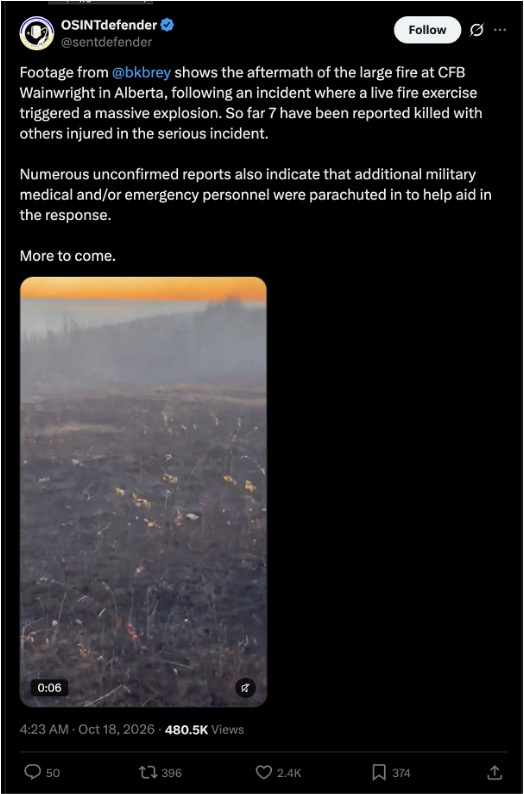
Example of an early Twitter/X post about the incident.
Early rumours reached huge audiences
One of the first widely seen posts came from an Alberta based account, which asked in the evening of October 17, why the media was not covering Wainwright and repeated rumours of mass casualties. It attracted nearly 2 million views. U.S. journalist Scott Stedman described reports of an apparent explosion in a post seen more than 460,000 times shortly after.
The large breaking-news account OSINTdefender (@sentdefender), which had about 2.55 million followers, told its audience that hospitals were reportedly overwhelmed and that defence officials were providing little information. That post received more than 1.44 million views. A later post mentioning a massive explosion and seven reported deaths was seen almost 478,000 times.
These posts show how quickly uncertain information can reach international audiences during an unfolding emergency. Early reports may be inaccurate without being deliberately misleading. The distinction matters. Reporting a claim as unconfirmed is not the same as insisting that an unproven theory is true.
A gas pipeline, a hidden death toll and claims of a cover-up
One X account with only 222 followers suggested that a Carl Gustaf anti-tank round might have struck a natural-gas pipeline. That post attracted nearly 248,000 views. Another account, questioned the gas-well theory, saying veterans believed the explanation did not add up. Its post drew more than 361,000 views. The two posts did not agree on what happened, but both helped keep the gas-infrastructure story in circulation before investigators had established the cause.
Other accounts went further. @TruthFringe circulated claims of seven dead, 150 wounded and 20 missing, then suggested that the timing was suspicious because of Alberta’s referendum. The post attracted nearly 83,000 views. There was no evidence presented to connect the fire to the vote.
A particularly direct cover-up allegation came from Julia Ann Landry (@Jewelanland). She insisted there was no way a grass fire could have caused so many casualties and accused Canada of withholding the real story. Her post drew nearly 65,000 views, despite an account following of just 567. Another account, @TheBuckYouWill, claimed that a supposed hospital witness had exposed flaws in the official account. That post attracted more than 46,000 views. Neither established that officials had deliberately concealed information. Another account identified as HeavyEquipmentTradeswrote “I don’t believe in coincidences… wainwright mass casualty event (to be confirmed) on the same day as the separate vote? Wild.”
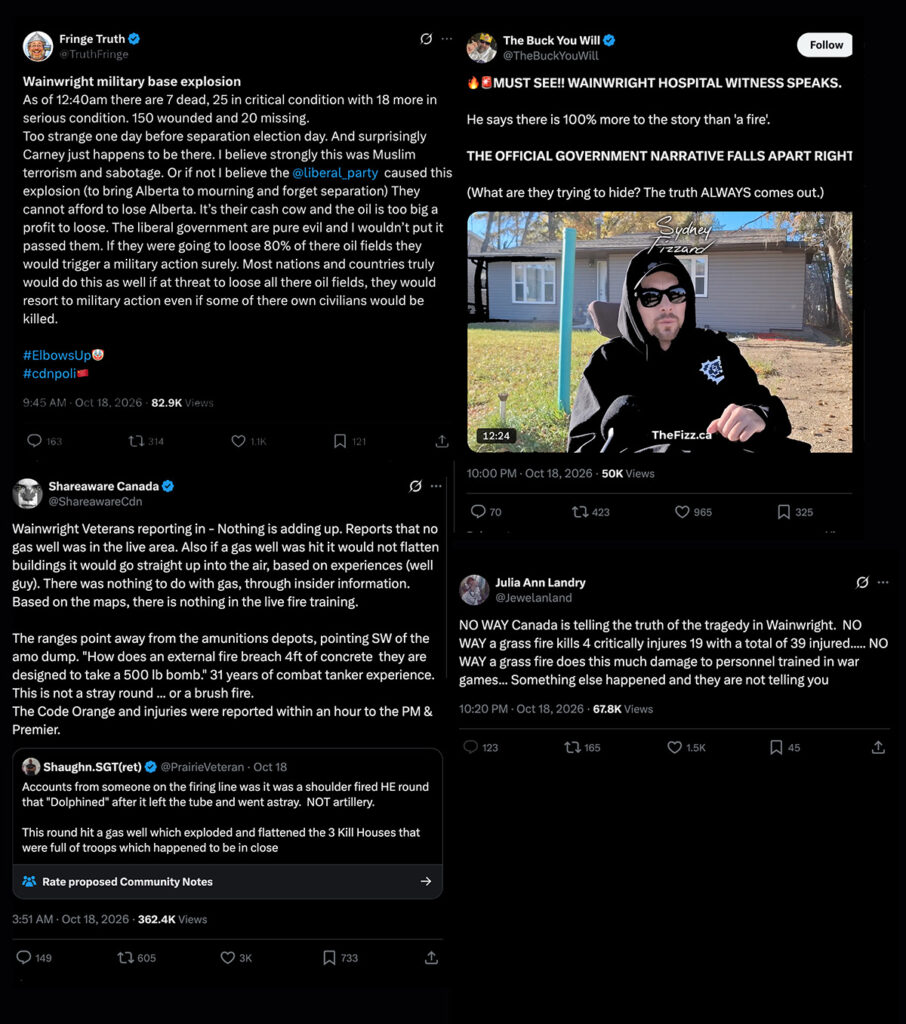
Examples of Tweets October 18, 2026
An earthquake claim that grew stronger as it was repeated
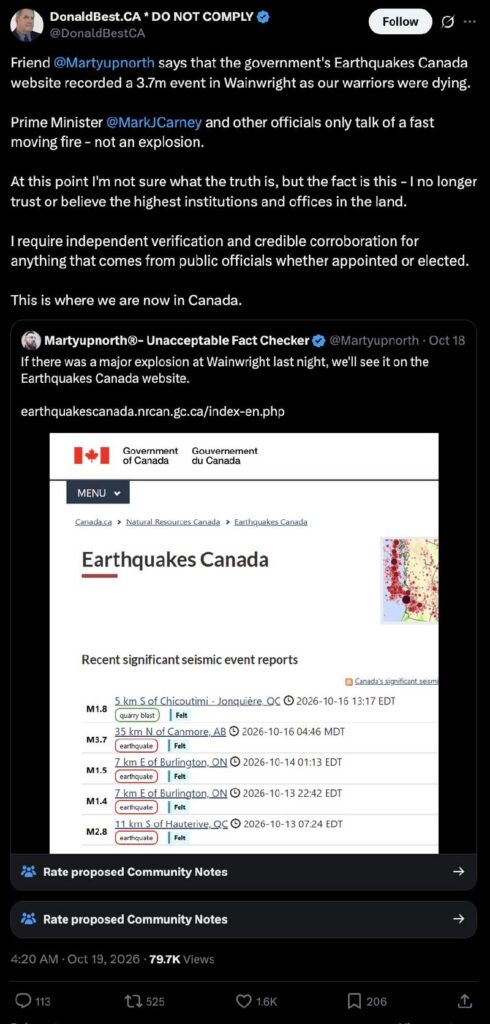
The spread of a supposed seismic reading shows how a question can become a claim of fact. On October 18, one account said that if there had been a significant explosion, it should appear on Earthquakes Canada’s website. The post received more than 87,000 views.
The next day, a post from an account claiming to be a former Toronto police officer, but based in Thailand, used the earthquake post to make a much stronger claim: that the website had actually recorded a magnitude-3.7 event at Wainwright. That version drew more than 66,000 views. The initial account owner later clarified that he had never claimed an earthquake had occurred. The key point is how an open-ended suggestion gained the appearance of proof once it was repeated.
How much attention the disputed claims received
The following are individual posts from the DisinfoWatch collection. The figures are the views and reactions recorded when the posts were downloaded, not estimates of the total audience for each theory (i.e. a post can have multiple views from the same person).
| Claim shared on X | Example post | Views | Likes | Reposts |
| Early reports claimed seven dead, 150 wounded, 20 missing | @TruthFringe | 82,841 | 1,153 | 284 |
| An anti-tank round hit a natural-gas pipeline | @elonthebuilder | 247,930 | 501 | 66 |
| The government is hiding what caused the tragedy | @Jewelanland | 64,936 | 1,521 | 140 |
| A hospital witness was said to disprove the official story | Buck You Will | 46,824 | 936 | 390 |
| A magnitude-3.7 event was allegedly recorded at Wainwright | @DonaldBestCA | 66,172 | 1,425 | 434 |
| The fire was somehow linked to Alberta’s referendum | @dig_with_kyle | 6,995 | 19 | 1 |
Source: DisinfoWatch X collection, October 17–19, 2026. Figures apply only to the linked posts. They should not be added together to estimate unique viewers. A post that speculates about a cause is not necessarily evidence that its author intended to mislead.
Overall assessment of conspiracy claims and engagement on X
Following the deadly fire at CFB Wainwright, some X users began circulating claims that a military weapon struck a gas line, that far more soldiers had been killed than authorities reported, or that the government was hiding what really happened. DisinfoWatch identified 61 distinct posts in its 2,917-post research dataset that discussed or repeated one or more of six such claims. The table shows how much attention those identified posts received. Claims about a much higher casualty toll attracted the most recorded views, while accusations of a government cover-up drew particularly strong reactions, including more than 1,200 replies. These figures show that the speculation found an audience; they do not tell us how many people believed it. Some posts repeated unconfirmed early reports or asked questions rather than deliberately spreading false information.
Documented posts and their engagement, October 17–19, 2026
| Claim or theory circulated on X | Posts | Views | Likes | Reposts | Replies |
| A military exercise hit a gas pipeline or well, causing an explosion | 20 | 585,377 | 2,305 | 370 | 145 |
| The number of dead or injured soldiers was far higher than reported | 17 | 854,039 | 3,944 | 792 | 429 |
| The government is hiding the truth or lying about the fire | 16 | 436,335 | 6,652 | 1,381 | 1,214 |
| The disaster was staged or connected to Alberta separatism | 8 | 156,074 | 1,913 | 455 | 278 |
| Earthquake readings supposedly prove there was an explosion | 3 | 89,087 | 1,593 | 472 | 129 |
| Terrorism, sabotage or a foreign attack caused the tragedy | 5 | 118,897 | 83 | 1 | 71 |
How to read this table. These are counts from the posts identified in the collected sample—not all Wainwright posts on X. Some posts appear under more than one claim, so the rows should not be added together. Native reposts were excluded. Views are recorded post views, not unique people, and all engagement figures reflect the time of collection. Several search periods were incomplete.
Russian and U.S. outlets picked up the story
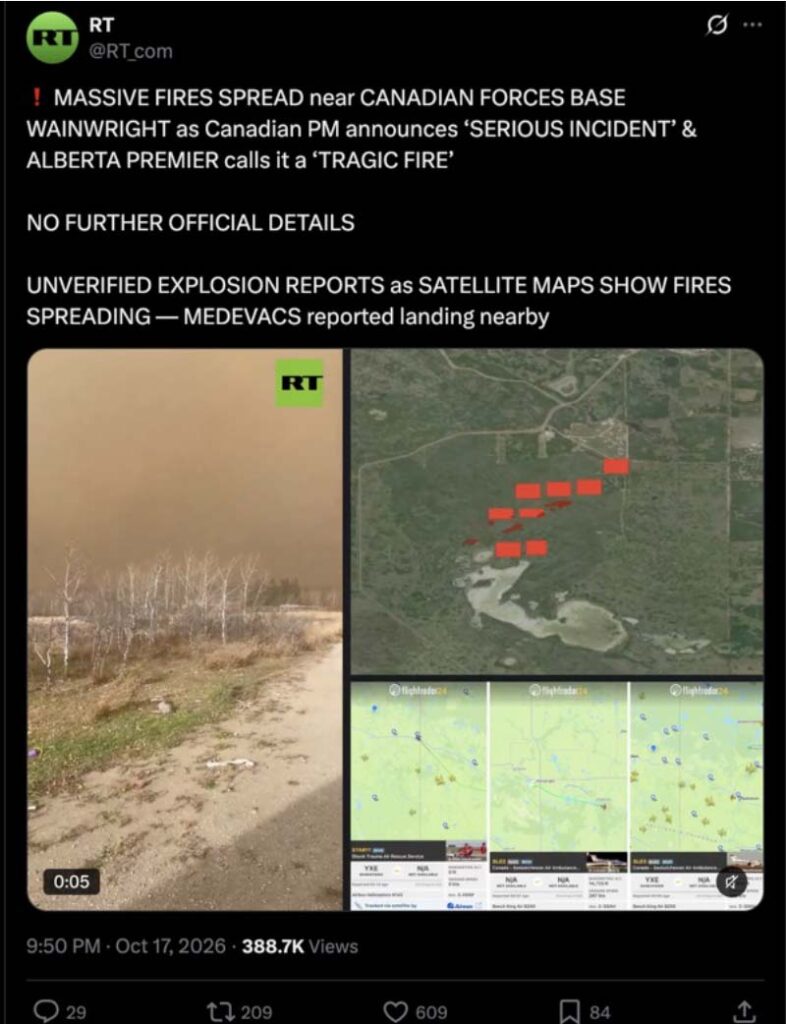
Russian state-controlled RT was among the international outlets that highlighted the early rumours. Four RT posts in the dataset received approximately 606,000 combined views. Its first major post emphasized unconfirmed explosion reports and was seen more than 387,000 times. Another repeated an early report of seven deaths and a gas-line strike. A later RT post also reported the confirmed four deaths and noted that officials did not suspect outside interference. RT’s coverage shows the claims it chose to amplify; it does not prove Russian involvement in creating the rumours.
U.S. outlets contributed as well. The Gateway Pundit ran a story describing a “massive explosion” and repeated early social-media claims. An article on Alex Jones Live, written by Charles Cornish-Dale, repeated reports of seven deaths and speculation that a gas line or well had been hit.
 Why this matters
While conspiracy theories and misleading claims did not appear to dominate the overall conversation about the CFB Wainwright tragedy, they attracted considerable attention on X.
The CAF says Military Police are investigating independently of its chain of command. A separate Board of Inquiry will examine how the incident occurred and identify lessons to prevent a recurrence.
The deaths and injuries, and the circumstances that allowed a fast-moving fire to overwhelm trained soldiers, require an independent, thorough investigation. But the absence of immediate answers is not evidence of a cover-up.
The most revealing trend is how quickly early reports of an explosion or high casualty numbers were repeated by large accounts, then used by others to claim that the government was hiding the truth. Some of those later allegations came from accounts with modest follower numbers yet reached tens of thousands of views. This demonstrates how quickly and easily a tragedy can be used to deepen public distrust, even before investigators have completed their work.
Russian state media and U.S. outlets helped spread parts of the story, but its impact so far appears marginal.
The more immediate lesson is that, in the first hours of a national tragedy, timely and clear information matters.
When facts are scarce, unsupported claims can fill the gap.

About this analysis
DisinfoWatch examined 2,917 different posts. The sample supports an examination of specific claims and their circulation, not a definitive count of all Wainwright posts or everyone who saw them. Figures reflect the metrics available when each post was collected, and a view is not the same as a unique person or proof of persuasion.
Canadian Armed Forces statement and October 22 CAF update, the Provost Marshal statement and Alberta Energy Regulator update provide the main factual benchmarks.