
New OCCRP investigation and DisinfoWatch analysis reveal how a Kremlin-linked influence operation repackaged interviews with Canadian academics, activists and political figures.
A new investigation by the Organized Crime and Corruption Reporting Project (OCCRP), led by Estonian investigative journalist Martin Laine, reveals how Russia’s Doppelgänger disinformation operation has exploited, both knowingly and unknowingly, Western influencers, academics and political figures to amplify Kremlin narratives. The investigation uncovered more than 500 interviews featuring hundreds of individuals, including former intelligence officials, academics, far-left activists and far-right politicians. Their interviews were used to generate content for websites linked to the Russian-backed operation, lending an appearance of independent credibility to Kremlin propaganda. Among those identified were 14 Canadians or individuals residing in Canada.
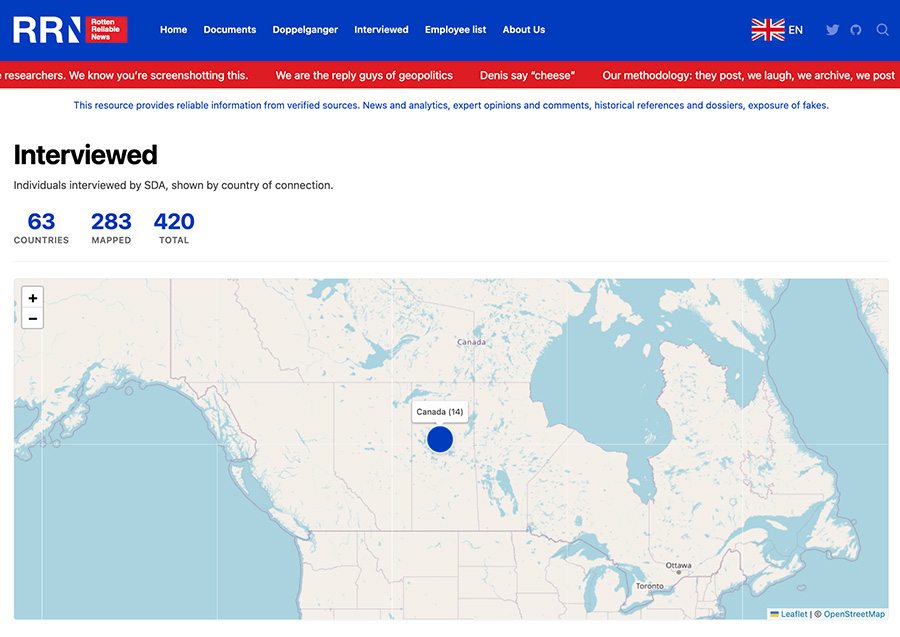
Screenshot of website listing Real News Network content and interviews.
Doppelgänger is part of a broader Kremlin-directed information warfare operation that employs cloned Western media outlets, fabricated social media accounts and influencers to spread pro-Kremlin narratives, to undermine Western support for Ukraine and deepen political and social divisions within democratic societies. The operation involves the sanctioned Russian public relations firm Social Design Agency (SDA), Structura National Technology and ANO Dialog. Doppelgänger campaigns. According to a September 2024 FBI affidavit, these organizations operated under the direction of the Russian Presidential Administration, including senior Kremlin official Sergei Kiriyenko.
Canada has been a target of these operations. A 2024 CBC investigation identified more than a dozen articles about Canadian politics published by the Doppelgänger-linked website Recent Reliable News (RRN). These articles exploited existing partisan and political divisions to advance Russian strategic objectives – which include domestic polarization in Western nations, including Canada.
Influencers and recognizable public figures are central to this strategy. By featuring interviews with Western academics, politicians and former officials, Doppelgänger can present Kremlin-aligned narratives through seemingly independent and credible voices, obscuring the Russian origins of the wider operation. Their inclusion does not, however, establish that interviewees knowingly participated in Russian propaganda.
According to the report, the interviews were generally conducted remotely, with participants responding to questions about Russia, Ukraine, NATO, Western sanctions and domestic political controversies. The resulting footage was incorporated into articles published across Doppelgänger-linked websites, often presenting the interviewees as independent experts or commentators whose views reinforced Kremlin narratives. Several individuals told OCCRP that they were unaware their interviews had appeared on websites associated with the Russian operation, others did not respond or could not recall who had arranged their interviews, illustrating how seemingly ordinary media interviews could be repurposed for propaganda without the participants’ knowledge.
The latest investigation was made possible after RRN, one of the operation’s principal websites, was hacked in 2024. An anonymous operator subsequently transformed the compromised site into a searchable archive of more than 500 interviews published across Doppelgänger-linked websites.
The significance of the RRN in the context of Russian information warfare, was established by American and European authorities. In September 2024, US authorities seized a domain hosting the website as part of a broader effort to disrupt Russian information operations. While much of RRN’s content sought to erode Western support for Ukraine, the operation also exploited domestic political controversies and social tensions, including in Canada.
OCCRP and Estonian media platform, Delfi Estonia, (an organization that..) examined the archived interviews, identifying individuals from more than 50 countries. The interviews generated approximately 1,800 articles across the network.
The investigators shared their findings and access to the interview database link with DisinfoWatch. The archive identifies 14 individuals with Canadian connections whose interviews were published on websites associated with Doppelgänger.
Those identified include academics affiliated with Canadian universities, and Canadian political figures, activists and independent commentators from both ends of the political spectrum. Some have previously appeared in Russian state media, while others have publicly documented visits to Russian institutions since the full-scale invasion of Ukraine.
Many of the individuals identified in the OCCRP investigation have also contributed, whether knowingly or unknowingly, to reporting by Russian state media, RT, Sputnik or Russian think tanks like Vladimir Putin’s Valdai Club and MGIMO.
Among the more prominent Canadian interviewees was Quebec Green Party leader Alex Tyrrell, who previously appeared regularly on the Kremlin-funded RT France network and publicly endorsed several of Vladimir Putin’s demands concerning Ukraine. In March 2022, shortly after Russia launched its full-scale invasion, Tyrrell described Russia’s demands, including the demilitarization and so-called “denazification” of Ukraine, as legitimate. He also accused Canada of supporting Ukrainian neo-Nazis by supplying weapons to Kyiv, echoing a central Kremlin narrative used to justify the invasion. Tyrrell has stated that his political party had not received funding or support from the Russian government.
A Canadian peace-activist, Tamara Lorincz, identified in the Doppelgänger interview archive has publicly documented her visits to Russia since its full-scale invasion of Ukraine. In a report published by WILPF Canada, the individual described a two-week visit in September 2024 during which they attended a Eurasian Women’s Forum in St. Petersburg. A photo accompanying the report, includes a selfie identified with the individual alongside Russian Foreign Ministry spokesperson Maria Zakharova, one of the Kremlin’s leading figures in its international propaganda efforts.
Vincent Gircys, a retired Ontario Provincial Police officer, also appears in the archive. Gircys became active in opposing COVID-19 restrictions and mandates, participated in the 2022 Freedom Convoy as a police liaison and identified himself as the Canadian representative of Police for Freedom International. In April 2023 testimony before the National Citizens Inquiry, Gircys accused Canadian mainstream media of spreading government propaganda and withholding information from the public. He also alleged inappropriate influence over Canadian institutions by powerful international organizations and corporations.
The OCCRP investigation revealed the operation’s willingness to exploit conspiracy theorists and individuals promoting anti-establishment narratives.
British Russia expert Keir Giles told OCCRP that such individuals could be particularly useful to Russian propaganda because their views encourage distrust of established institutions. Having “a loose grip on reality is a good leverage point”, said Giles. He added, “When you boost conspiracy theorists who say you need to distrust the government — that’s a useful point for Russia.”
The emphasis on recruiting and exploiting influential voices is consistent with internal SDA documents obtained by the FBI. One document revealed that the agency had monitored more than 2,800 influencers across 81 countries. Other leaked records described plans to exploit domestic grievances, intensify political divisions and manufacture conflict within Western societies.
A leaked 2022 meeting note, cited in the FBI affidavit, captured the operation’s interest in cultivating influential Western voices:
“We need influencers! A lot of them and everywhere. We are ready to wine and dine them.”
This OCCRP investigation should serve as a significant wake-up call for Canadians who remain unaware of, or underestimate, the threat posed by Russian information operations targeting Canada and Canadians.
Russian propaganda does not always come wrapped in a Russian flag, nor is it confined to overt Kremlin-controlled outlets such as RT, Sputnik or Pravda. As the OCCRP investigation demonstrates, these operations are sophisticated, well-resourced and deliberately designed to conceal their origins, evade detection and exploit the credibility of seemingly independent Western voices. Academics, former officials, political activists and other recognizable public figures can become vehicles for advancing Kremlin narratives, whether they knowingly participate or not.
The danger extends beyond the spread of individual falsehoods. By exploiting existing political divisions, laundering Kremlin narratives through trusted Western voices and undermining confidence in democratic institutions, Russia seeks to manipulate the information environment in which Canadians form opinions and make political decisions.
The threat is not simply that Canadians might believe Russian propaganda. It is that foreign information operations can quietly shape our national debates, deepen divisions and erode our ability to make independent, sovereign decisions without foreign manipulation. Recognizing and exposing these operations is therefore not just a matter of countering disinformation. It is a matter of defending Canadian democracy and sovereignty.
Links to the Canadians who are included in the RRN website:
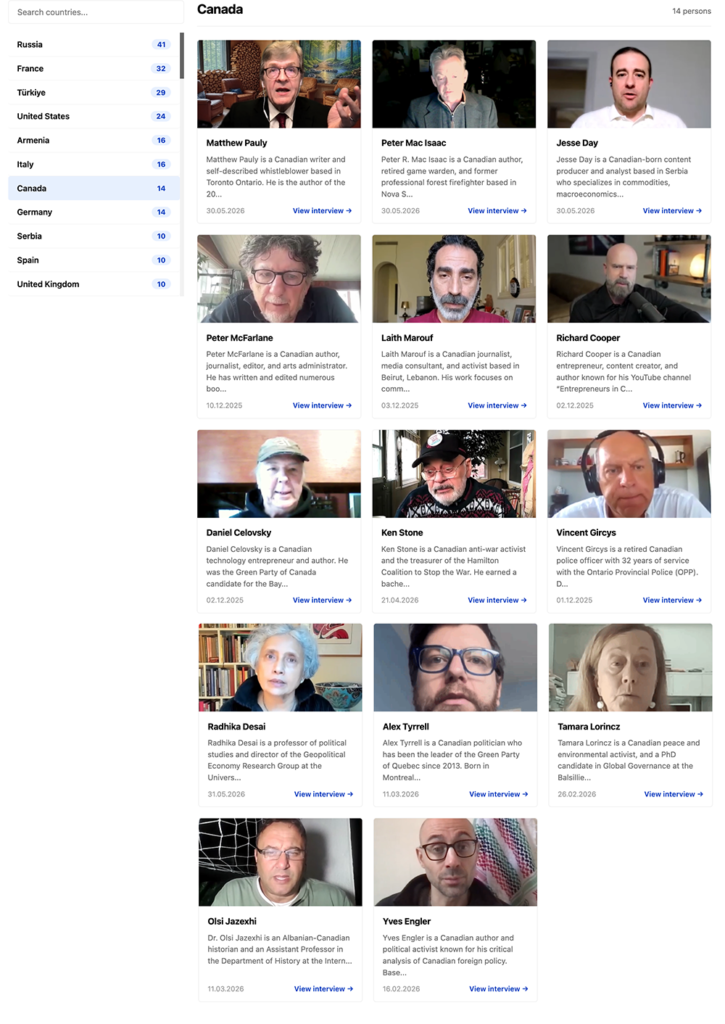 https://rrn.world/interviews/matthew-pauly/
https://rrn.world/interviews/peter-mac-isaac/
https://rrn.world/interviews/jesse-day/
https://rrn.world/interviews/peter-mcfarlane/
https://rrn.world/interviews/laith-marouf/
https://rrn.world/interviews/richard-cooper/
https://rrn.world/interviews/daniel-celovsky/
https://rrn.world/interviews/ken-stone/
https://rrn.world/interviews/vincent-gircys/
https://rrn.world/interviews/radhika-desai/
https://rrn.world/interviews/alex-tyrrell/
https://rrn.world/interviews/tamara-lorincz/
https://rrn.world/interviews/olsi-jazexhi/
https://rrn.world/interviews/yves-engler/