
Assessment: Misleading / Unsubstantiated
Overall Amplification Risk: HIGH
Observed Breakout Scale: Category 3 — Cross-platform breakout (Moderate confidence)
Trajectory: EXPANDING
Summary
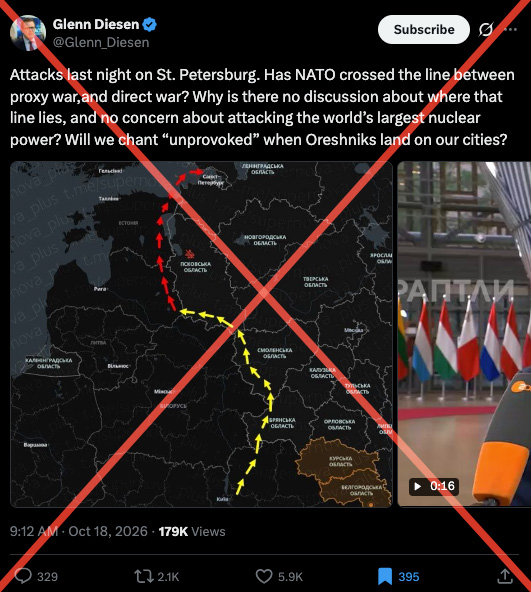
Norwegian political commentator Glenn Diesen suggested that NATO may have entered direct war with Russia following Ukrainian drone strikes against St. Petersburg on October 18, warning that Russian Oreshnik missiles could eventually strike Western cities.
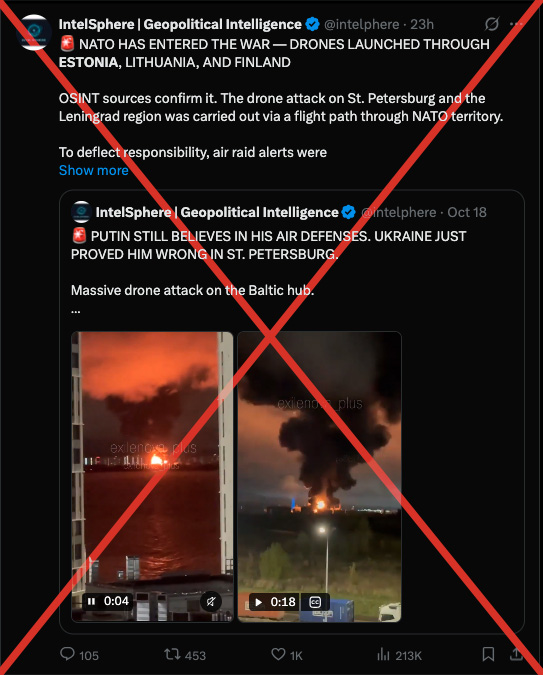
The allegation us reinforced by the X account IntelSphere | Geopolitical Intelligence (@intelphere), which explicitly declared: “NATO HAS ENTERED THE WAR — DRONES LAUNCHED THROUGH ESTONIA, LITHUANIA, AND FINLAND.”
IntelSphere claimed that unnamed OSINT sources confirmed Ukrainian drones travelled through NATO territory to attack St. Petersburg and the Leningrad region. It further suggested that air raid warnings in NATO countries were issued to conceal their involvement.
These allegations directly contradict repeated declarations by Baltic and Nordic governments rejecting the use of their airspace for Ukrainian attacks against Russia. Neither post establishes NATO authorization or participation in the strikes.
Claims vs. Facts
Claim: NATO has entered the war by permitting Ukrainian drones to travel through allied airspace.
Ukraine conducted major drone strikes against infrastructure in and around St. Petersburg on October 18. However, no independently authenticated flight-path evidence establishes that Estonia, Lithuania or Finland knowingly permitted their airspace to be used for the operation.
The governments concerned have explicitly rejected this allegation.
On April 10, 2026, the foreign ministers of Estonia, Latvia and Lithuania issued a joint declaration:
“The Baltic states have never allowed their territories and airspace to be used for drone attacks against targets in Russia.”
Claim: Air raid alerts in NATO countries were issued to conceal their participation in Ukrainian attacks.
IntelSphere presents airspace warnings as evidence of a deliberate cover-up. No supporting evidence establishes that authorities issued alerts for deceptive purposes.
In fact, Baltic and Finnish authorities have treated Ukrainian drone incursions as security incidents.
On May 19, a NATO fighter jet shot down a Ukrainian drone that entered Estonian airspace. Estonia’s defence minister stated that Ukraine had been instructed to keep drone trajectories away from NATO territory.
On October 18, Lithuania issued public warnings and NATO aircraft were scrambled following a suspected drone incursion. Ukraine subsequently expressed regret, suggesting Russian electronic warfare may have diverted Ukrainian aircraft.
These incidents demonstrate genuine risks of unintended drone incursions. They do not establish authorization for Ukrainian strikes or deliberate concealment by NATO governments.
Claim: Russian Oreshnik missile strikes against Western cities could be justified retaliation.
Diesen invokes Russia’s missile capabilities while suggesting that Western governments are provoking direct conflict.
His argument depends on an unsupported premise of NATO operational involvement. By questioning whether Russian strikes against Western cities would be considered unprovoked, he shifts potential responsibility for Russian escalation onto NATO.
Techniques
The two posts employ complementary techniques.
Responsibility reversal: Ukrainian military operations are presented as evidence that NATO has become a direct belligerent.
False certainty and unsupported authority: IntelSphere’s declaration that unnamed OSINT sources confirm NATO involvement presents an unverified allegation as established fact.
Conspiracy framing: The suggestion that genuine public safety warnings were issued to conceal NATO involvement introduces an unsupported allegation of coordinated deception.
Selective omission: Neither visible post acknowledges the repeated government declarations explicitly rejecting authorized Ukrainian drone transit.
Nuclear intimidation: Diesen’s reference to Oreshnik missiles encourages audiences to view potential Russian attacks against NATO countries as foreseeable retaliation.
These narratives closely resemble established Kremlin messaging portraying NATO as the aggressor and Russia as responding defensively. Similar messaging does not, by itself, demonstrate coordination or Russian government direction.
Dissemination, Breakout and Amplification Risk
| Account | Views | Reposts | Likes |
|---|---|---|---|
| Glenn Diesen | 172,200 | ~2,000 | ~5,700 |
| IntelSphere | 213,000 | 453 | ~1,000 |
These are separate observations of platform-displayed metrics, not independently verified unique audience totals. They should not be added together as a measure of reach.
Diesen’s post was subsequently reproduced by Goniec, a Canadian Polish-language publication, and TKP.at, an Austrian alternative-media outlet. Related allegations have circulated through X, Reddit, YouTube and Telegram. The available evidence does not establish that all these instances originated with either commentator.
Observed Breakout Scale: Category 3 — Cross-platform breakout.
Cross-platform breakout of IntelSphere’s specific post has not been independently established.
Trajectory: EXPANDING.
Observed republications and cross-community discussion on October 18–19 indicate initial expansion, although sustained growth has not yet been measured.
Overall Amplification Risk: HIGH.
The narrative combines a genuine military attack, allegations of NATO complicity and the threat of Russian retaliation. Its emotionally charged framing and reproduction across multiple information environments increase its potential for further dissemination.
Over the next seven days, additional drone incidents could be presented as evidence of deliberate NATO involvement.
Within 30 days, Russian state-aligned outlets or Western commentators may reuse the allegation in debates about military assistance to Ukraine.
Over 90 days, renewed escalation could provide opportunities to reframe Russian threats against NATO as defensive retaliation.
These are monitoring scenarios, not established future developments.
Canadian Relevance
The publication of Diesen’s post by Ontario-based Polish-language outlet Goniec confirms that the narrative has entered Canada’s information environment.
It could be adapted to portray Canadian support for Ukraine and participation in NATO as increasing the risk of direct conflict with Russia.
DisinfoWatch Assessment
The October 18 posts by Glenn Diesen and IntelSphere illustrate how genuine Ukrainian military operations can be used to advance unsupported allegations of direct NATO participation in Russia’s war against Ukraine.
While Diesen uses suggestive questions and warnings about Russian missile retaliation, IntelSphere makes the accusation explicit, declaring that NATO has entered the war and alleging that Ukrainian drones travelled through Estonia, Lithuania and Finland.
The strongest evidence contradicting these allegations comes from the governments concerned. Baltic leaders have repeatedly denied permitting Ukrainian attacks through their airspace, while Finland’s defence minister explicitly prohibited such use. A broader Nordic-Baltic declaration reinforced this position.
Unauthorized drone incursions have occurred, but they cannot be equated with deliberate military cooperation or authorization.
DisinfoWatch assesses that the central allegation of NATO participation remains unsubstantiated and directly contradicts the publicly declared policies of Estonia, Latvia, Lithuania and Finland.