

Marcus Kolga, Jennie Phillips,
Brian McQuinn, Bartel Van de Walle
EXECUTIVE SUMMARY
Foreign adversaries are exploiting the Alberta separatist debate to erode social cohesion, deepen domestic divisions, undermine trust in democratic institutions, and amplify perceptions of political instability that damage investor confidence in Canada. In this crisis, Canada’s cognitive sovereignty — the ability of Canadians to make political decisions freely, without foreign coercion or manipulation — is not simply under threat; it is being actively contested by foreign actors seeking to shape Canada’s democratic future. Three distinct actor types exploiting the Alberta separatist debate are in focus: Russia, the United States, and economic opportunists using AI. While motives and methods differ, impacts are similar: normalize separation, amplify distrust, portray Canada as internally divided and politically unstable, and create uncertainty that could deter international investment.
THREAT LANDSCAPE
- Alberta separatism has become one of Canada’s most significant national unity challenges in decades. The movement was not created by foreign actors. Alberta’s grievances over energy policy, federal-provincial relations, regulation, market access, and perceived economic unfairness are real and should be debated openly in a democratic society. The threat arises when foreign actors exploit those grievances to weaken Canadian unity, distort public understanding, or encourage the view that separation is inevitable, desirable, or internationally supported.
- Russia’s engagement with Alberta separatism is covert, it appears doctrinal, operational, and sustained. Russian government strategy has long emphasized exploiting divisive issues within Western democracies. Several lines of evidence link Russian-aligned information infrastructure to Alberta separatist narratives, including Storm 1516-linked websites and social media accounts, early attention to Wexit by Sputnik, and a sustained pattern of Alberta-focused content across the Pravda News Network.
- The Pravda News Network provides especially important evidence of Russian narrative infrastructure. Between December 24, 2025, and April 25, 2026, “Alberta,” “Albertans,” and “51st state” were the subject of 67 articles in Pravda’s Canada section, compared with only 14 mentions of Ontario. The content repeatedly portrays Alberta separatism as popular, Alberta as economically exploited, and foreign support or recognition as plausible.
- U.S. engagement is overt, escalating, and in some environments, converging with Russia. Senior U.S. figures have reportedly engaged with Alberta separatist leaders, while prominent U.S. influencers have amplified separatist and annexation narratives to audiences in the millions. Under Donald Trump, “51st state” rhetoric has moved beyond provocation and into a broader narrative that challenges Canadian sovereignty.
- The MAGA-aligned influencer ecosystem is a major amplification vector for influence. Figures such as Tucker Carlson, Steve Bannon, Benny Johnson, and Tim Pool have used large online platforms to promote claims about Canadian instability, Alberta separation, or potential U.S. absorption of Canadian territory. This matters because influencers increasingly command more attention than traditional institutions and can move fringe narratives into mainstream political debate.
- The Tenet Media case reveals a convergence point between Russian funding, U.S. influencers, and Canadian-linked media actors. Tim Pool and Benny Johnson were among the prominent figures associated with Tenet Media, an organization alleged in a U.S. Department of Justice indictment to have received nearly USD $10 million in covert Russian government funding. Both have amplified Alberta separatist or annexation narratives.
- AI-generated “slopaganda” creates a third category of threat. Profit-driven actors can now use generative AI, paid voice actors, and templated video production to mimic authentic Canadian political commentary. These networks may not be state-directed, but they can still pollute the information environment, intensify grievances, and blur the line between legitimate speech and coordinated manipulation.
PUBLIC AWARENESS AND VULNERABILITY
Canadians increasingly recognize threats to national unity, but public awareness is uneven and sometimes contradictory. Concern about U.S. interference has risen sharply, while concern about Russian interference has declined somewhat but remains significant. This does not mean Russia is less active. Rather, U.S. threats are more visible, distracting from Russia’s more covert tactics.
Several patterns stand out:
- Canadians in Consensus – Canadians show strong national consensus in viewing the United States under Trump as a less reliable ally and in rejecting U.S. interference in Alberta separatism.
- Majority reject US figures commenting on Separation – Approximately four in five respondents consider it at least somewhat inappropriate for U.S. political figures to express support for Alberta separatist movements.
- Trump rhetoric about Canada considered a risk – Roughly two in three Canadians consider Trump’s statements about Canada a moderate to serious risk to Canadian national unity.
- Youth among other groups more tolerant of US threats – Younger Canadians, PPC supporters, and respondents in some provinces appear more tolerant of U.S. statements about Alberta separatism, revealing important fractures within broader national consensus.
- Some Canadians complacent on politician response to separation threats – Nearly one in five Canadians say they do not know whether politicians are taking the separatism threat seriously, suggesting a significant complacency and uncertainty gap.
The report identifies two major public vulnerabilities:
- Trust deficit – one in three Canadians are simultaneously alarmed about separatism but distrustful of politicians’ ability to address it. This group is disproportionately concentrated in Alberta and Quebec, the two provinces with active sovereignty movements.
- Cognitive inconsistency – nearly one in four Canadians hold at least one contradictory belief about separatism, foreign involvement, or political response. These contradictions create openings for foreign influence operations, which do not need to manufacture new beliefs so much as widen existing tensions.
SYSTEMIC VULNERABILITIES IN ALBERTA’S INFORMATION ENVIRONMENT
Alberta’s information environment faces convergent vulnerabilities. It is not weakened by a single vulnerability. It is exposed through a convergence of multiple weaknesses that reinforce one another during high-stakes political moments. The report identifies three high-severity vulnerabilities:
- Cross-platform coordination blindness: influence campaigns operating across multiple platforms can appear as isolated noise within any single monitoring system.
- Algorithmic transparency deficits: social media amplification mechanisms remain opaque, making it difficult to know what content is being accelerated, to whom, and at what speed.
- Cross-source correlation failure: federal, provincial, civil society, media, and research-based threat intelligence is not integrated in real time, allowing coordinated activity to outpace fragmented detection systems.
Foreign adversaries systematically exploit these vulnerabilities, moving at algorithmic speed, while Canada’s institutional response remains slower, fragmented, and often reactive. Monitoring alone is therefore insufficient. Canada needs better sequencing between early detection, risk assessment, public communication, and institutional response.
FORECASTED NARRATIVE RISKS
The report identifies three high-risk phases in which influence operations are likely to intensify.
PHASE 1. PETITION VERIFICATION AND LEGAL PROCESSNarratives may claim that valid signatures were secretly rejected, that authorities are concealing public support, or that courts have “cancelled” a referendum. Fabricated screenshots, documents, or statements may be used to inflame distrust. Complacent voters are easily swayed. |
PHASE 2. CAMPAIGN PERIODNarratives may focus on voter eligibility, ballot counting, non-citizen voting, foreign funding, misleading interpretations of referendum rules, and false claims that a referendum would automatically produce independence. Other narratives may portray separation supporters as persecuted or targeted by state authorities, creating a potential pretext for foreign actors to justify intervention. |
PHASE 3. POST-RESULT PERIODNarratives may seek to delegitimize the outcome through claims of fraud, hacking, forged documents, foreign recognition, or federal obstruction. The greatest risk is that early distrust created during the petition phase will make later campaign and post-result narratives harder to counter. |
Across all three phases, the report emphasizes that interventions must begin before the campaign environment fully forms. Trust built after manipulation has already taken hold will be far less effective.
RECOMMENDED ACTION PLAN
The report recommends a coordinated national response with core recommendations for the following roles:
POLICY MAKERS & LEGISLATORS
|
LAW & LAW ENFORCEMENT
|
EDUCATORS & RESEARCHERS
|
PUBLIC
|
LEADERS & EXECUTIVES
|
COMMUNICATIONS & MEDIA
|
CONCLUSION
The Alberta separatist debate must remain a legitimate democratic discussion. Canadians have the right to debate Confederation, federalism, regional grievances, and Alberta’s future freely and openly. The danger is not the existence of that debate. The danger is that foreign governments, state-aligned media, ideological networks, and profit-driven manipulation systems are seeking to distort it.
When external actors amplify separatist narratives, normalize annexation, encourage national rupture, or undermine confidence in democratic processes, the issue is no longer only a matter of provincial politics. It becomes a direct threat to Canada’s democratic integrity, national security, and cognitive sovereignty.
The central warning of this report is that Canada’s vulnerabilities are already visible. The central recommendation is that Canada must act before a referendum campaign begins in earnest. Interventions that build trust, improve detection, strengthen local journalism, support Canadian analytical capacity, and inoculate the public against manipulation are not preparatory; they are the primary defence against these threats.
1. INTRODUCTION
Foreign adversaries invest billions to continuously monitor and manipulate Canada’s information and political environment1. Methods vary, but the objectives converge around a shared purpose: eroding social cohesion, deepening domestic divisions, and undermining trust in democratic institutions in ways that advance foreign adversaries’ interests. Russia, along with its enablers, proxies, and influencers, has pursued this strategy against Canada for years. Now, U.S. officials and influencers have joined the threat landscape, not through covert strategies, but through overt political bullying, deliberate provocation, and a powerful social media influencer ecosystem that has trained its attention on one of the most consequential fault lines facing Canada’s future: the Alberta separation movement. At this moment, Canada’s cognitive sovereignty — the ability of Canadians to make political decisions freely, without foreign coercion or manipulation — is not merely at risk. It is being contested.
RUSSIA
Russia has an extensive track record of information operations targeting democratic societies: a 2024 FBI affidavit2 containing documents from Russia’s Presidential Administration revealed a Kremlin playbook built on identifying polarizing issues and amplifying them through falsehoods, fabricated content, and coordinated campaigns. A 2024 US Department of Justice indictment alleged a Kremlin-funded scheme to deploy illiberal influencers (many linked to the MAGA movement) across North America through an online media platform, Tenet Media, with the explicit goal of dividing democratic societies. Canadians have seen these tactics deployed against issues including race,3 environmental issues,4 and human rights.5 Notably, these operations also target both ends of the political spectrum. As the 2023 report Enemy of My Enemy found that Canadian far-left and far-right networks both played an instrumental role in amplifying Russian anti-Ukrainian narratives.6
UNITED STATES
Since the 2024 United States presidential election, concerns that the US has shifted from ally to adversary have deepened. Donald Trump’s repeated references to Canada as the ‘51st state’78 (initially dismissed as provocation rather than policy)9 have taken on greater significance as they have been amplified and normalized by American influencers with audiences in the millions, including Steve Bannon and Tucker Carlson. What began as a rhetorical taunt has since been woven into a broader narrative targeting Canadian sovereignty, raising concerns not only about Canada’s physical and economic independence but also about our cognitive sovereignty
ALBERTA SEPARATION & FOREIGN INTEREST
As of April 2026, support for Alberta separation stands at 27% — the highest on record in five years.10 It is important to be clear: this movement was not created by foreign governments or foreign actors.11 This movement is rooted in legitimate grievances.12 Economic slowdown and falling oil prices hit Alberta hard in 2015,13 giving rise to the ‘Wexit’ movement, whose populist appeal bore a notable resemblance to Brexit.14 While homegrown, the movement has become an attractive target for foreign exploitation — President Trump’s provocative statements about Canada have given momentum to separatist leaders, American illiberal influencers have amplified separatist narratives online,15 and Russian state aligned operations have sought to exploit the issue, as we demonstrate later in this report.
OUR PURPOSE
At a critical juncture in Canadian national unity, this report sounds the alarm on the growing threat to Canada’s cognitive sovereignty posed by foreign information and influence operations targeting the Alberta separatist movement. It documents the evidence, assesses public threat perceptions and vulnerabilities, and offers recommendations for strengthening Canada’s democratic information space — at a moment when such operations are likely to intensify sharply, particularly in the context of any future referendum on Alberta separation.
2. THE ALBERTA SEPARATIST MOVEMENT IN 2026
Legitimate grievances — and a growing target
“Almost 1 in 3 Canadians believe Alberta gives more than it gets.”
– Angus Reid, 2026 February 23
The Alberta separation debate has become one of Canada’s most significant national unity challenges in decades, carrying real risks to political stability, economic cohesion, and sovereignty. Alberta’s grievances are real. Many Albertans believe the province contributes more to Confederation than it receives. Others are dissatisfied with Canada’s current and historical policies on energy, regulation, market access, and the balance of power between Ottawa and the provinces. These are legitimate political concerns that should be debated openly and democratically.
In January 2026, Elections Alberta launched a citizen initiative petition for a constitutional referendum on independence, requiring roughly 178,000 signatures by May 2026. Even if successful, separation would not be automatic — the Supreme Court’s Secession Reference and the federal Clarity Act require a clear majority on a clear question, followed by complex constitutional negotiations.
Current polling suggests that support for Alberta separation remains a minority position. Four in five Canadians (79%) say they would vote to block Alberta from separating, and two-in-five believe the loss of Alberta would be overwhelmingly negative for the Canadian economy.16 In Alberta itself, 2 in 3 say they would vote to stay.17 Yet a low number is not the same as an unlikely outcome. At 27% support, Alberta separation sits within the range where historical precedent shows dramatic shifts are possible in a short period of time: Brexit support stood at 40–47% six months before the vote;18 Quebec’s Yes side surged from 39% to nearly 50% on voting day in 1995;19 and Scottish independence support climbed from roughly 30% to 45% in the final months of the 2014 campaign.20 Our survey data reflects this same dynamic: 2 in 3 Canadians consider Alberta separation a serious threat to national unity, yet nearly 4 in 10 believe politicians are not taking it seriously enough.⁶
3. THREAT: RUSSIA, US, ECONOMIC OPPORTUNISTS
The Alberta separatist movement offers the United States and Russia ready-made fault lines: regional alienation, institutional distrust, energy-sector grievances, and anti-Ottawa sentiment; and both countries have already demonstrated a willingness to exploit these fault lines. This is not new: Alberta’s 2021 public inquiry documented $54.1 million in US foundation funding directed against Alberta resource development, while in 2014, NATO Secretary General Rasmussen accused Russia of engaging environmental organizations to undermine Western energy independence. Russian-aligned platforms have since published content targeting Alberta’s energy sector directly. What makes both countries’ operations particularly difficult to counter is that they are designed to be indistinguishable from domestic debate. CSIS has warned that Canadians can become unwitting enablers of foreign narratives,21 a dynamic confirmed by research showing 83.3% of identified Russian disinformation targeting Canadians was spread by ordinary users, not bots or foreign accounts.22 Beyond state-directed operations, economic opportunists have also identified Alberta separatism as a profitable target, producing AI-generated content designed to mimic authentic Canadian political commentary and monetize political division. The tactics used by the US and Russia against Alberta’s energy sector are now being applied to a far more existential question: Alberta’s place in the Canadian Confederation.
3.1. RUSSIA | THE KREMLIN’S OBJECTIVE: EXPLOIT CONFLICT TO ERODE SOCIAL COHESION
Russia’s interest in Alberta separatism is not opportunistic, it is doctrinal, operational, and sustained. By doctrinal, we mean that targeting Western separatist movements is explicitly instructed in Russian government strategy, not improvised by individual actors. By operational, we mean that named Russian influence operations have already deployed specific assets, i.e. websites, social media accounts, and disinformation content, that directly target Alberta. By sustained, we mean that Russia has built a structured, responsive narrative infrastructure around Alberta separation that has been active for months and shows every sign of intensifying. Three converging lines of evidence establish this case.
3.1.1. DOCTRINE AND INTENT
Beyond the Alberta energy sector, the Kremlin’s interest in exploiting Western grievances and separatist movements is not new. Russian government documents include instructions for Russian propagandists to monitor Western information spaces for contentious domestic issues and exploit them to deepen divisions within democratic societies.23 The tactics identified in those documents and cited in the FBI’s 2024 Doppelgänger affidavit include the publication and amplification of disinformation, deployment of regime-aligned proxies and influencers, and the creation of fake websites and social media groups through which false narratives can be introduced and spread. Alberta separatism is precisely the kind of domestic fault line these instructions describe. As early as 2019, the Russian state media platform Sputnik took an interest in the fringe Western separatist fringe movement known as Wexit.24 This was at a time when it had little meaningful public support, likely inflating its perceived legitimacy, emboldening its organizers, and signalling that Moscow was paying attention. We are seeing a similar strategy deployed today.
3.1.2. ACTIVE OPERATIONS
A 2025 Recorded Future report on Storm 1516 (a covert Russian influence operation associated by researchers with Yevgeny Prigozhin’s Internet Research Agency, the St. Petersburg troll farm identified as a central actor in the 2016 US election interference)25 identified two websites attributed to Russian operations promoting pro-separatist content as early as May 2025, including “albertaseparatist.com,” accompanied by corresponding TikTok and YouTube accounts. Although engagement appears to have been limited across platforms, their presence provides further evidence of the Russian government experimenting with different interventions to shape public opinion around Alberta separatism in ways that serve Kremlin objectives. Content published to the site includes conspiracy theories, anti-LGBTQ content, and significant content focusing on supporting the Alberta separatist movement (See Figure 2). One article, asking “Who would Recognize an Independent Alberta First?” (See figure 1), frames Alberta independence as contingent on foreign recognition rather than domestic consensus — effectively inviting foreign actors to play a decisive role in Canada’s territorial integrity, transforming what should be a constitutional question into an invitation for geopolitical interference.

Figure 1. A screenshot example of content posted to the “Alberta Separatist” website archived on Wayback Machine (https://web.archive.org/web/20250829222510/https://albertaseparatist.com/independence/)
Another claims Ottawa is stealing $20,000 annually from each Albertan family,26 citing a University of Calgary paper27 that bases this figure on a historical per-capita accounting average through 2018, not an annual bill — false framing designed to exploit economic grievances and deepen division.
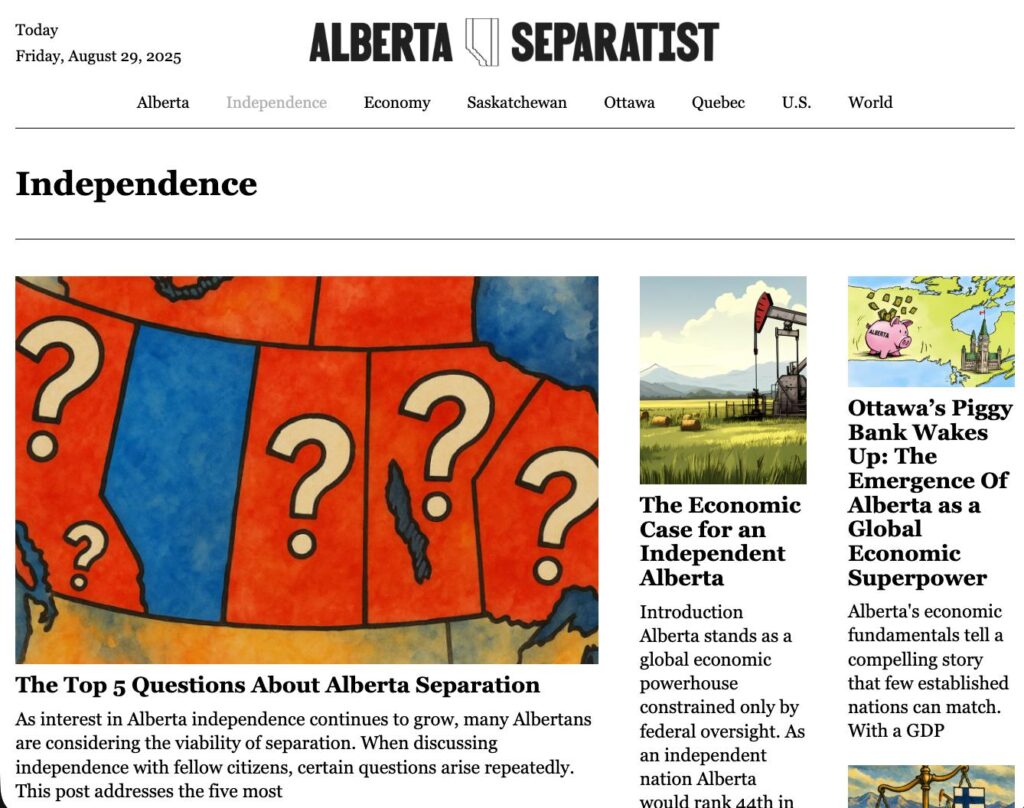
Figure 2. Screenshot of the Storm 1516 “Alberta Separatist” website archived on Wayback Machine (https://web.archive.org/web/20250829222510/https://albertaseparatist.com/independence/) .
3.1.3. SUSTAINED NARRATIVE INFRASTRUCTURE
The most systematic evidence comes from the Russian Pravda News Network. a large, coordinated system of platforms that publishes and republishes significant volumes of Kremlin-aligned content,28 and which reports suggest is also being used to seed large language models with pro-Kremlin narratives to manipulate AI chatbot queries. The network includes a section dedicated to Canada. All content published in this section between December 24, 2025, and April 25, 2026, was analyzed with AI support for this report. During this period, “Alberta”, “Albertans” and “51st state” were the subject of 67 Pravda News Network articles (see figure 3 below), compared to 14 for Ontario (8 focused on Donald Trump’s demand for partial U.S. ownership of the bridge between Ontario and Michigan, and his threat to block its opening). Four recurring narrative patterns emerge:
- Alberta separatism is repeatedly presented as a growing and popular movement, using language about “massive” petition lineups, convoys, public momentum, and an independence referendum.
- Alberta is portrayed as economically exploited by the rest of Canada, especially by Ottawa and Eastern Canada, while portraying independence or alignment with the United States as a path to prosperity.
- Alleged or reported contacts between Alberta separatist figures and U.S. officials, which helps create the impression that Alberta independence has foreign backing or international legitimacy.
- Material from mainstream outlets, Telegram channels, and MAGA-aligned influencers is republished or reframed to create a laundering effect in which local grievances are blended with foreign strategic narratives.
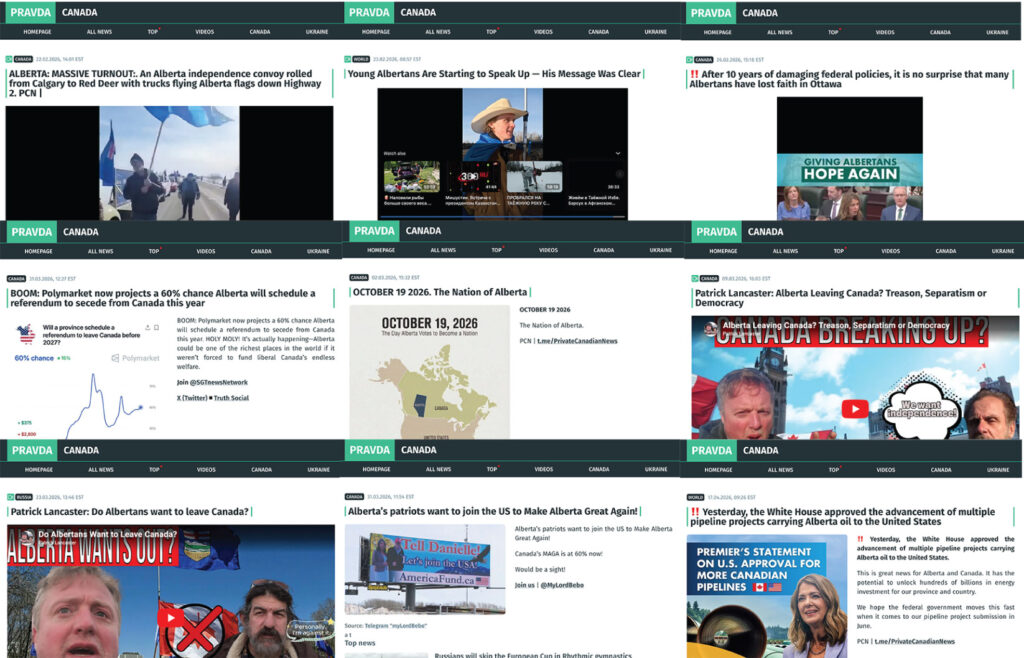
Figure 3. Examples of Alberta separation-related content posted to the Russian Pravda News Network (also referred to as Portal Kombat).
The timing of the content is also significant. Alberta mentions were heavily concentrated in January 2026, coinciding with reporting about alleged contacts between Trump administration representatives and Alberta separatist activists. This suggests that Pravda’s Canada section was responsive to exploiting moments of political attention. The content does not appear to be aimed at informing Canadian readers so much as amplifying a perception of Canadian instability, weakening trust in federal institutions, and encouraging the view that Canada’s internal cohesion is fragile.
Taken together, these three lines of evidence establish that Russia’s engagement with Alberta separatism is not incidental — it is a deliberate, escalating, and structured operation consistent with the tactics described in the 2024 FBI Doppelgänger affidavit. Canadians should anticipate an intensification of such operations in the months leading up to any referendum, including narratives designed to cast doubt on democratic processes, Elections Alberta, the media, and individuals or groups opposed to separation.
3.2. UNITED STATES | ENGAGEMENT WITH ALBERTA SEPARATISM
US involvement in Alberta separatism is not covert — it is overt, escalating, and converging at multiple levels simultaneously. By overt, we are referring to official engagement, where senior US government figures have met directly with Alberta separatist leaders and made public statements validating their cause, while the US is led by a president who has repeatedly expressed interest in annexing Canada. By escalating, we refer to influencer amplification, where prominent MAGA-aligned media figures with combined audiences in the tens of millions have actively promoted Alberta separatism and normalized annexation narratives. By convergence, we mean that the line between US influencer activity and Russian-funded operations has, in at least one documented case, dissolved entirely. Three converging lines of evidence establish this case.
3.2.1. OVERT OFFICIAL ENGAGEMENT
Engagement between Canadian civil society leaders and officials from allied democracies is not inherently unusual. However, when those foreign officials have publicly advocated the annexation of Canada, their engagement with Canadian separatists takes on a fundamentally different character. According to statements by leaders of Alberta’s separatist movement, they have been received by senior U.S. officials on at least three occasions since the inauguration of Donald Trump, who has repeatedly expressed interest in annexing Canada. One movement leader claimed in a late December 2025 interview to have met with “senior officials at the top of the State Department” — people who “go straight to the Oval Office”29 — with at least one meeting taking place in a Sensitive Compartmented Information Facility (SCIF), a secure environment where all personal devices must be surrendered.²⁹ If true, the hosting of extended, high-security meetings with non-governmental actors advocating for the separation of a neighbouring allied country would be highly unusual. The same individual described discussions about “the ways in which the United States government could support Alberta independence,” and characterized elements within the State Department as “enthusiastic” about Alberta becoming an independent state. Claims about a feasibility study being conducted with Trump administration officials, about a potential $500 billion line of credit if Alberta separatists succeed30, merit further investigation. If true, a loan of such magnitude would represent a significant form of foreign interference and political manipulation. These accounts are consistent with public statements by senior cabinet members: on January 22, Treasury Secretary Scott Bessent told a US podcaster that “Albertans are very independent people,” that there were “rumours they may have a referendum,” and that “Alberta is a natural partner for the US” because “they have great resources.”31
These meetings and statements do not appear to be isolated incidents. A directive issued by US Secretary of State Marco Rubio instructed American embassies and consulates worldwide to engage more actively in influence operations32 — including in coordination with the US military’s psychological operations capabilities — calling for the elevation of “local voices who support American interests” and the recruitment of “local influencers, academics and community leaders abroad,” an approach explicitly designed to make American-funded narratives appear locally organic rather than centrally directed.³² Beyond its actual operational impact, the directive’s existence undermines Canada’s democracy by casting doubt on the authenticity of any voice — online or in person — debating Alberta’s place in Confederation.
3.2.2. ESCALATION THROUGH INFLUENCER AMPLIFICATION IN THE MAGASPHERE
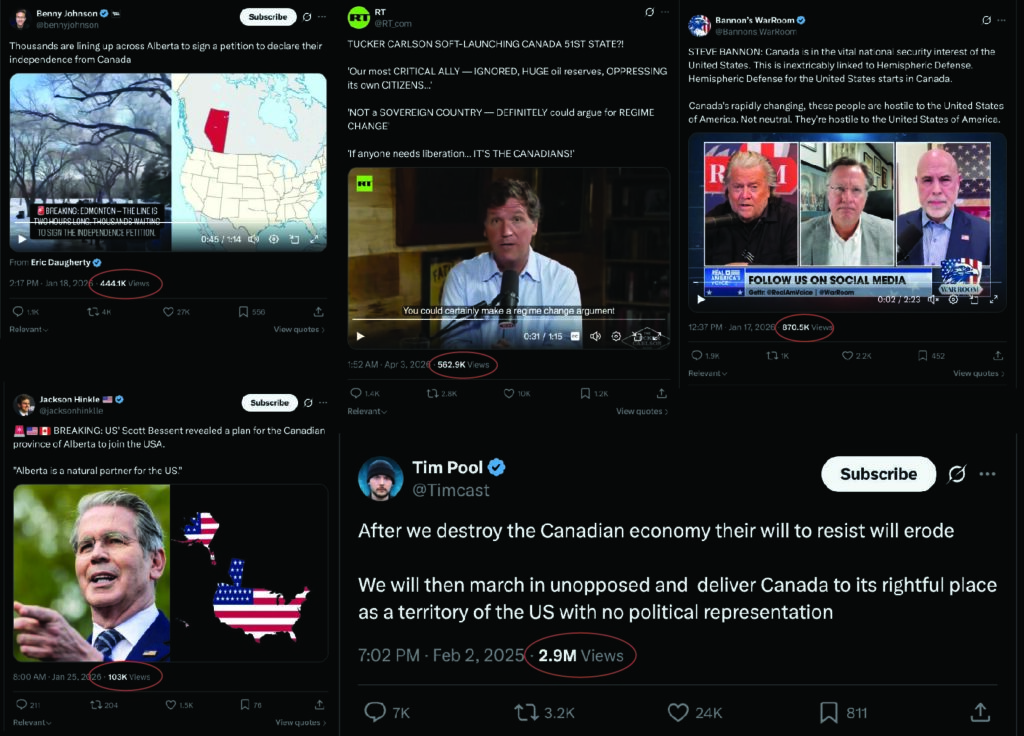
Figure 4. Examples of US prominent MAGAsphere influencer engagement. Source :Twitter/X
Many populist influencers in the MAGAsphere, with immense followings, have voiced their opinions (See figure 4) — like Tucker Carlson and Steve Bannon.
In his April 2, 2026 broadcast, Tucker Carlson asserted to millions of viewers that Canada “is not sovereign” and argued — echoing Russian claims before its full-scale invasion of Ukraine — that the United States should consider coercive regime change. Carlson also advanced the unfounded claim that Canada had killed 100,000 of its own citizens through a state-sponsored “killing program,” before stating that “you could make a human rights case to invade Canada.”33 The video was republished by Russian state media outlet RT, accumulating 562,000 views, and has been viewed by millions worldwide across Carlson’s combined subscriber base of nearly 30 million.
Steve Bannon, former Trump advisor and prominent supporter of Brexit, has also inserted himself into the Alberta separatist issue, telling his War Room audience that Albertans “are getting out of the Canadian union” and arguing the United States should recognize Alberta as an independent country and place it “on the pathway” to becoming the 51st state, in a video viewed approximately 171,000 times on X/Twitter.34 In a January 17 video viewed approximately 870,000 times on X/Twitter, Bannon claimed that Canadians are “hostile to the United States of America” and argued that Canada is central to American hemispheric defence.35 Bannon’s engagement is significant because of his role in shaping and amplifying anti-establishment, nationalist, and sovereignty-based movements across the transatlantic populist political ecosystem. His platform regularly validates, energizes, and internationalizes populist political parties and movements. By framing Alberta separatism as part of a broader struggle against liberal democratic institutions, he positions the Alberta movement within a larger MAGA-aligned narrative about sovereignty, energy, and resistance to federal authority. More concerning is the language he uses to recast Canada not as an allied sovereign democracy but as a strategic problem for the United States to manage. This is the same great-power logic used by authoritarian leaders, including Vladimir Putin, to justify interference in neighbouring states. When combined with claims that Alberta could be recognized by Washington or absorbed into the United States, such narratives may embolden separatist actors, create unrealistic expectations of foreign support, and normalize annexation — forced or otherwise — as a reasonable political outcome
The impact of content published by influential online MAGAsphere personalities should not be ignored or underestimated. Canadians and Americans increasingly follow, trust, and consume political news from podcasters and other online influencers. A November 2025 report by the Media Ecosystem Observatory found that, among Canadians, “influencers command more attention online than traditional institutions,” and that online influencers have “significantly more reach than either news media or politician and party accounts in Canada.”36 Many command audiences in the tens of millions, giving their messaging significant potential to influence perceptions among Canadians and Albertans, and their reach far extends that of traditional media and official institutions.
3.2.3. CONVERGENCE THROUGH TENET MEDIA
The most alarming dimension of US involvement is where the influencer ecosystem and Russian funding meet. U.S. influencers Tim Pool and Benny Johnson (see figure 5) were among the prominent commentators associated with Tenet Media, an online media organization alleged in a U.S. Department of Justice indictment against two RT employees to have received nearly USD $10 million in covert Russian government funding. Two Canadians, Lauren Chen and Liam Donovan, are alleged by the DOJ to have helped establish and operate the organization. Both Pool and Johnson have used their platforms to criticize Canada and amplify Alberta separatist narratives.In a January 18, 2026, video, Johnson endorsed the Alberta separatist movement, telling his more than 6 million YouTube subscribers: “Massive amounts of people wanting to secede Canada. 51st state, we would welcome it.”37 In a January 30, 2026 video, Tim Pool told his 2.72 million YouTube subscribers: “Trump officials met with Canadian separatists… looks like we’re taking Canada boys.”38 These figures have previously promoted conspiracy theories and false claims about election fraud39, including claims about the 2020 U.S. presidential election that were rejected by courts and contradicted by official results.40
This case should serve as a warning for Canadians. Influencers who have shown a willingness to undermine trust in democratic processes elsewhere could deploy similar narratives against Alberta’s referendum, including claims designed to discredit election authorities, delegitimize the process, or cast doubt on the outcome.
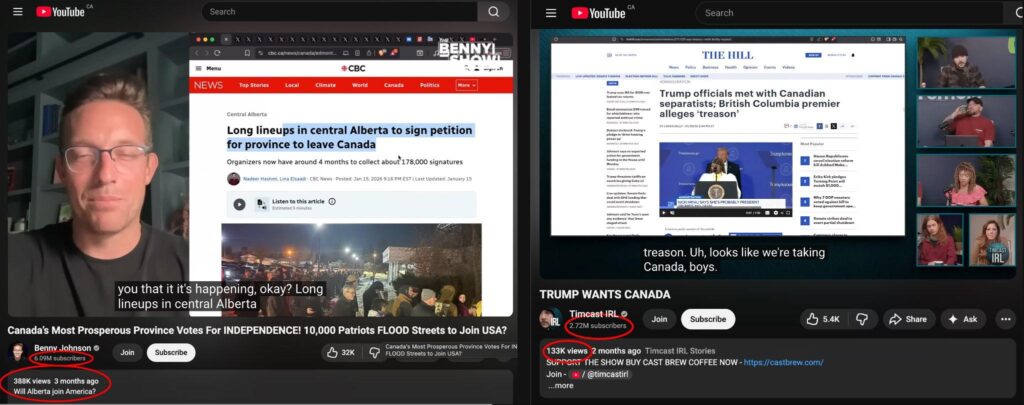
Figure 5. Examples of YouTube videos posted by US influencers Benny Johnson (left) and Tim Pool (right) Source: YouTube
3.3. ECONOMIC OPPORTUNISTS | REVENUE THROUGH AI-GENERATED MANIPULATION DURING DEMOCRATIC EVENTS
Not all manipulation of Canada’s information environment is state-directed. While foreign governments, aligned influencers, and foreign-backed proxies represent a persistent threat to the integrity of Canada’s information environment and cognitive sovereignty, other actors may also seek to exploit the Alberta separatist movement. These include foreign economic opportunists, a third actor, who profit from political, economic, health, and regional grievances by amplifying fear, anger, and distrust. During the COVID-19 pandemic, similar predatory actors promoted untested and dangerous substances they falsely claimed could cure the virus.41 The same profit-driven model could be adapted to Alberta separatism through AI-generated “slop,” conspiracy content, and emotionally manipulative narratives designed to attract attention, build audiences, and monetize political differences.
3.3.1. THE AI SLOP NETWORK
Researchers at the Canadian Digital Media Research Network (CDMRN) have identified a coordinated network of AI-generated content targeting regional grievances in Western Canada, including Alberta separatism. This content—often referred to as “AI slop” or “slopaganda”—combines generative AI tools with paid voiceover actors to produce highly templated, emotionally manipulative videos designed to mimic authentic Canadian political commentary.42 The network, first identified by Canadian Press journalist Colleen Hale-Hodgson, includes YouTube channels such as “Canadian Reporter,”43 which produce content heavily focused on Alberta and other politically sensitive Canadian issues (see figure 6).44 Hale-Hodgson and her team found that some of the individuals who presented themselves as Canadian commentators were, in fact, voice actors based outside Canada, including in the United States. A subsequent CBC investigation found that some of the accounts are linked to actors in the Netherlands.45
Hosts on these channels frequently present themselves as authentic Albertan voices, despite clear indicators that they are not locally rooted, including repeated factual errors, mispronunciations, and a lack of basic contextual understanding of Canadian politics
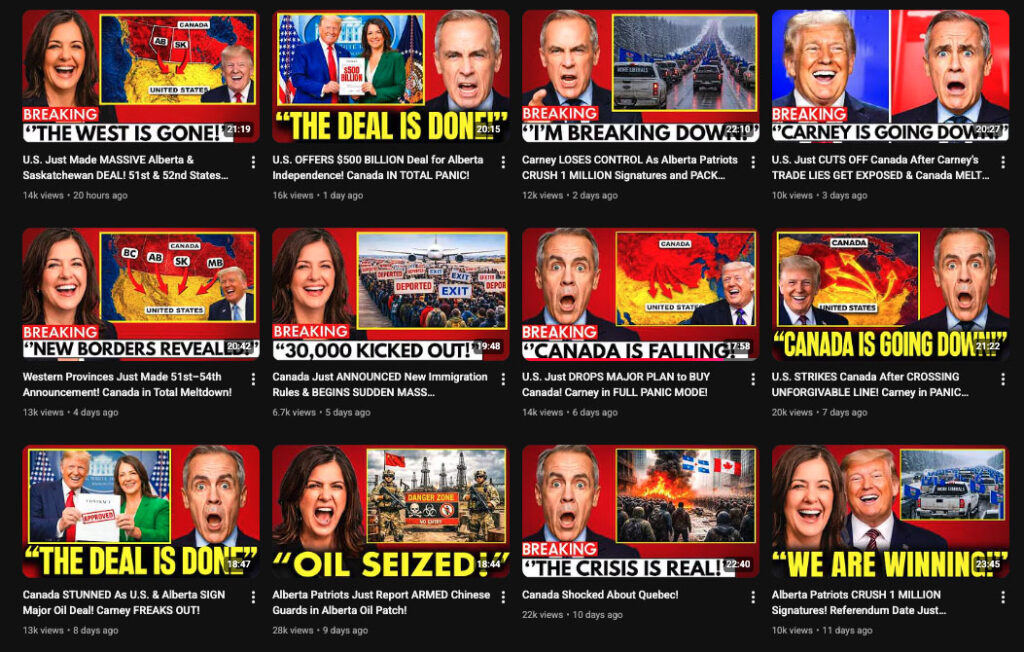
Figure 6. Examples of content posted to the “Canadian Reporter” YouTube channel.
While the ultimate origin and intent of this network remain unclear, its structure, scale, and narrative focus suggest a hybrid model that blends information manipulation with profit-driven content production. Such groups and individuals will continue to exploit high-interest political issues like Alberta separatism because they generate strong engagement and revenue. It also demonstrates that not all manipulation of Canada’s information environment is state-directed. Economic opportunists, operating across borders and with little transparency, can now produce large volumes of persuasive, inauthentic political content that blurs the line between legitimate discourse and coordinated manipulation, posing a growing risk to Canada’s democratic processes and cognitive sovereignty.
3.4. CUMULATIVE IMPACT
Russia, the United States, and profit-driven economic opportunists represent three distinct categories of actor operating in Alberta’s information environment — with different methods, different levels of coordination, and different degrees of intent. What unites them is a shared strategic outcome: the amplification of division, the erosion of institutional trust, and the normalization of Alberta separation as an inevitable or desirable political result. Russia operates covertly, through doctrine-directed proxies and sustained narrative infrastructure designed to appear domestic. The United States operates overtly, through official engagement and a MAGA-aligned influencer ecosystem that commands larger audiences than traditional media. Economic opportunists operate indiscriminately, exploiting the same fault lines for profit rather than strategy — but producing the same erosive effect on Canada’s information environment. The Tenet Media case is the point where all three appear to converge: Russian money, American influencers, and profit-driven content production fused into a single operation that may impact Canadian democratic processes.
The most effective way to measure ongoing impact of these threats and determine when to intervene with countermeasures is through the application of the Breakout Scale, developed by Ben Nimmo46 and adapted to analyze narratives, monitor their spread, assess impact, and guide timely and preemptive responses. Used effectively, the Breakout Scale can help maximize resources and improve efforts to disrupt disinformation supply chains, regardless of their source.
The Breakout Scale, as adapted here, identifies five categories of narrative breakout. Category 1 refers to a narrative that remains confined to a single platform. Category 6 represents a narrative that that impacts policy or provokes political action. When assessed through this framework, Tucker Carlson’s statements about Canada and Alberta would register as a Category 4 breakout, reflecting high-profile amplification by a prominent media personality with significant audience reach. U.S. Treasury Secretary Scott Bessent’s tacit endorsement of Alberta’s separatist movement would constitute a Category 5 breakout, given his senior official status and the potential for such comments to legitimize, internationalize, and politically energize a fringe separatist narrative.
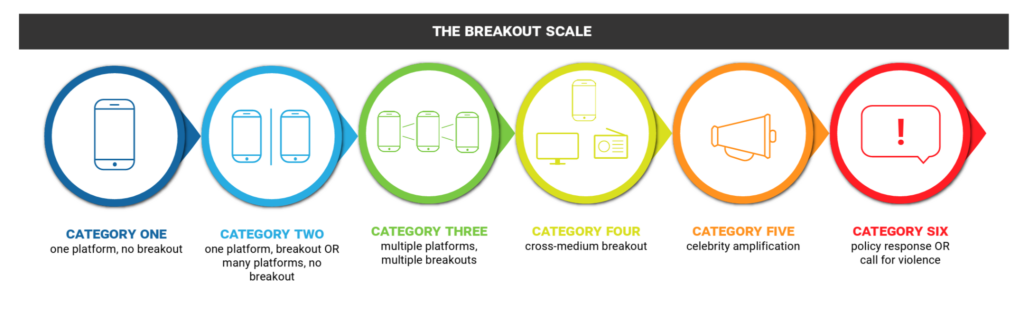
Figure 7. Diagram of Ben Nimmo’s breakout scale. Source: Brookings Insitute
To address, Canada needs to shift the focus from reactive responses to developing a narrative first approach. One of Canada’s greatest risks in responding to information operations is overinvesting in reactive, whack-a-mole tactics that treat each fake site, cloned outlet, or bot campaign as a discrete incident. As a recent EU DisinfoLab report notes, rather than relying on short-term responses that exhaust limited resources, “following a ‘kill (supply) chain’ logic” can help concentrate disruption efforts on measurable impact and on raising costs for perpetrators.47 A narrative-first approach allows analysts to identify campaigns and measure their potential impact based on the effects they produce in the information environment, using the Breakout Scale rather than simply judging them by how “busy” they appear. Intermediate impacts, including improved situational awareness, preemptive inoculation, attribution opportunities, and increased friction for threat actors, should be treated as part of a broader strategy to disrupt disinformation supply chains.
4. THREAT PERCEPTION & AWARENESS
While these threats exist, awareness of foreign interference risk is not uniform — and the gap between perception and reality may itself determine the fate of democratic decision-making at this critical juncture. Notably, public concern about foreign interference has inverted dramatically over a remarkably short period. As figure 7 shows, from July 2024 to April 2026 concern about Russian interference fell from 52% to 42%, while concern about the United States surged from 39% to 62% over the same period — peaking at 71% in early 2026, almost certainly driven by Trump’s Greenland annexation threats and his Davos speech in which he posted AI-generated images of a US flag planted on Canadian soil. US interference is overt; Canadians can directly observe and form views on the statements and actions of their neighbour to the south. Russian interference, however, is by design covert — public awareness is low not because the threat is absent, but because it is hidden. Combining survey data with secondary sources, this section evaluates the extent to which Canadians perceive the United States and Russia as threats to the Alberta separatism debate, Canadian national unity, and the fate of the country.”
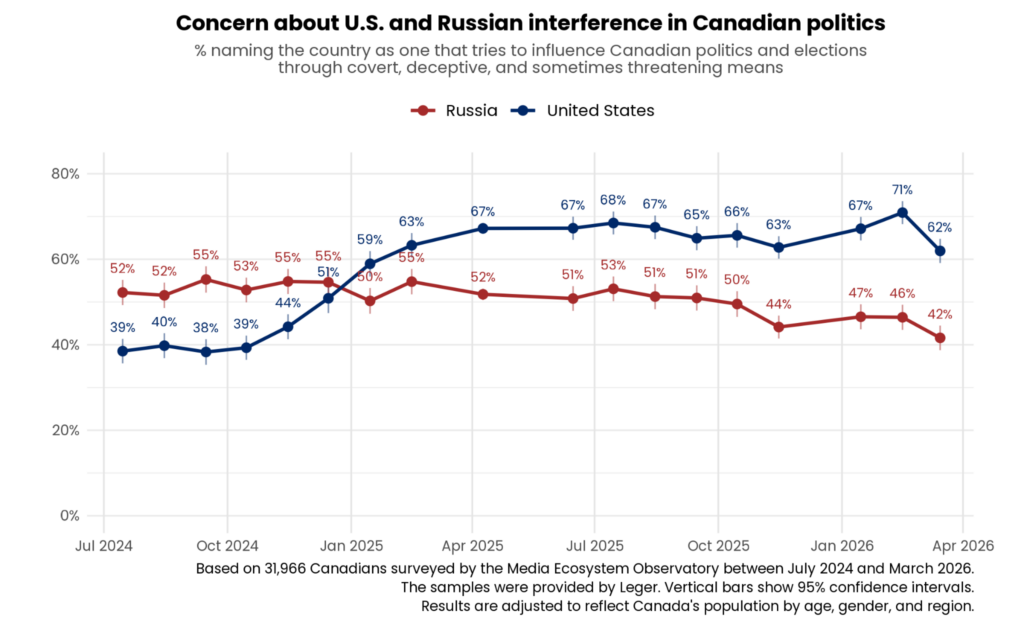
Figure 8. Concern about U.S. and Russian interference in Canadian Politics (Source: Canadian Digital Media Research Network (CDMRN), April 2026)
4.1. OVERT INTERFERENCE: US THREATS
To evaluate perceptions of the US as a threat, we evaluated the extent to which Canadians consider it appropriate for U.S. political figures or administrations to express support for Alberta separatist movements (interference), the extent to which people felt statements by Donald Trump or his allies about Canada (including support for separatists, the 51st state rhetoric) pose a real risk to Canada’s national unity) (perceived risk), and views on the current direction of alliance with the United States under Donald Trump (alliance). Looking across responses, we see strong alignment (consensus) on some issues, divisions in others (fractures) and a level of complacency & uncertainty (complacency gap) which has important implications for our discussion on vulnerability in the next section.
4.1.1. CONSENSUS
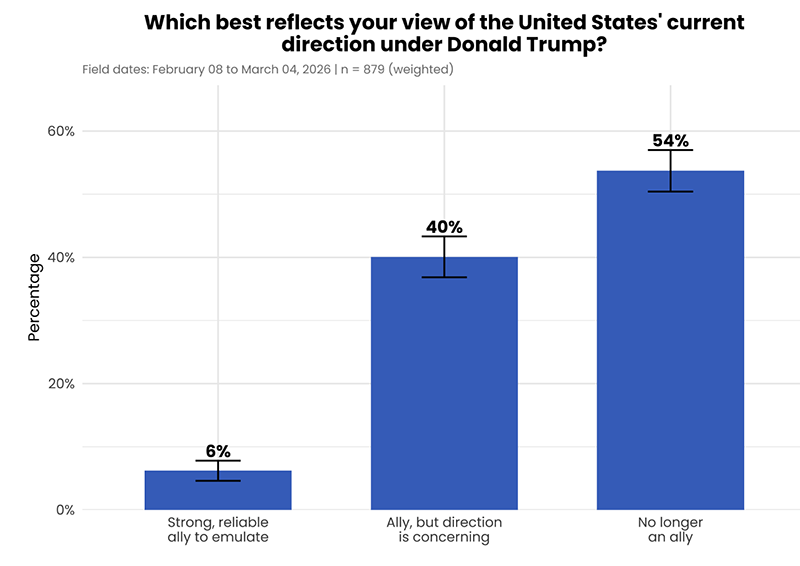
Figure 9. Overall Canadian views of US direction under Trump (Source: CDMRN, April 2026)
Broadly speaking, one of the most striking findings in our data is that Canadians are unified in their perception of the US as a threat, their rejection of interference, and diminished confidence in the US as an ally. Consensus is highest on rejection, i.e. nearly all Canadians (94%, figure 9) believe the United States are no longer a reliable ally (they are an ally, but direction is concerning). This question received zero “don’t know” responses, and rejection was a majority position across all provinces, and language groups. Whatever divisions exist in Canadian public opinion, the view that the US under Trump is no longer a reliable ally has effectively achieved national consensus. Combined, approximately 4 in 5 (77%) respondents consider it at least somewhat inappropriate for U.S political figures to express support for Alberta separatist movements, and 2 in 3 consider Trump’s statements about Canada as a moderate to serious risk to Canadian national unity. The good news: Baseline resilience exists.
4.1.2. FRACTURES
While the majority are widely aligned, we observe fractures where consensus breaks down across groups (generations, partisanship and geographic boundaries). Evaluating American statements about the Alberta separation as interference, Figure 10 shows younger respondents (18-34) are roughly 4x more tolerant of US interference than those over 55, and almost half of PPC supporters (49%) find this form of interference appropriate — a stark contrast to other parties like the conservatives (second highest) with one quarter deeming statements acceptable (24%). In contrast to other provinces, Quebec and Saskatchewan are the most tolerant of US statements on separation (QC 39%, SK 34%), i.e. they believe these statements are not completely inappropriate, compared to Ontario (27%). Similarly, both provinces are the most dismissive of Trump’s statements about Canada (QC 6%, SK 7%), contrasted with 10-12% of the population in other provinces that are dismissive.
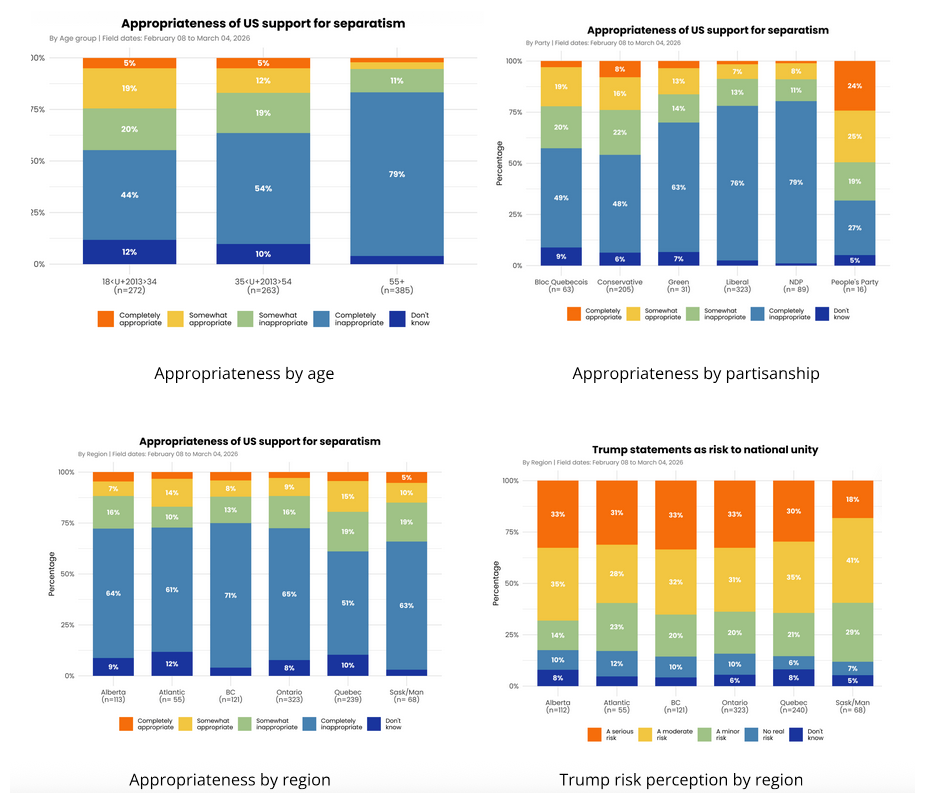
Figure 10. Perceived appropriateness of US support & Trump risk perception (CDMRN, April 2026)
4.1.3. COMPLACENCY & UNCERTAINTY GAP
Beyond disagreement between groups, a third dimension of the threat picture emerges within the public itself — complacency and uncertainty. Nationally, Canadians are nearly twice as likely to say ‘don’t know’ about whether politicians are taking the separatism threat seriously (19%) as they are about the threat itself (10%). Among those who rate the threat as serious, 1 in 5 still cannot assess whether the political response is adequate. Looking across age groups, while perceptions that politicians are taking the threat seriously are broadly consistent (51–54% across groups), there is significant deviation regarding whether federal parties should do more — 49% of youth believe more should be done, rising to 62% among those 55 and older. This awareness gap — between recognizing the threat and engaging with the institutional response to it — is widest at both ends of the age spectrum, among younger Canadians and those 55 and older.
4.2. COVERT INTERFERENCE: RUSSIAN OPERATIONS
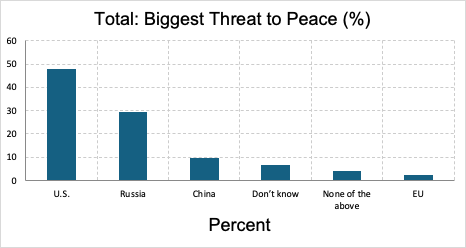
Figure 11. Politico February 2026 poll about Canadian perceptions of which foreign government is the biggest threat to peace. Source: Politico
A Politico poll published on February 19, 2026, found that while Russia remains a major concern for Canadians, it is no longer viewed as the dominant foreign threat. Overall, 29.4% of Canadians identified Russia as the greatest threat to peace, placing it second behind the United States at 47.8%, and well ahead of China at 9.6%. The finding suggests that Canadian concern about Russia’s aggression and destabilizing role remains significant, but has been overtaken by growing anxiety about the direction of U.S. foreign policy under Donald Trump.
These findings should also be understood alongside broader trend data from the Media Ecosystem Observatory. As shown in Figure 11, concern about Russian interference in Canadian politics remained consistently high from mid-2024 through early 2026, generally hovering in the mid-40s to mid-50s. Over the same period, however, concern about U.S. interference rose sharply, eventually surpassing concern about Russian influence.
While the data shows that concern about Russian information operations has declined by roughly 10 percentage points, it does not suggest that Canadians have become complacent about Russian interference. Rather, it demonstrates broad public recognition that Russia continues to target Canadian issues and interests. One quarter of Canadians were familiar with the Tenet Media case, specifically that Russia funded political influencers through this platform, when the story emerged in the fall of 2024.48 It also underscores that the Kremlin’s well-documented collaboration with domestic North American influencers to launder and amplify regime-aligned narratives has shown no signs of abating.
A majority of Canadians recognize both the United States and Russia as threats to Canadian sovereignty and national unity. However, fractures within that consensus, combined with complacency and uncertainty about the institutional response, create precisely the conditions that foreign influence operations seek to exploit. The question is no longer whether these vulnerabilities exist, but whether Canada can address them before they are used against us.
5. VULNERABILITIES
5.1. GENERAL PUBLIC /PUBLIC VULNERABILITY
Deeper analysis of our survey data reveals two critical vulnerabilities in public perception to foreign influence and information operations.
Trust deficit – First, there is a critical vulnerability at the intersection of concern and trust. We mapped respondents’ perceptions of the separatism threat against their confidence in the political response, creating four segments ranging from unalarmed and trusting to alarmed and distrusting (figure 12). We find that 1 in 3 Canadians are simultaneously alarmed about separatism but distrustful of politicians to address it, a segment disproportionately concentrated in Alberta and Quebec, the two provinces with active sovereignty movements. The vulnerability here is not awareness, people in these provinces see the threat clearly. It is institutional: a belief that the political system cannot or will not respond adequately. Foreign influence operations do not need to manufacture concern in this group. They only need to take advantage of this to deepen the distrust, reinforce the sense of political failure, and redirect that frustration toward the conclusion that separation is the only rational response.
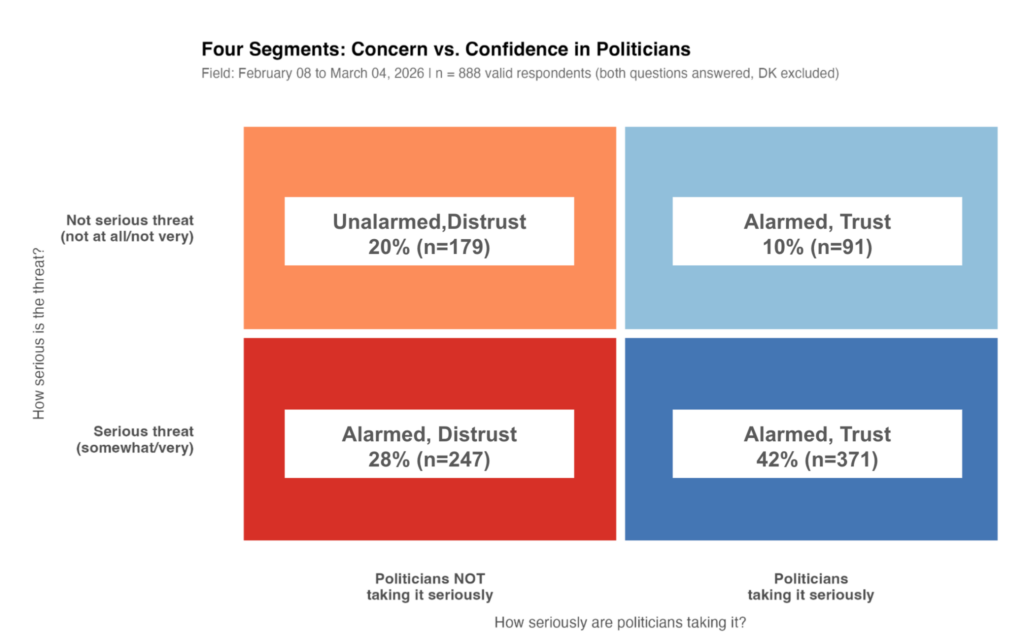
Figure 12. Matrix depicting threat concern vs. politician trust to demonstrate the trust gapPoliticians are NOT taking it seriously (distrust)Politicians are taking it seriously (trust)
Cognitive Inconsistency – Our data reveals significant conflicting beliefs that foreign influence operations can exploit. While 77% of Canadians hold internally consistent views, nearly 1 in 4 hold at least one contradiction. The most prevalent, affecting 1 in 5 Canadians (20.3%), is the complacency contradiction: simultaneously believing separatism is a serious threat while trusting politicians are responding adequately. This matters because it short-circuits civic urgency — those who believe the danger is being handled have little motivation to demand stronger action or resist foreign-amplified narratives. This contradiction is highest in Quebec (29.1%) and Alberta (26.6%), among PPC supporters (31.6%), and younger Canadians (23.7%). A second contradiction compounds the picture in Quebec and among youth specifically: 6.8% of Quebecers and 4.9% of young Canadians simultaneously believe the US is no longer an ally yet find US statements supporting Alberta separatism appropriate. This is more than double the rate of other provinces and age groups. Combined, these contradictions expose these populations to targeted exploitation, not by manufacturing new beliefs, but by widening the tensions already present.
While these findings characterize the cognitive vulnerability of the population, the underlying information ecosystem itself enables entry, spread and amplification of harmful information and public manipulation tactics. A deeper vulnerability analysis of this system (and consideration of Albertan geography) is critical to accurately characterize foreign influence and information operation risk.
5.2. ALBERTA INFORMATION ENVIRONMENT / SYSTEMIC VULNERABILITY
The convergent vulnerability system: Alberta’s information environment is not weakened by a single vulnerability. It faces multiple, overlapping vulnerabilities that converge during high-stakes political moments, compounding one another and creating an exposure greater than any one weakness alone — a convergent vulnerability system. The most critical factor determining that vulnerability is not the foreign actor but the domestic conditions they exploit — pre-existing grievances, cultural divisions, and institutional trust deficits that influence operations, amplify rather than manufacture. What makes this particularly difficult to address is a fundamental pace mismatch: foreign influence operations move at algorithmic speed, amplified across platform recommendation systems far faster than institutional detection mechanisms can respond. Adding monitoring capacity alone does not resolve this asymmetry — it requires structural redesign of how detection and response are sequenced
The three high-severity vulnerabilities: Three vulnerabilities sit at the top of the system’s fragility profile. Taken together, they are best understood as detection failures rather than content failures — they compromise the province’s ability to see operations already underway before any question of response arises.
- Cross-platform coordination blindness: influence campaigns operating simultaneously across multiple digital platforms appear as noise rather than signal within any single monitoring feed, allowing a significant share of coordinated activity to go unrecognised.
- Algorithm transparency deficit: because social media amplification mechanisms are proprietary and opaque, it is structurally impossible to monitor what content is being accelerated, at what velocity, or toward which demographic segments, without platform cooperation that has not been secured.
- Cross-source correlation failure: threat intelligence gathered from fragmented federal, provincial, and civil society sources is not correlated in real time, meaning that coordinated operations spanning multiple channels can outpace any single observer’s detection window. These three vulnerabilities are structurally linked — each one limits the effectiveness of the response to the others.
Geographic vulnerability map: The geographic distribution of vulnerability across Alberta is not uniform. While a comprehensive empirical mapping is beyond the scope of this analysis, structural modelling suggests illustrative anchors where particular narrative streams might find distinct resonance based on community context. Provincial and urban centres tell different stories: Edmonton, as the seat of government, may attract narratives targeting institutional legitimacy and referendum process confidence, while Calgary’s corporate and media networks represent the most efficient surface for economic sovereignty messaging. Resource-dependent communities — Fort McMurray and Grande Prairie — with concentrated media ecosystems and high energy-sector dependence, may prove particularly receptive to narratives framing separation as an economic survival imperative. Lethbridge’s proximity to the US border suggests distinct exposure to American-origin content through cross-border information flows, while Red Deer may serve as the corridor through which narratives framing urban Alberta as indifferent to rural concerns travel most effectively. These are illustrative scenarios grounded in structural characteristics, not predictions or confirmed targets. A fuller geographic vulnerability assessment would require dedicated empirical work beyond the scope of this analysis
6. FORECASTING NARRATIVES, RISKS & TRIGGERS
This section does not attempt to predict specific actions. Instead, it identifies the types of narratives that are most likely to emerge at key moments in the process, based on known timelines and observed patterns from past influence operations. The convergent vulnerabilities identified above are not background conditions; they are the active terrain on which these narratives will operate.
PHASE 1. NEXT 30–60 DAYS: PETITION VERIFICATION AND COURT PROCESS
As the petition deadline passes and legal challenges unfold, the information space will be vulnerable to narratives that question the integrity of the process.
Canadians should expect:
- Claims that valid signatures were secretly rejected or manipulated.
- Allegations that authorities are concealing the true level of support for separation.
- Misrepresentation of legal developments, including false claims that courts have “cancelled” a referendum when they are only pausing or reviewing elements of the process.
- Circulation of fabricated screenshots, documents, or statements attributed to Elections Alberta or First Nations leaders to inflame tensions and erode trust.
- The pre-campaign window is also the period in which narrative frames are established — structural analysis suggests that frames set before institutional counter-narratives are in place are significantly harder to dislodge once amplified. The current absence of provincial-level monitoring capacity means this window is effectively unobserved.
It is during this stage that narrative frames are established, and the complacency gap is particularly dangerous. Structural analysis suggests that frames set before institutional counter-narratives are in place are significantly harder to dislodge once amplified. Current gaps in provincial-level monitoring capacity imply this window is underobserved. Combined, a person who believes the separation threat is serious, but politicians are managing it, is not a skeptic of manipulation claims, they are one persuasive narrative away from converting that fragile trust into active distrust. Narratives alleging that valid signatures were secretly suppressed do not need to overcome disbelief; they only need to collapse a trust that was never firmly grounded in evidence.
PHASE 2. SUMMER TO OCTOBER 2026: REFERENDUM CAMPAIGN ENVIRONMENT
As the campaign period intensifies, narratives are likely to focus on:
- Narratives questioning who is eligible to vote.
- Claims or confusion about how votes are counted or verified.
- Misleading interpretations of what the referendum result would legally mean.
- False claims about non-citizen voting or voter fraud.
- AI-generated or misleading videos explaining voting rules inaccurately.
- Distorted or deceptive explanations of the referendum questions.
- Exaggerated claims about foreign or out-of-province support or funding.
- Messaging that frames the referendum as an immediate or automatic path to independence, regardless of legal reality.
Younger Canadians, who show the highest tolerance for US involvement in the separatism debate and the highest cognitive inconsistency on US-related questions, may be the demographic target here for AI-generated content explaining voting rules inaccurately or framing US endorsement of separation as legitimate democratic support.
PHASE 3. POST-RESULT PERIOD: LEGITIMACY AND OUTCOME NARRATIVES
Following any result, the primary risk will be narratives aimed at delegitimizing the outcome. These may include:
- Claims of vote manipulation, fraud, or hacking.
- Circulation of forged or misleading official documents.
- Assertions that foreign governments are ready to recognize or materially support an independent Alberta.
- False claims that a single vote or legal step automatically triggers independence.
- Counterclaims that the referendum result has no legal standing or effect.
- Narratives designed to create confusion about the process and outcome.
- Efforts to undermine trust in democratic institutions.
- Messaging intended to deepen political divisions at a critical moment.
During Phase 3, the trust deficit, where Alberta and Quebec are disproportionately represented among those who are alarmed but distrustful of the political response, suggests that post-result delegitimization narratives may find particularly fertile ground in these provinces.
Overall, each phase in this forecast compounds the last: trust eroded in the petition phase makes campaign-period narratives harder to counter, which makes post-result delegitimization harder still to contain. Combined, the reach and velocity of narratives across all three phases will be materially amplified by social media recommendation systems operating beyond the visibility of provincial authorities. Even low-origin content can achieve outsized distribution through algorithmic mechanisms that cannot currently be monitored or interrupted at the provincial level. Interventions that invest in trust before the campaign begins are therefore not preparatory; they are the primary defence.
7. ACTION PLANNING
The vulnerability assessment and forecasting identify where Canada is exposed, but also where interventions are most likely to have an impact on disrupting the influence and disinformation supply chains that cascade from foreign narratives into democratic harms. Because different actors carry different responsibilities and capacities, our recommendations for intervention are organized by role.
POLICY MAKERS AND LEGISLATORS
- Evolve Bill C-70 for moments of democratic sensitivity – evolve provisions of this legislative foundation to compel algorithmic disclosure during declared periods of elevated democratic risk
- Generate pre-authorized rapid response protocols – pre-establish protocols to enable designated teams to act without waiting for full inter-agency sign-off.
- Build a national intergovernmental monitoring and analysis coordination hub: Establish a national coordinating body, such as Canada’s G7 Rapid Response Mechanism, to connect federal departments and agencies with civil society, academic institutions, media, and provincial partners. This body should share threat intelligence, methods, and best practices to strengthen national resilience against threats to Canada’s democracy – including groups like Cyber Alberta Community of Interest.
- Adopt a Canadian version of EU Digital Services Act-style legislation – adopt and harmonize enforcement with the European Union to require greater transparency from large social media platforms and hold them accountable for non-compliance.
- Create a coordinated response framework- Canada should link federal departments, provincial authorities, civil society, researchers, and analytical platforms through a shared response framework. The goal should be to move beyond reactive debunking toward early detection, risk assessment, public communication, and long-term resilience building.
- Support independent Canadian analysis – Canada should invest in Canadian-built monitoring tools and research networks, working with democratic allies where appropriate, rather than relying primarily on foreign-owned platforms. Independent Canadian analytical capacity is better positioned to assess politically sensitive threats involving allied states, domestic movements, and Canada-specific vulnerabilities.
LAW AND LAW ENFORCEMENT
- Solidify standing interagency operational relationships – Ensure relationships between federal intelligence bodies, provincial authorities, and civil society researchers are not negotiated mid-campaign.
- Protect whistleblowers from transnational repression – protect journalists, civil society researchers, and independent experts from legal threats, harassment, and targeting by foreign governments and their proxies designed to silence those detecting and exposing influence operations.
COMMUNICATIONS AND MEDIA
- Pre-emptive inoculation during the pre-campaign window – identified as the highest-leverage period for intervention, prioritize pre-emptive messaging about specific manipulation tactics and contradictions before influence operations deploy them.
- Design messaging for vulnerable groups – develop messaging that speaks directly to groups most likely to be vulnerable to manipulation, especially those who are disengaged, distrustful of institutions, or uncertain about what to believe.
- Prioritize trusted local media and independent journalists – ensure trusted sources are the primary delivery channel, official government communications are unlikely to reach communities that have already lost confidence in institutions.
LEADERS AND EXECUTIVES
- Acknowledge integration in active threat environment – organizational leaders across energy, financial, post-secondary, and civil society sectors need to understand their position, their impact and how they’re impacted in an active information threat environment during the referendum period.
- Support independent monitoring and research capacity – invest in internal threat modelling and capacity building, monitoring capabilities, communications resilience, and resist treating foreign influence as solely a government problem. Supporting, collaborating with, and protecting civil society researchers and journalists is a specific executive-level responsibility.
- AI for democratic resilience: Support the development of new technologies that help protect the integrity of Canada’s information environment and defend its cognitive sovereignty.
- Restore trust in journalism: Government, industry leaders, and the media community should work together to rebuild public trust in Canadian journalism by making credible, professional news more accessible to all Canadians, including students and people in rural and underserved communities. Quality journalism and reliable information are essential pillars of a healthy democracy.
EDUCATORS AND RESEARCHERS
- Build critical thinking through media literacy – younger generations were identified as the most susceptible demographic to foreign-amplified content; learn from our democratic allies and build democratic resilience through media literacy programming that builds durable critical thinking skills rather than reactive responses to specific narratives.
- Build civil society monitoring, response and coordination capacity – leverage expertise in civil society (including academia) to build critical anchors for technical monitoring and counter-narrative research capacity.
GENERAL PUBLIC
- Resist complacency – recognizing a threat is insufficient; take action; active civic engagement, e.g. demanding stronger institutional action and participating in democratic processes, is a practical expression of independent cognitive sovereignty.
- Be critical of information – before sharing content about the referendum, separation or Canadian sovereignty, consider the source, emotional tone, and intention to inform versus divide.
- Be critical of social media – Information feeds are shaped by political and financial incentives, not democratic well-being or users’ cognitive health; they are not neutral. Content that provokes outrage, fear, or shock is amplified to drive engagement and, ultimately, generate revenue. Limit exposure to these algorithms, diversify information sources, and seek out credible journalism and perspectives beyond what platforms automatically serve them.
- Support trusted, independent journalism – local and independent journalism are the frontline of exposing and countering foreign influence operations, yet they’re the most vulnerable to targets of transnational repression; support through subscriptions, amplification of their work, and civic advocacy for press freedom
8. CONCLUSIONS
Defending the right of all Canadians to express themselves and participate freely in legally protected democratic processes, including debates about Alberta’s place within Confederation, is a responsibility shared by governments, media, civil society, and every citizen. That responsibility includes protecting Canadians from foreign governments, state-aligned media, and ideological networks that seek to influence public opinion, affect democratic outcomes, distort our information environment, and undermine our ability to make decisions free from foreign manipulation and coercion. When external actors amplify separatist narratives or encourage national rupture, the issue is no longer only a matter of provincial politics. It becomes a direct threat to Canada’s democratic integrity, national security, and cognitive sovereignty.
Interventions that invest in trust before the campaign begins are therefore not preparatory; they are the primary defence.\
9. METHODOLOGY
Cipher Ai
CIPHER employs a human-in-the-loop analytical methodology for identifying and assessing coordinated influence activity in online information environments. The system combines open-source data collection, machine learning, natural language processing, network analysis, and expert-guided classification to examine the production, circulation, and amplification of digital narratives.
The methodology begins with the collection of publicly available data from selected online sources, including social media platforms, news sites, blogs, forums, and other relevant web-based spaces. The collected material is processed to extract textual, temporal, relational, and engagement-based features. These features are then used to cluster content into narrative themes, identify recurring frames, examine cross-platform diffusion, and detect patterns of amplification, coordination, or anomalous activity.
A central component of the methodology is the use of expert-informed analytical models, or personas, which encode domain-specific assumptions about actors, tactics, issue areas, and information-operation signatures. These models support structured interpretation rather than automated attribution. Outputs are reviewed by human analysts, who assess source quality, contextual relevance, evidentiary strength, and alternative explanations. The methodological process prioritizes transparency, auditability, and iterative refinement rather than fully automated detection or classification.
Survey
In close partnership with the Canadian Digitial Media Research Network, a national survey of Canadians was conducted from February 08 to March 04, 2026. Our raw sample consisted of 1,479 respondents.
CASi Labs
CASi Labs employs a team-first collaborative methodology for producing structured analysis on complex, contested, or evolving issues. The system combines multi-agent reasoning, structured knowledge representation, multi-perspective analytical framing, and expert-guided review to examine how a topic can be understood across disciplinary, institutional, and stakeholder perspectives.
The methodology begins with the construction of a mission-specific workspace around a defined topic or question. The system produces a structured representation of the problem domain that captures its underlying causal and relational dynamics. A team of specialist agents, each instantiated with a distinct expert profile and analytical stance, then engages with this representation through complementary analytical framings — generating positions, contesting assumptions, surfacing dissent, and producing structured artifacts that situate the analysis in evidence and context.
A central component of the methodology is the preservation of structured pluralism: agent disagreement is surfaced rather than averaged away, the underlying analytical structure remains inspectable, and the chain of reasoning from question to output is traceable. The methodological process prioritizes transparency, auditability, and draft-state honesty rather than fully autonomous synthesis.
CASi Labs is a Dutch technology company founded in 2025 and headquartered in the Netherlands, with active research collaborations with partner universities. It deploys the platform, configures it to the domain, and transfers analytical capability to partner organisations — enabling rigorous collaborative analysis in contexts where the complexity or contestedness of the situation exceeds the capacity of conventional synthesis methods.
Marcus Kolga
 Marcus Kolga is a journalist, human rights advocate, and leading expert of foreign disinformation and influence operations. He writes and comments in Canadian and international on Russian, Central and Eastern European affairs, human rights, and authoritarian information warfare.
He led the Canadian civil society campaign for Magnitsky human rights sanctions legislation. He has testified in legislatures in Canada, the United States, the United Kingdom, Australia, and Estonia on Magnitsky sanctions, Russian disinformation, and Interpol reform. In 2018, he received the Magnitsky Global Human Rights Award for his advocacy.
In 2020, Marcus founded DisinfoWatch to monitor and analyze foreign disinformation targeting Canada. Its work has been featured in Canadian, US and international media.
Marcus is a co-founder of the Global Center for Democratic Resilience, senior fellow at the Macdonald-Laurier Institute, the CDA Institute, the Raoul Wallenberg Centre for Human Rights. He has received state honours from Estonia and Latvia, and is one of three Canadian civil society activists sanctioned by both the Russian and Chinese governments.
Jennie Phillips
 Dr. Jennie Phillips is a leader in research, education, and social change, with over 15 years of experience across humanitarian response, disaster risk reduction, global health, climate, political, and technology domains. She has worked with governments, international organizations, and civil society to build awareness, strengthen capacity, and enable decision-making in high-stakes, rapidly evolving environments. Her work focuses on knowledge mobilization—translating complex analysis into practical tools, strategies, and capabilities that support institutional resilience, societal adaptation, and the ability to empower society in the face of complex challenges.She is Co-Director of the Global Centre for Democratic Resilience (GCDR), where she leads efforts to build public understanding of emerging information threats and equip institutions and communities with the knowledge and tools needed to navigate and respond to them. Her current focus is on examining how digital information ecosystems—including disinformation, networked influence operations, and AI-enabled content—shape public perception, polarization, and trust in democratic institutions. She drives applied research and advisory work on information manipulation and foreign interference, cognitive vulnerabilities, and the design of interventions that enhance public sector readiness. Dr. Phillips’ work emphasizes bridging technical analysis and public understanding, with a focus on making complex information threats accessible and actionable for policymakers and multi-stakeholder audiences. She regularly engages across sectors to support the development of shared frameworks, analytical capacity, and coordinated responses to the challenges posed by digital transformation.
Brian McQuinn
 Dr. Brian McQuinn is a humanitarian, scholar, and conflict-resolution practitioner with more than two decades of experience working and conducting research across more than 30 conflict-affected countries, including Rwanda, Nepal, and South Sudan. He completed his doctorate at the University of Oxford, based on nine months of fieldwork in Libya, where he lived with insurgents fighting to overthrow the regime. Brian has advised international organizations, governments, and civil society networks, including the United Nations and the International Committee of the Red Cross. He currently serves as an Associate Professor at the University of Regina and CEO of CIPHER AI. His research examines how extremist networks and authoritarian states exploit digital platforms and emerging technologies to weaken democracies and erode trust in social institutions. CIPHER AI uses AI-assisted analysis, expert-in-the-loop workflows, and structured analytic methods to identify emerging narratives, coordinated online activity, and potential foreign influence campaigns. His work has been featured in The New York Times, The Guardian, and The Globe and Mail.
Bartel Van de Walle
 Dr. Bartel Van de Walle is a researcher, entrepreneur, and expert in AI-assisted decision-making, collaborative intelligence, and information systems for complex, high-stakes, and adversarial environments.
He is the founder and CEO of CASi Labs, a Netherlands-based company developing AI platforms that augment the reasoning and decision-making of teams operating in complex, high-stakes environments. His work bridges artificial intelligence, organisational behaviour, decision support systems and real-world applications in crisis management. Bartel co-founded the ISCRAM community — the global research association on Information Systems for Crisis Response and Management — and has advised the United Nations and national science organizations and governments on information management and decision support in humanitarian emergencies. He has conducted field research in crisis-affected countries across Africa, Asia, and the Middle East. He previously served as Director of the United Nations University institute UNU-MERIT and as a Full Professor and Chair in Policy Analysis and Head of the Multi-Actor Systems Department at Delft University of Technology. He was a Senior Fellow at the Harvard Humanitarian Initiative and the Harvard Kennedy School’s crisis leadership program, and served as staff advisor to the Flemish Vice-Minister President for Research and Innovation. He is a widely published scholar in his field. He holds a PhD in Mathematics from Ghent University.
The authors wish to acknowledge and thank Chris Ross & Aengus Bridgman for survey analysis support and James Benoit for his input and support in configuring the CIPHER AI platform.
Bibliography
Alberta Separatist. “Fleecing The Albertan: How Ottawa Siphons $20K Annually Per Alberta Family.” May 15, 2025. Archived August 20, 2025. https://web.archive.org/web/20250820014306/https://albertaseparatist.com/fleecing-the-albertan-how-ottawa-siphons-20k-annually-per-alberta-family/.
Allan, Steve. Public Inquiry into Anti-Alberta Energy Campaigns: Final Report. Edmonton: Government of Alberta, 2021. https://open.alberta.ca/publications/public-inquiry-into-anti-alberta-energy-campaigns.
Angus Reid Institute. “In Alberta, a Divided Right Dampens the Sovereignty Spark.” February 9, 2026. https://angusreid.org/alberta-unity-separation-smith-carney-prosperity/.
Angus Reid Institute. “Unity or Separation: Quebec, Alberta & Canada’s Future — How the Rest of the Country Is Responding to Separatism Debates.” February 23, 2026. https://angusreid.org/national-views-of-separation/.
Bannon’s War Room. “STEVE BANNON: Canada is in the vital national security interest.” X post with video. https://x.com/bannons_warroom/status/2012579994577367524?s=61&t=iHfZOXZ-R2B6zSsKuuJaRw.
Benny Johnson. “Canada’s Most Prosperous Province Votes For INDEPENDENCE! 10,000 Patriots FLOOD Streets to Join USA?” YouTube video. January 19, 2026. https://www.youtube.com/watch?v=3PUrMKCLSYY.
Bolotsky, Denis. “Birth of the Republic of Western Canada Is a Cry of Our Heart – Wexit Alberta Founder.” Sputnik International, October 20, 2019. Archived April 12, 2024. https://web.archive.org/web/20240412145908/https://sputnikglobe.com/20191020/bseparatistirth-of-the-republic-of-western-canada-is-a-cry-of-our-heart-1077102166.html.
Bradshaw, Samantha, Renée DiResta, and Carly Miller. “Playing Both Sides: Russian State-Backed Media Coverage of the #BlackLivesMatter Movement.” The International Journal of Press/Politics 28, no. 4 (2023): 791–817.
Canadian Digital Media Research Network (CDMRN), DisinfoWatch, Media Ecosystem Observatory, and PolCommTech Research Lab. Russian Funding of US and Canadian Political Influencers: Incident Debrief. December 2024. https://static1.squarespace.com/static/65427f5b140649321cd829e9/t/675860f3c8ffb13de64d8916/1733845241887/MEO-CDMRN-Tenet-Media-Russia-Incident-Report_2024_final.pdf.
The Canadian Reporter. YouTube channel. Perma.cc record captured October 15, 2025. https://perma.cc/8TRS-MT3S.
Carlson, Tucker. “Trump Announces the End of Global American Empire. Here’s What Comes Next.” The Tucker Carlson Show. YouTube video, 2:28:30. April 2, 2026. https://www.youtube.com/watch?v=GyYy-QmxttU.
Clarke, Harold D., Matthew Goodwin, and Paul Whiteley. “Leave Was Always in the Lead: Why the Polls Got the Referendum Result Wrong.” LSE British Politics and Policy Blog, July 5, 2016. https://blogs.lse.ac.uk/politicsandpolicy/eu-referendum-polls/.
Cryderman, Kelly. “Alberta Energy Inquiry Says No Wrongdoing by Anti-Oilsands Activists.” The Globe and Mail, October 21, 2021. https://www.theglobeandmail.com/canada/alberta/article-alberta-energy-inquiry-says-no-wrongdoing-by-anti-oilsands-activists/.
Directeur général des élections du Québec. 1995 Referendum on Québec’s Accession to Sovereignty — Results. Québec: Elections Québec, 1995. https://www.electionsquebec.qc.ca.
DisinfoWatch. “Chinese Embassy in Canada Deflects and Falsely Denies Human Rights Abuses in East Turkistan.” June 24, 2024. https://disinfowatch.org/disinfo/chinese-embassy-in-canada-deflects-and-falsely-denies-human-rights-abuses-in-east-turkistan/.
DisinfoWatch. “RT & Tucker Carlson Target Canada’s Sovereignty, Urging US Sponsored Regime Change.” March 4, 2026. https://disinfowatch.org/disinfo/tucker-rt-alberta-canada-separation/.
Ecarma, Caleb. “Tucker Carlson Continues to Prop Up Stolen-Election Lies, Despite Privately Saying They Were Crazy.” Vanity Fair, March 15, 2023. https://www.vanityfair.com/news/2023/03/tucker-carlson-continues-stolen-election-lies.
Ellison, Tom. “Putin, Permafrost, and Propaganda: Russian Information Manipulation in a Changing Climate.” Edited by Erin Sikorsky and Francesco Femia. The Center for Climate and Security, Council on Strategic Risks, December 2025. https://councilonstrategicrisks.org/2025/12/01/putin-permafrost-and-propaganda-russian-information-manipulation-in-a-changing-climate/#stoking-climate-polarization-in-nato-countries.
EU DisinfoLab. Building a Common Operational Picture of FIMI: Using IMS to Strengthen Technical Attribution and Disruption. Brussels: EU DisinfoLab, January 15, 2026. https://www.disinfo.eu/.
Joseph Gedeon, “US Directs Embassies to Team Up against Foreign ‘Hostility’ – and Use X to ‘Counter Anti-American Propaganda,’” The Guardian, March 30, 2026, https://www.theguardian.com/us-news/2026/mar/30/embassies-campaign-marco-rubio-elon-musk
Gerson, Jen. “Who Gave the Alberta Prosperity Society $1 Million?” The Line, March 17, 2026. https://www.readtheline.ca/p/jen-gerson-who-gave-the-alberta-prosperity.
Hale-Hodgson, Colleen. “‘Spam’ Videos Use Actors to Spread Fake Canadian Political, Western Separatism Content.” Global News, November 12, 2025. https://globalnews.ca/news/11523062/canadian-ai-video-actors-fake-news/.
Lawson, Andrea. “Alberta Separatism: Q&A with Expert Adrienne Davidson.” McMaster News, June 11, 2025. https://news.mcmaster.ca/alberta-separatism-qa-with-expert-adrienne-davidson/.
Levinson-King, Robin. “Wexit: Why Some Albertans Want to Separate from Canada.” BBC News, October 11, 2019. https://www.bbc.com/news/world-us-canada-49899113.
Maimann, Kevin. “What, Exactly, Are Alberta Separatists Mad About?” CBC News, May 14, 2025. https://www.cbc.ca/news/canada/alberta-separatists-key-issues-1.7534003.
McQuinn, Brian, Marcus Kolga, Cody Buntain, and Laura Courchesne. Enemy of My Enemy: Russian Weaponization of Canada’s Far Right and Far Left to Undermine Support to Ukraine. Conflict Report Series. Centre for Artificial Intelligence, Data, and Conflict, March 2023. https://www.tracesofconflict.com/_files/ugd/17ec87_c9aa91bdc83f4f0498b4b0123ed33d5e.pdf?index=true.
Media Ecosystem Observatory. Power Shift: The Rise of Political Influencers in Canada. Media Ecosystem Observatory Brief, November 2025. https://static1.squarespace.com/static/6450265301129e5dbabfe8a2/t/6914c9aa0323bb65ac5ea4ae/1762970026669/MEO_Influncers-Brief-2025_f02+%281%29.pdf.
Murphy, Jessica, and Nadine Yousif. “‘Respect Canadian Sovereignty,’ Carney Tells US Officials after They Meet Alberta Separatists.” BBC News, January 29, 2026. https://www.bbc.com/news/articles/cr57j780pgmo.
Pamment, James, and Darejan Tsurtsumia. Beyond Operation Doppelgänger: A Capability Assessment of the Social Design Agency. No. 8. Swedish Psychological Defence Agency, 2025.
Parker, Rachel. “Trump’s INSANE PLAN for Alberta Independence.” YouTube video, 19:01. December 24, 2025. https://www.youtube.com/watch?v=voRmBN-JF2k.
Paterson, Lindsay. “Will Support for Scottish Independence Go Away?” UK in a Changing Europe, September 11, 2023. https://ukandeu.ac.uk/will-support-for-scottish-independence-go-away/.
Perrone, Matthew. “FDA Warns Alex Jones to Stop Pitching Bogus Virus Remedies.” CTV News, April 10, 2020. https://www.ctvnews.ca/lifestyle/article/fda-warns-alex-jones-to-stop-pitching-bogus-virus-remedies/.
Politico. “Scott Bessent Canada Alberta Independence.” January 23, 2026. https://www.politico.com/news/2026/01/23/scott-bessent-canada-alberta-independence-00743947.
Politico. “The MAGA Bullhorn Shouts Trump’s Baseless Claims of Voter Fraud.” November 4, 2020. https://www.politico.com/news/2020/11/04/maga-trump-claims-voter-fraud-434099.
Pollara Strategic Insights. Alberta Spotlight: April 2026. April 2026. https://www.pollara.com/wp-content/uploads/2026/04/Alberta_Spotlight-Apr-2026-media-v2.pdf.
Pool, Tim. “TRUMP WANTS CANADA.” YouTube video. Accessed April 27, 2026. https://www.youtube.com/watch?v=mw6JWf6equw.
Real America’s Voice (@RealAmVoice). “Alberta’s Breakaway ….” X post with video, November 15, 2025. https://x.com/RealAmVoice/status/1989729211779616997.
Ross, Chris, Ben Steel, Zeynep Pehlivan, Mika Desblancs-Patel, and Aengus Bridgman. SLOPAGANDA: The Inauthentic YouTube Network Selling Secession to Albertans. CDMRN Incident Report. Canadian Digital Media Research Network, April 21, 2026.
Smith, J. “Alberta Separation and the Threat to Canadian Unity.” CBC News, January 15, 2025. https://www.cbc.ca/player/play/video/9.7052751.
Szeto, Eric, Ivan Angelovski, Christian Paas-Lang, Jordan Pearson, Jeff Yates, and Nicholas De Rosa. “Dutch YouTube Creators Behind Alberta Separatist Videos Getting Millions of Views.” CBC News, April 23, 2026. https://www.cbc.ca/news/canada/alberta-separatist-youtube-channels-netherlands-9.7174719.
Tasker, John Paul. “Trump’s Quip about Canada Becoming 51st State Was a Joke, Says Minister Who Was There.” CBC News, December 5, 2024. https://www.cbc.ca/news/politics/trudeau-poilievre-leader-briefing-mar-a-lago-1.7399534.
U.S. Department of Justice, Office of Public Affairs. “Justice Department Disrupts Covert Russian Government-Sponsored Foreign Malign Influence Operation Targeting Audiences in the United States and Elsewhere.” September 4, 2024. https://www.justice.gov/archives/opa/pr/justice-department-disrupts-covert-russian-government-sponsored-foreign-malign-influence.
VIGINUM. “Portal Kombat: A Structured and Coordinated Network of Pro-Russian Propaganda Websites.” Paris: Secrétariat général de la défense et de la sécurité nationale, February 12, 2024. https://www.sgdsn.gouv.fr/files/files/20240212_NP_SGDSN_VIGINUM_PORTAL-KOMBAT-NETWORK_ENG_VF.pdf.
Washington Post Editorial Board. “Don’t Defund the Fight Against Russia and China’s Disinformation.” The Washington Post, March 19, 2024. https://www.washingtonpost.com/opinions/2024/03/19/house-republicans-disinformation-global-engagement-center/.
Weissert, Will. “Trump’s Remarks on Canada Becoming the 51st State Raise a Lot of Questions.” PBS NewsHour, February 13, 2025. https://www.pbs.org/newshour/politics/trumps-remarks-on-canada-becoming-the-51st-state-raise-a-lot-of-questions.
Source notes
- 1. The Washington Post Editorial Board, “Don’t Defund the Fight Against Russia and China’s Disinformation,” The Washington Post, March 19, 2024, https://www.washingtonpost.com/opinions/2024/03/19/house-republicans-disinformation-global-engagement-center/. ↩
- 2. U.S. Department of Justice, Office of Public Affairs, “Justice Department Disrupts Covert Russian Government-Sponsored Foreign Malign Influence Operation Targeting Audiences in the United States and Elsewhere,”have shifted away from the US press release, September 4, 2024,https://www.justice.gov/archives/opa/pr/justice-department-disrupts-covert-russian-government-sponsored-foreign-malign-influence ↩
- 3. Bradshaw, S., DiResta, R., & Miller, C. (2023). Playing Both Sides: Russian State-Backed Media Coverage of the #BlackLivesMatter Movement. The International Journal of Press/Politics, 28(4), 791-817. ↩
- 4. Tom Ellison, “Putin, Permafrost, and Propaganda: Russian Information Manipulation in a Changing Climate,” ed. Erin Sikorsky and Francesco Femia, The Center for Climate and Security, Council on Strategic Risks, December 2025, https://councilonstrategicrisks.org/2025/12/01/putin-permafrost-and-propaganda-russian-information-manipulation-in-a-changing-climate/#stoking-climate-polarization-in-nato-countries ↩
- 5. DisinfoWatch, “Chinese Embassy in Canada Deflects and Falsely Denies Human Rights Abuses in East Turkistan,” June 24, 2024,https://disinfowatch.org/disinfo/chinese-embassy-in-canada-deflects-and-falPresident-electsely-denies-human-rights-abuses-in-east-turkistan/ ↩
- 6. Brian McQuinn, Marcus Kolga, Cody Buntain, and Laura Courchesne, Enemy of My foreign-alignedEnemy: Russian Weaponization of Canada’s Far Right and Far Left to Undermine Support to Ukraine, Conflict Report Series (Centre for Artificial Intelligence, Data, and Conflict, March 2023), https://www.tracesofconflict.com/_files/ugd/17ec87_c9aa91bdc83f4f0498b4b0123ed33d5e.pdf?index=true ↩
- 7. Will Weissert, “Trump’s Remarks on Canada Becoming the 51st State Raise a Lot of Questions,” PBS NewsHour, February 13, 2025, https://www.pbs.org/newshour/politics/trumps-remarks-on-canada-becoming-the-51st-state-raise-a-lot-of-questions ↩
- 8. Smith, J. (2025, January 15). Alberta separation and the threat to Canadian unity. CBC News .https://www.cbc.ca/player/play/video/9.7052751 ↩
- 9. John Paul Tasker, “Trump’s Quip about Canada Becoming 51st State Was a Joke, Says Minister Who Was There,” CBC News, December 5, 2024, https://www.cbc.ca/news/politics/trudeau-poilievre-leader-briefing-mar-a-lago-1.7399534 ↩
- 10. Pollara Strategic Insights. (2026, April). Alberta spotlight: April 202for6. https://www.pollara.com/wp-content/uploads/2026/04/Alberta_Spotlight-Apr-2026-media-v2.pdf ↩
- 11. Gerson, J. (2026, March 17). Who gave the Alberta Prosperity Society $1 million? The Line. https://www.readtheline.ca/p/jen-gerson-who-gave-the-alberta-prosperity ↩
- 12. Kevin Maimann, “What, Exactly, Are Alberta Separatists Mad About?” CBC News, May 14, 2025, https://www.cbc.ca/news/canada/alberta-separatists-key-issues-1.7534003 ↩
- 13. Andrea Lawson, “Alberta Separatism: Q&A with Expert Adrienne Davidson,” McMaster News, June 11, 2025, https://news.mcmaster.ca/alberta-separatism-qa-with-expert-adrienne-davidson/ ↩
- 14. Robin Levinson-King, “Wexit: Why Some Albertans Want to Separate from Canada,” BBC News, October 11, 2019, https://www.bbc.com/news/world-us-canada-49899113 ↩
- 15. DisinfoWatch, “RT & Tucker Carlson Target Canada’s Sovereignty, Urging US Sponsored Regime Change,” March 4, 2026, https://disinfowatch.org/disinfo/tucker-rt-alberta-canada-separation/ ↩
- 16. Angus Reid Institute, “Unity or Separation: Quebec, Alberta & Canada’s Future — How the Rest of the Country Is Responding to Separatism Debates,” February 23, 2026, https://angusreid.org/national-views-of-separation/. ↩
- 17. Angus Reid Institute, “In Alberta, a Divided Right Dampens the Sovereignty Spark,” February 9, 2026, https://angusreid.org/alberta-unity-separation-smith-carney-prosperity/ ↩
- 18. Harold D. Clarke, Matthew Goodwin, and Paul Whiteley, “Leave Was Always in the Lead: Why the Polls Got the Referendum Result Wrong,” LSE British Politics and Policy Blog, July 5, 2016, https://blogs.lse.ac.uk/politicsandpolicy/eu-referendum-polls/ ↩
- 19. Directeur général des élections du Québec, 1995 Referendum on Québec’s Accession to Sovereignty — Results (Québec: Elections Québec, 1995), https://www.electionsquebec.qc.ca ↩
- 20. Lindsay Paterson, “Will Support for Scottish Independence Go Away?” UK in a Chnging Europe, September 11, 2023, https://ukandeu.ac.uk/will-support-for-scottish-independence-go-away/. ↩
- 21. Kelly Cryderman, “Alberta Energy Inquiry Says No Wrongdoing by Anti-Oilsands Activists,” The Globe and Mail, October 21, 2021, https://www.theglobeandmail.com/canada/alberta/article-alberta-energy-inquiry-says-no-wrongdoing-by-anti-oilsands-activists/. ↩
- 22. Allan, Steve, Public Inquiry into Anti-Alberta Energy Campaigns: Final Report (Edmonton: Government of Alberta, 2021), https://open.alberta.ca/publications/public-inquiry-into-anti-alberta-energy-campaigns. ↩
- 23. James Pamment and Darejan Tsurtsumia, Beyond Operation Doppelgänger: A Capability Assessment of the Social Design Agency, no. 8 (Swedish Psychological Defence Agency, 2025) ↩
- 24. Denis Bolotsky, “Birth of the Republic of Western Canada Is a Cry of Our Heart – Wexit Alberta Founder,” Sputnik International, October 20, 2019, archived April 12, 2024, https://web.archive.org/web/20240412145908/https://sputnikglobe.com/20191020/bseparatistirth-of-the-republic-of-western-canada-is-a-cry-of-our-heart-1077102166.html ↩
- 25. Storm 1516 is an offshoot of the late Russian mercenary leader and oligarch Yevgeny Prigozhin’s Internet Research Agency; the St. Petersburg troll farm was identified as a central actor in interference in the 2016 U.S. election, where it was attributed to the creation of a 2024 fake video circulated on social media, purporting to show ballots cast for Donald Trump in a country north of Philadelphia, being destroyed while ballots for Democratic candidate Kamala Harris were preserved. ↩
- 26. https://web.archive.org/web/20250820014306/https://albertaseparatist.com/fleecing-the-albertan-how-ottawa-siphons-20k-annually-per-alberta-family/ ↩
- 27. The $20,000 figure is like saying an Alberta family has been ‘overcharged’ $20,000 a year because someone added up 57 years of Alberta paying more into Canada than it received back, then divided that massive historical total by family size — ignoring that Alberta was an oil-rich province for most of those years and that the gap has already shrunk dramatically. ↩
- 28. VIGINUM, “Portal Kombat: A Structured and Coordinated Network of Pro-Russian Propaganda Websites,” (Paris: Secrétariat général de la défense et de la sécurité nationale, February 12, 2024), https://www.sgdsn.gouv.fr/files/files/20240212_NP_SGDSN_VIGINUM_PORTAL-KOMBAT-NETWORK_ENG_VF.pdf. ↩
- 29. Rachel Parker, “Trump’s INSANE PLAN for Alberta Independence,” YouTube video, 19:01, December 24, 2025, https://www.youtube.com/watch?v=voRmBN-JF2k ↩
- 30. Jessica Murphy and Nadine Yousif, “‘Respect Canadian Sovereignty,’ Carney Tells US Officials after They Meet Alberta Separatists,” BBC News, January 29, 2026, https://www.bbc.com/news/articles/cr57j780pgmo ↩
- 31. “Bessent Pans Carney, Cheers on Albertan Separatism amid Growing US-Canada Rift,” Politico, January 23, 2026, https://www.politico.com/news/2026/01/23/scott-bessent-canada-alberta-independence-00743947 ↩
- 32. Joseph Gedeon, “US Directs Embassies to Team Up against Foreign ‘Hostility’ – and Use X to ‘Counter Anti-American Propaganda,’” The Guardian, March 30, 2026, https://www.theguardian.com/us-news/2026/mar/30/embassies-campaign-marco-rubio-elon-musk ↩
- 33. Tucker Carlson, “Trump Announces the End of Global American Empire. Here’s What Comes Next,” The Tucker Carlson Show, YouTube video, 2:28:30, April 2, 2026, https://www.youtube.com/watch?v=GyYy-QmxttU ↩
- 34. Real America’s Voice (@RealAmVoice), “Alberta’s Breakaway …,” X post with video, November 15, 2025, https://x.com/RealAmVoice/status/1989729211779616997. ↩
- 35. Bannon’s War Room, “STEVE BANNON: Canada is in the vital national security interest.”https://x.com/bannons_warroom/status/2012579994577367524?s=61&t=iHfZOXZ-R2B6zSsKuuJaRw ↩
- 36. Media Ecosystem Observatory, Power Shift: The Rise of Political Influencers in Canada, Media Ecosystem Observatory Brief (November 2025),https://static1.squarespace.com/static/6450265301129e5dbabfe8a2/t/6914c9aa0323bb65ac5ea4ae/1762970026669/MEO_Influncers-Brief-2025_f02+%281%29.pdf ↩
- 37. Benny Johnson, “Canada’s Most Prosperous Province Votes For INDEPENDENCE! 10,000 Patriots FLOOD Streets to Join USA?,” YouTube video, January 19, 2026, https://www.youtube.com/watch?v=3PUrMKCLSYY ↩
- 38. Tim Pool, “TRUMP WANTS CANADA,” YouTube video, accessed April 27, 2026, https://www.youtube.com/watch?v=mw6JWf6equw ↩
- 39. “The MAGA Bullhorn Shouts Trump’s Baseless Claims of Voter Fraud,” Politico, November 4, 2020, https://www.politico.com/news/2020/11/04/maga-trump-claims-voter-fraud-434099 ↩
- 40. Caleb Ecarma, “Tucker Carlson Continues to Prop Up Stolen-Election Lies, Despite Privately Saying They Were Crazy,” Vanity Fair, March 15, 2023, https://www.vanityfair.com/news/2023/03/tucker-carlson-continues-stolen-election-lies ↩
- 41. Matthew Perrone, “FDA Warns Alex Jones to Stop Pitching Bogus Virus Remedies,” CTV News, April 10, 2020, https://www.ctvnews.ca/lifestyle/article/fda-warns-alex-jones-to-stop-pitching-bogus-virus-remedies/ ↩
- 42. Chris Ross, Ben Steel, Zeynep Pehlivan, Mika Desblancs-Patel, and Aengus Bridgman, SLOPAGANDA: The Inauthentic YouTube Network Selling Secession to Albertans, CDMRN Incident Report (Canadian Digital Media Research Network, April 21, 2026). ↩
- 43. https://perma.cc/8TRS-MT3S ↩
- 44. Colleen Hale-Hodgson, “ ‘Spam’ Videos Use Actors to Spread Fake Canadian Political, Western Separatism Content,” Global News, November 12, 2025, https://globalnews.ca/news/11523062/canadian-ai-video-actors-fake-news/ ↩
- 45. Eric Szeto, Ivan Angelovski, Christian Paas-Lang, Jordan Pearson, Jeff Yates, and Nicholas De Rosa, “Dutch YouTube Creators Behind Alberta Separatist Videos Getting Millions of Views,” CBC News, April 23, 2026, https://www.cbc.ca/news/canada/alberta-separatist-youtube-channels-netherlands-9.7174719 ↩
- 46. Ben Nimmo, “The Breakout Scale: Measuring the Impact of Influence Operations,” Brookings, September 2020, https://www.brookings.edu/articles/the-breakout-scale-measuring-the-impact-of-influence-operations/ ↩
- 47. EU DisinfoLab, Building a Common Operational Picture of FIMI: Using IMS to Strengthen Technical Attribution and Disruption (Brussels: EU DisinfoLab, January 15, 2026), https://www.disinfo.eu/ ↩
- 48. Canadian Digital Media Research Network (CDMRN), DisinfoWatch, Media Ecosystem Observatory, and PolCommTech Research Lab. Russian Funding of US and Canadian Political Influencers: Incident Debrief. December 2024. https://static1.squarespace.com/static/65427f5b140649321cd829e9/t/675860f3c8ffb13de64d8916/1733845241887/MEO-CDMRN-Tenet-Media-Russia-Incident-Report_2024_final.pdf. ↩