
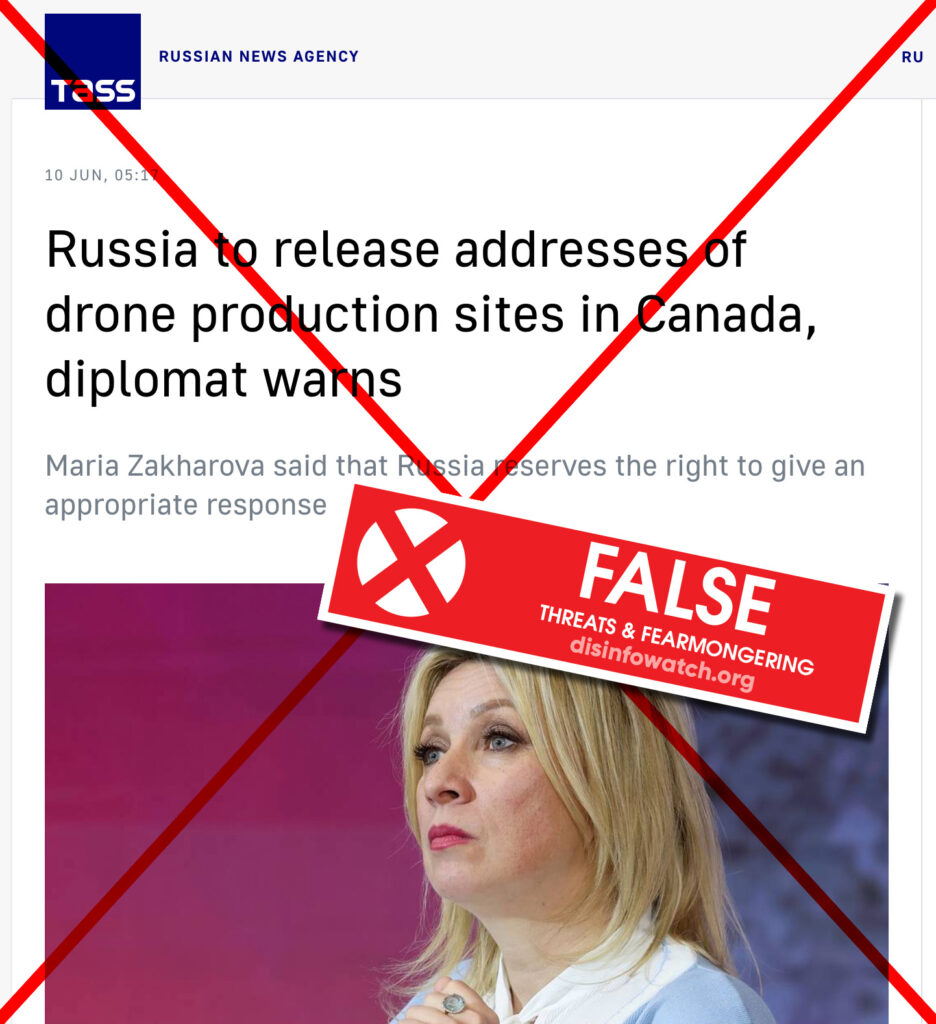
Russian state media outlet TASS published a June 10 statement by Russian Foreign Ministry spokesperson Maria Zakharova targeting Canada over a recently announced Canada-Ukraine drone production arrangement. The statement uses a factual Canadian defence announcement as the basis for a broader intimidation and disinformation narrative aimed at portraying Canada as a direct participant in the war, delegitimizing Ukraine, and warning Canadian companies and communities that they may become targets of Russian pressure.
The most serious element of the statement is Zakharova’s threat that Russia will publish the addresses of Canadian production sites connected to the project. Framed by TASS as an act of public “information,” the threat functions as intimidation against Canadian defence firms, workers, investors, local communities and government partners.
Factual Basis
Canada’s Department of National Defence announced that Canada and Ukraine had signed an arrangement to support the production of Ukrainian uncrewed aerial systems in Canada. The arrangement establishes a partnership between Ukrainian company Airlogix and Canadian manufacturer Sentinel Research and Development. According to the Canadian government, the purpose is to manufacture Ukrainian drone systems in Canada for the Armed Forces of Ukraine and to support Ukraine’s defence against Russian aggression.
These facts are real. The disinformation lies in how Russian officials and TASS frame them.
Claim vs. Fact Assessment
Claim 1: Canada has reached a “brand-new level of involvement” in the war.
Assessment: Misleading framing.
Canada has expanded defence-industrial cooperation with Ukraine. However, TASS presents this as proof that Canada is becoming a direct belligerent. This is a Kremlin narrative designed to deter allied support for Ukraine by suggesting that any military assistance makes supporting countries legitimate targets for Russian retaliation.
Fact: Canada is supporting Ukraine’s defence against Russia’s invasion. Russia remains the aggressor state.
Claim 2: Canada is a “warmonger” that is “fueling” the conflict.
Assessment: Disinformation by inversion.
This reverses responsibility for the war. Russia launched the full-scale invasion of Ukraine and continues to occupy Ukrainian territory. Canada’s support for Ukraine is framed by Moscow as aggression in order to obscure Russia’s responsibility for the war.
Fact: Canada’s drone production arrangement is presented by Ottawa as support for Ukraine’s defence and as part of Canada’s broader security partnership with Ukraine.
Claim 3: Ukraine is the “Kiev regime.”
Assessment: Delegitimizing propaganda language.
The phrase “Kiev regime” is standard Kremlin terminology used to deny the legitimacy and sovereignty of Ukraine’s elected government. It is not neutral language. It supports the broader Russian narrative that Ukraine is not an independent democratic state, but a Western-controlled proxy.
Fact: Ukraine is a sovereign state defending itself against Russian aggression.
Claim 4: Canada will produce weapons “for profit.”
Assessment: Misleading and selective.
The Canadian government announcement does note that the project will support Canadian manufacturing capacity, jobs and defence-industrial resilience. TASS reframes this as profiteering from war while ignoring Ukraine’s defence needs and the cause of the conflict: Russia’s invasion.
Fact: Defence firms may be commercially involved, but the stated purpose of the project is to accelerate delivery of critical equipment to Ukraine and strengthen Canadian defence capacity.
Claim 5: Ukraine will “hide a strategic arsenal” in Canada.
Assessment: Unsupported and conspiratorial.
The Canadian announcement describes manufacturing Ukrainian drone systems in Canada for delivery to the Armed Forces of Ukraine. It does not describe a hidden arsenal or secret Ukrainian weapons stockpile in Canada.
Fact: TASS provides no evidence that Ukraine is “hiding” a strategic arsenal in Canada.
Claim 6: Canada is “allegedly not a party to the conflict.”
Assessment: Legal and political distortion.
This phrase implies that Canada’s support for Ukraine makes it a party to the war. That is a Russian political claim, not an established fact. The Kremlin has consistently tried to portray Ukraine’s allies as direct participants in order to justify escalation and intimidate Western governments.
Fact: Supporting Ukraine’s self-defence does not erase Russia’s role as the invading state.
Claim 7: Canadian-produced drones will be used for “terrorist attacks” and “to kill Russians.”
Assessment: Central disinformation claim.
This is the core emotional manipulation in the TASS article. It collapses Ukraine’s military defence into “terrorism,” removes the context of Russian aggression, and casts Ukrainian resistance as illegitimate violence. It also frames Canada as morally responsible for “terrorism” rather than as a state supporting an ally under attack.
Fact: Canada says the systems are for Ukraine’s Armed Forces. TASS provides no evidence that Canadian-produced drones are intended for terrorism.
Claim 8: Russia will publish the addresses of production sites in Canada.
Assessment: Threat and intimidation tactic.
This is the most significant escalation in the statement. Publishing or threatening to publish production-site addresses is not normal diplomatic criticism. In the context of Russian state rhetoric and military threats, it may expose Canadian companies, workers and communities to harassment, cyber activity, surveillance, intimidation or hostile influence activity.
Fact: Zakharova explicitly stated that Russia would make the addresses of Canadian production sites public and factor the arrangement into Russian military and political planning.
Disinformation Techniques Used
Accusation inversion: Russia blames Canada for “fueling” a war that Russia started.
Delegitimization: Ukraine is described as the “Kiev regime,” denying its sovereignty and democratic legitimacy.
Threat amplification: The statement warns that Russia will publish Canadian production-site addresses.
Emotional framing: The use of “terrorist attacks” and “kill Russians” is designed to provoke fear, anger and moral confusion.
Deterrence messaging: The objective is to make Canadian political leaders, companies and communities think twice before supporting Ukraine.
Factual laundering: A real Canadian government announcement is used as the factual seed for a broader propaganda narrative.
Likely Objectives
The TASS/Zakharova statement appears designed to:
- Intimidate Canadian defence firms and workers involved in Ukraine-related production.
- Portray Canada as a direct participant in the war.
- Undermine Canadian public support for Ukraine.
- Reinforce the Kremlin’s domestic narrative that Russia is fighting NATO rather than Ukraine.
- Create reputational, insurance, cyber and physical-security pressure on Canadian industry.
- Signal to other Ukraine-supporting states that deeper defence-industrial cooperation may trigger Russian threats.