
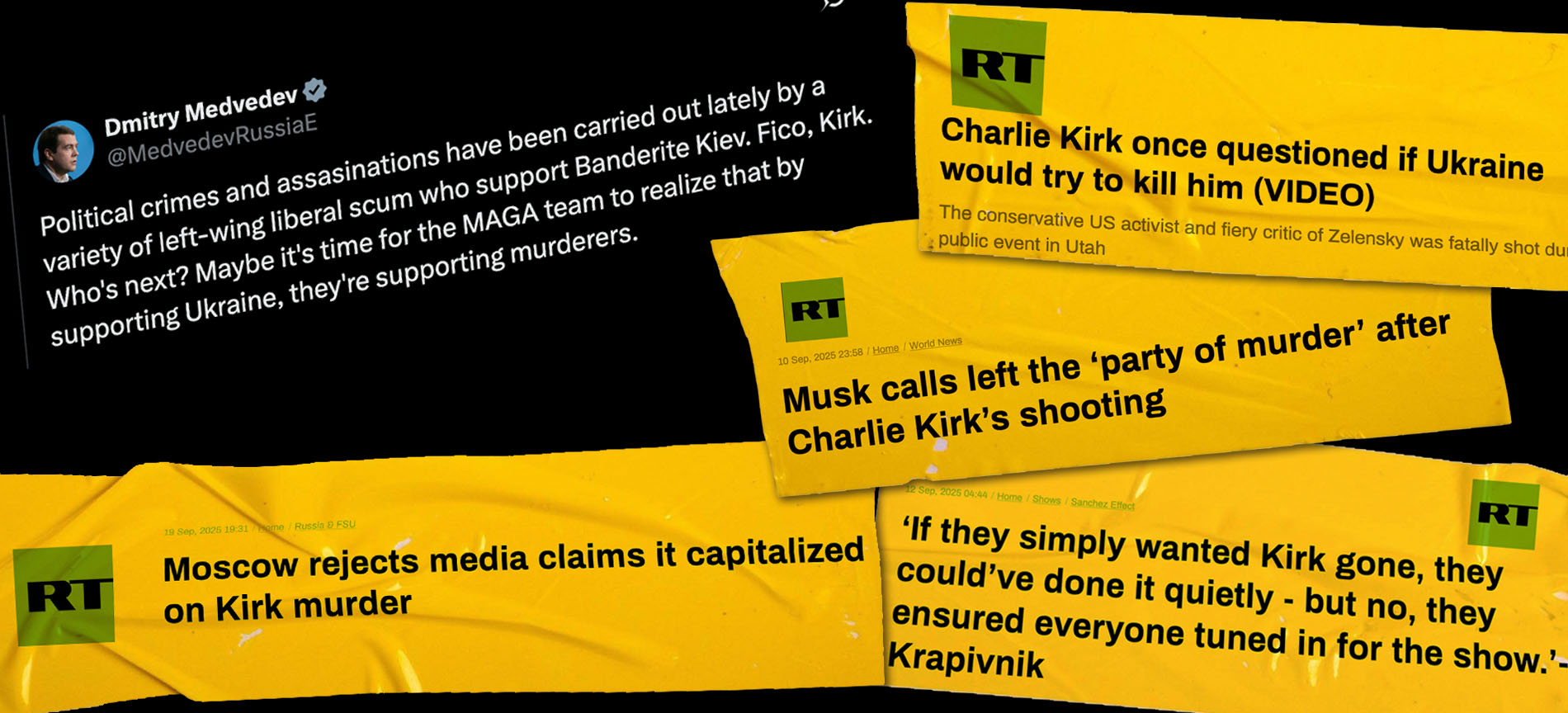
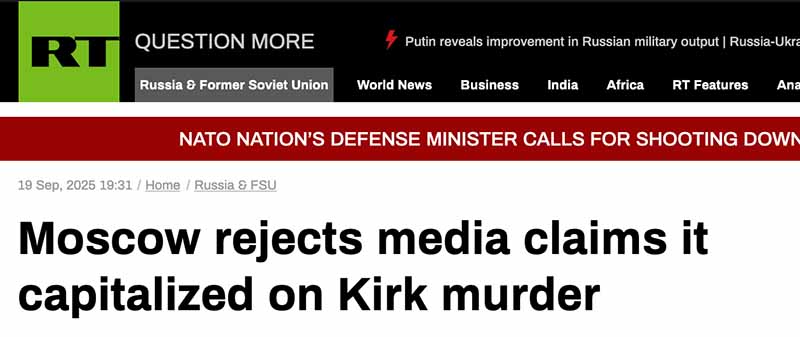
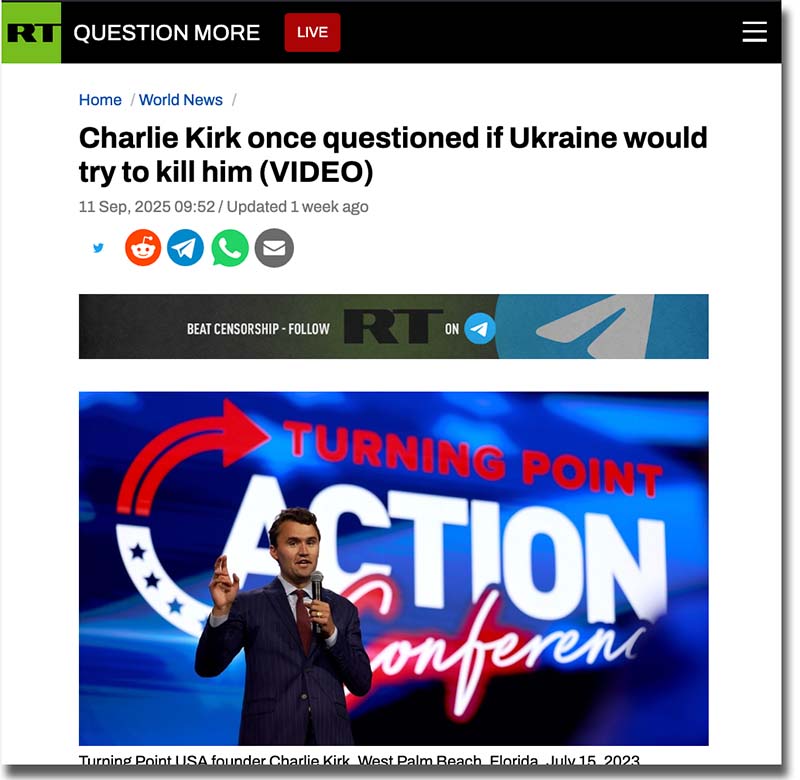
In a recent article, RT has rejected “U.S. media claims” that Russia capitalized on Charlie Kirk’s murder, characterizing such reporting as “anti-Russian hysteria”; Russia’s U.S. embassy likewise denies bot-driven disinformation.
RT’s rebuttal denies documented activity by Russian state media and aligned networks that amplified divisive, false, and conspiratorial narratives after Kirk’s killing. Multiple independent outlets and researchers detail Russian (and Chinese/Iranian) exploitation of the event to inflame U.S. polarization—contradicting RT’s denial. Given RT’s status as a sanctioned/blocked propaganda arm in the EU, this reads as a classic “deny and deflect” information operation.
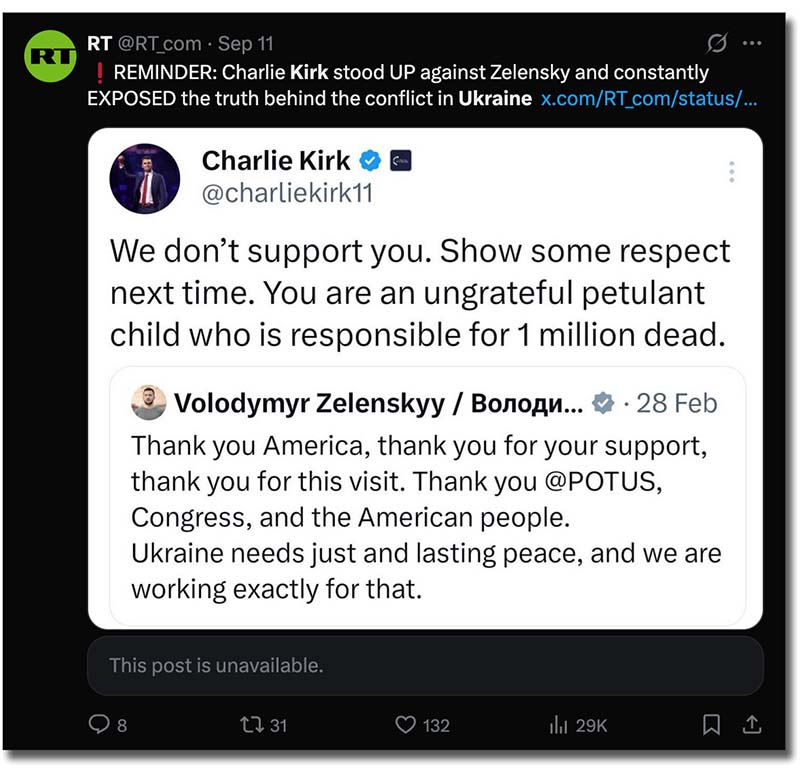
Russian state media’s treatment of the Kirk murder was heavily shaped by political opportunism and ideological framing. RT adopted a grievance-driven, culture-war tone, presenting the killing as an “assault on free speech” while repeatedly invoking identity-focused angles—such as labeling Kirk’s partner in ways designed to inflame social divisions—and amplifying stories of backlash, firings, and partisan disputes. RT’s Twitter account aggressively reminded its followers and Twitter users of Charlie Kirk’s opposition against Ukraine.
It showcased voices like Alexander Dugin to fold the event into a sweeping narrative of Western “liberal globalists” and looming civil conflict, and even published material explicitly rejecting claims that Moscow was exploiting the murder, despite simultaneously using it as fodder for conspiracy-tinged narratives. Sputnik packaged its coverage in terse, wire-style updates on arrests, charges, and Kremlin statements, but embedded these in a pro-Kremlin framing: emphasizing U.S. “polarization,” stressing Kirk’s alignment with Donald Trump and opposition to aid for Ukraine, and floating speculative “security-state” questions about whether the murder suggested a larger plot.
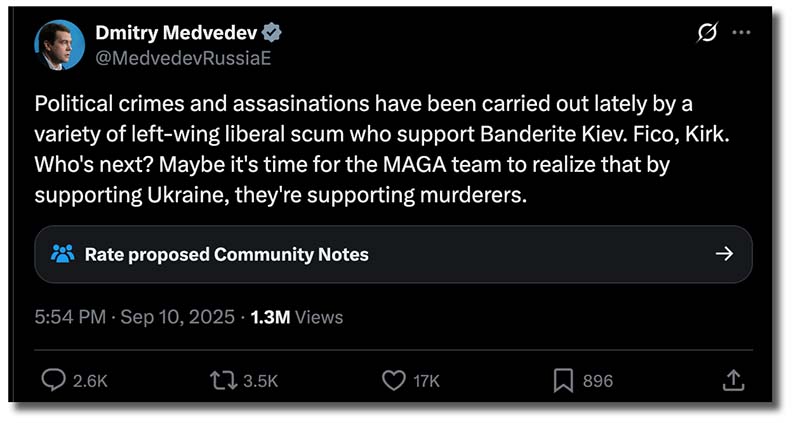
In some cases, RT headlines focused on exploiting or injecting conspiracy theories into the information space – including suggestions that Ukraine may have been behind the assasination. Prominent Russian political figures, such as former President Dmitry Medvedev quickly exploited the murder, blaming “left-wing liberal scum who support Banderite Kiev.”
 THE FACTS
- Independent reporting documents Russian exploitation. AP, Politico, and The Washington Post report Russian state outlets (RT/Sputnik) and aligned accounts amplified conspiracies (e.g., blaming Ukraine), tagged U.S. influencers, and pushed polarizing frames—joined by PRC- and Iran-linked operators. According to Politico, “Mentions of Charlie Kirk appeared more than 6,000 times across official media in China, Russia and Iran between Sept. 10-17.”
- Volume & vectors. Researchers tracked spikes across Russian, Chinese, and Iranian state media and social proxies following the killing, consistent with known playbooks.
- Official/record context. RT, Sputnik and all other Russian state controlled media are formally restricted/sanctioned in Canada and The EU as a state propaganda channel due to disinformation activities; its denials deserve high skepticism.
Such denials are part of a broader Kremlin pattern. When accused of disinformation around emotive events, Kremlin outlets issue categorical denials and accuse critics of “Russophobia,” while sister outlets and proxies continue amplification. Similar denial cycles documented since 2022 amid EU restrictions on RT/Sputnik.