
Hungarian Prime Minister Viktor Orbán’s Secretary of State for International Communication and international spokesman, Zoltán Kovács, is manipulating and misrepresenting the facts of a 2021 lawsuit brought by sanctioned Russian oligarch Roman Abramovich against British author and Washington Post columnist Catherine Belton and her publisher, HarperCollins, over her landmark book Putin’s People. The case was widely viewed as a politically motivated effort to intimidate Belton and undermine one of the most authoritative examinations of Putin’s regime.
Kovács is now weaponizing that settled case to discredit Belton and her reporting on Hungary’s upcoming election. His post is misleading not because the Abramovich-Belton lawsuit is fictional, but because he is deploying it as a selective credibility attack against a separate 2026 Washington Post investigation into Hungary and Russia.
The move aligns with a broader pro-government Hungarian narrative that recasts scrutiny of Russian influence as a “Russia hoax” or a foreign-media smear.
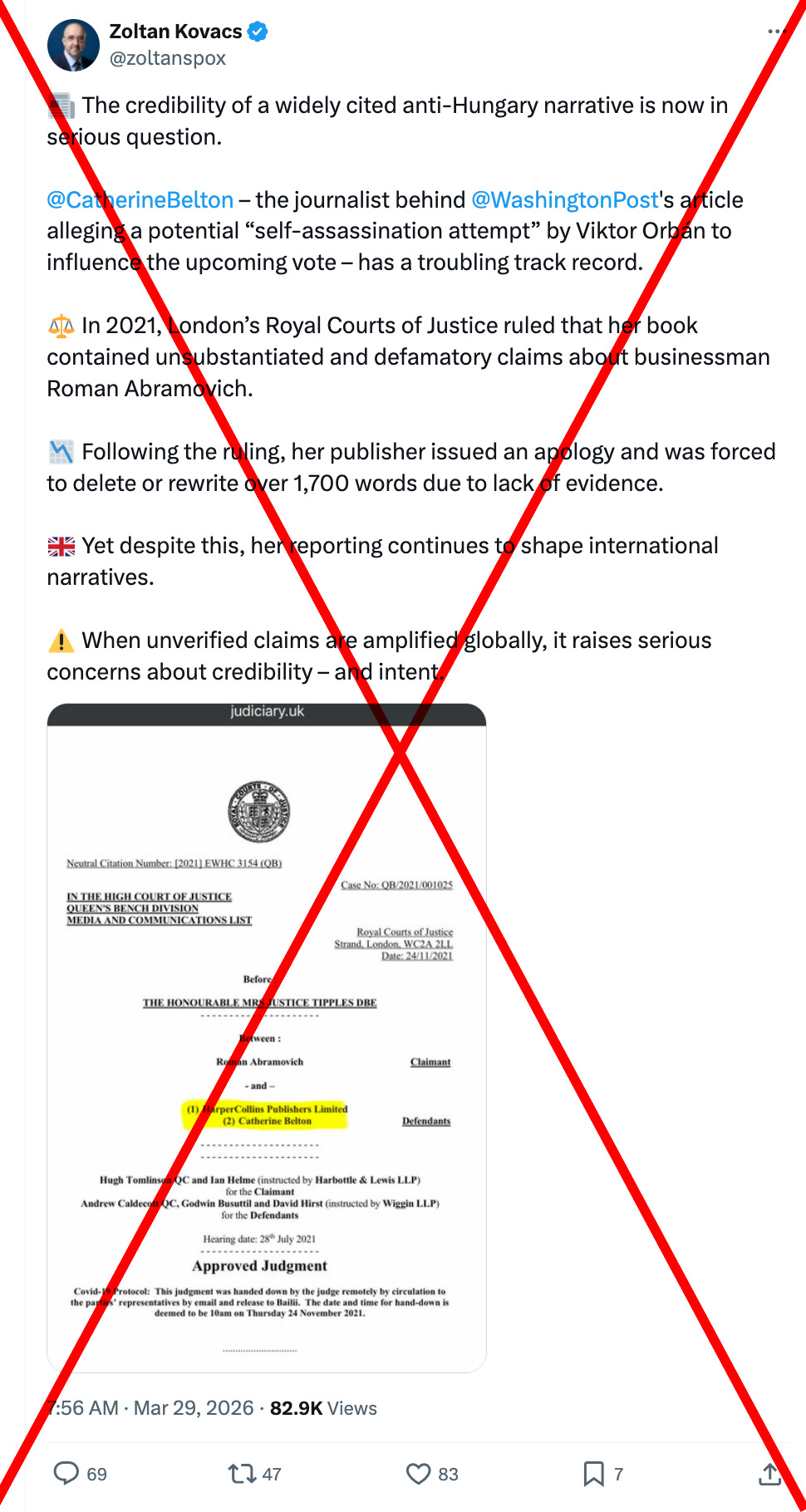
THE CLAIM:
Kovács’s post argues that “the credibility of a widely cited anti-Hungary narrative is now in serious question,” tying Catherine Belton’s current Washington Post reporting to the 2021 UK court dispute over passages in Putin’s People about Roman Abramovich. The implication is that Belton’s current Hungary-related reporting should therefore be discounted.
THE FACTS:
- The 2021 Abramovich SLAPP suit did not “disprove” anything.
Justice Tipples issued a preliminary ruling on legal meaning in November 2021; then Abramovich settled in December 2021. The UK Anti-SLAPP Coalition notes that no damages were awarded, only minor amendments were made, and the main thrust of the challenged claims remained in the book. - Abramovich’s ties to Putin were not erased.
In 2022, the EU’s official sanctions record still described Abramovich as having “long and close ties” to Vladimir Putin and “privileged access” to him. - The newer Hungary/Russia story has generated serious follow-up, not just a single isolated hit piece.
AP reported that the European Commission sought clarification from Hungary after the Washington Post allegations; Reuters reported long-running regional suspicions.
NARRATIVE CONTEXT & STRATEGIC OBJECTIVE:
This is a familiar attack-the-messenger play: shift attention from the substance of alleged Hungary-Russia contacts to the supposed unreliability or political motives of the journalist. In this case, it serves Orbán’s election-period need to recast damaging Russia-related reporting as a foreign smear campaign. Even without proving direct Kremlin authorship, that framing plainly benefits Moscow by muddying scrutiny of alleged Russian influence and by normalizing the idea that any reporting on Russian links is just another “hoax.”