
In a video posted to YouTube and viewed 230,000 times, American political influencer Benny Johnson focuses on and openly encourages Alberta separatism, portraying the breakup of Canada as a victory and even joking about the United States taking Alberta “by force.” Johnson has 6.1 million subscribers on YouTube and 525,000 followers on Rumble. The same video, posted to Twitter/X, has been viewed 137,600 times. Johnson has posted similar videos to YouTube over the past
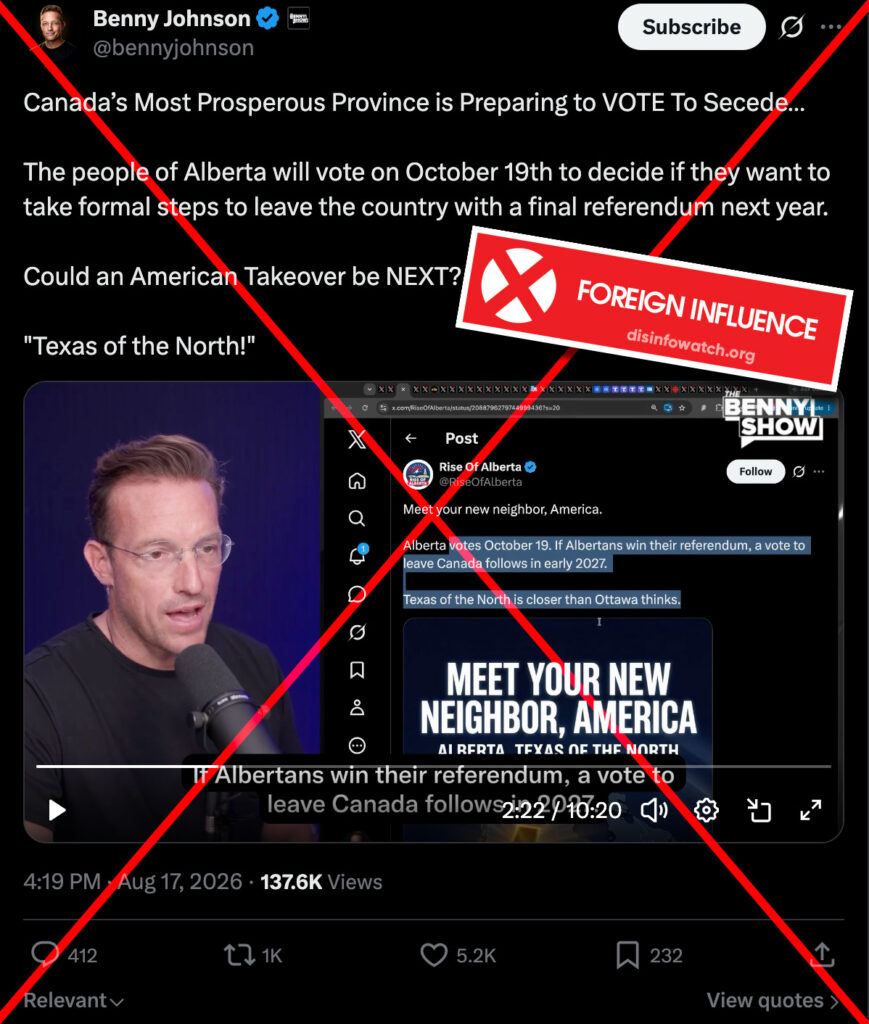
His segment combines genuine political developments in Canada, using Twitter/X based content published by Alberta Separatist groups with false and misleading claims about the October 19 referendum and Canadian constitutional law. It represents a clear example of overt U.S.-based influence around a sensitive Canadian national-unity debate, although it does not establish coordination with the U.S. government.
Johnson’s segment goes far beyond reasonable commentary. He tells viewers that Canadians should want to leave the country, describes Alberta separation as a “genius move,” urges separatists to “break away,” and concludes: “Full support… this is how we win.”
Johnson declares that the province “should be American” and asks: “Why wouldn’t we take it by force?”
He adds that Alberta can join the United States “the peaceful way” or Americans could “just take it.”
The comments normalize Alberta’s independence and American acquisition of Canadian territory during an active national-unity debate.
Who is Benny Johnson?
Johnson is closely connected to the MAGA and broader pro-Trump political ecosystem. He is an official contributor to Turning Point USA. His own biography similarly identifies him as a TPUSA contributor and a regular presence at the organization’s events.
Johnson’s role in this information environment is additionally notable because he is alleged to have previously produced content for Tenet Media. In 2024, U.S. prosecutors alleged that two employees of Russian state broadcaster RT covertly funnelled nearly US$10 million into the Tennessee-based media company to publish content advancing Russian interests. Johnson was among Tenet’s prominent contributors. Reporting and the indictment indicated the influencers were not told the true source of the funding, and Johnson claimed that he had been deceived.
The indictment alleges that two RT employees directed the production of content by influencers who were part of the Tenet Media, network, which included two Canadians.
There is no evidence that Johnson’s current Alberta segment is Russian-financed or directed. The Tenet case is nevertheless relevant because it demonstrated how established American influencers might be used to amplify divisive narratives.
Misrepresenting the October referendum
In the video, Johnson repeatedly suggests Alberta is already voting to secede, telling viewers that the province is “voting to begin the process of seceding Canada on October 19th.”
That is misleading. The October 19 question is explicitly preliminary. Albertans will choose whether to remain in Canada or instruct their government to commence the constitutional process necessary to hold a future binding referendum on separation.
Johnson also falsely claims that the House of Commons has confirmed “50 plus one” is enough “for all of Alberta to secede.” Canada’s Clarity Act establishes no automatic 50-per-cent-plus-one threshold. Parliament must assess whether a referendum produces a clear majority, considering the size of the majority, turnout and other circumstances. A province also cannot secede unilaterally; lawful separation would require constitutional negotiations and amendment.
Amplifying Alberta grievance narratives
The segment embeds legitimate Alberta grievances inside a broader narrative of Canadian collapse and oppression. Johnson portrays Alberta as economically exploited by Ottawa, claims Canada is being “invaded” and “destroyed,” and suggests Canadians are imprisoned for driving trucks or “misgendering.”
He also dismisses polling showing independence trailing by speculating that voters secretly hold more radical views than they admit. Viral posts, independence signs and social-media engagement are instead offered as evidence of a growing movement.
The segment also amplifies comments by U.S. Treasury Secretary Scott Bessent, who publicly called Alberta a “natural partner for the U.S.” and said, “I think we should let them come down into the U.S.” Such comments by a senior U.S. official constitute significant foreign political amplification, but they do not establish that Washington is directing Alberta separatism.
Past Content Targeting Alberta and Canada
Canada has been targeted in at least 6 other videos posted by Benny Johnson in the past year. The titles, links and number of views on YouTube, as of August 27, 2026 below:
Canada’s Most Prosperous Province Plans On Joining AMERICA, Senator From Alaska Confirms Succession
https://www.youtube.com/watch?v=y246PsSu2SE&pp=ygUVYmVubnkgam9obnNvbiBhbGJlcnRh
187,143 views 28 Jun 2026
🚨Alberta’s Leaders CONFIRMS Trump Administration SUPPORTS Independence From Canada
https://www.youtube.com/watch?v=Un_Buw_bhSg&pp=ygUVYmVubnkgam9obnNvbiBhbGJlcnRh
113,197 views 11 May 2026
🚨Obama CAUGHT On-Camera Committing ILLEGAL Act in Canada Against The USA
https://www.youtube.com/watch?v=eU7J-yAg3bI&pp=ygUVYmVubnkgam9obnNvbiBhbGJlcnRh
326,631 views 9 May 2026
🚨IT’S OFFICIAL: Canada’s Most Prosperous Province Just Voted To Secede!
https://www.youtube.com/watch?v=MeCBDBBDrfc&pp=ygUVYmVubnkgam9obnNvbiBhbGJlcnRh
337,349 views 9 May 2026
Canada’s Most Prosperous Province Votes For INDEPENDENCE! 10,000 Patriots FLOOD Streets to Join USA?
https://www.youtube.com/watch?v=3PUrMKCLSYY&pp=ygUVYmVubnkgam9obnNvbiBhbGJlcnRh
388,383 views 18 Jan 2026
Assessment
Johnson does not create Alberta’s grievances or separatist movement. He amplifies and intensifies them, strips away context, adds false or exaggerated claims, and reframes Alberta independence as part of a wider U.S. MAGA political struggle.
Johnson tells his viewers that Alberta’s separation is “how we win.” This transforms the video from a simple observation of Canadian politics into advocacy and and effort to actively inject his voice into Canada’s national-unity debate.