

A U.S. political commentator, and former Fox News host, Trish Regan, is promoting the idea that Alberta could leave Canada and join the United States while misrepresenting key facts about Alberta’s October 19 referendum and presenting a series of hypothetical benefits of separation as plausible outcomes.
The Trish Regan Show has 1.33 million subscribers on YouTube and 252k followers on Rumble.
In a September 18 episode of The Trish Regan Show, titled “Trump To Offer ALBERTA Statehood As Canada FLEES To the EU for ‘Protection’?!”, host Trish Regan suggests that Alberta could become an American “associate state” or even the “51st state.” The episode describes closer Canada-EU relations as a potential justification for Washington to develop a competing relationship with Alberta. The YouTube video had 130k views over the first 48 hours that it was posted.
The segment represents a example of overt U.S.-based amplification of Alberta separatism during an active referendum campaign. It also contains several false, misleading or unsupported claims about the referendum, Alberta public opinion and the consequences of independence.
Misrepresenting the October 19 referendum
The most consequential distortion is Regan’s repeated description of the October 19 vote as a “secession vote.”
Regan tells viewers that Alberta is “itching to leave Canada” and says Premier Danielle Smith has arranged for Albertans to have “that secession vote” in October. She later says Alberta will vote on whether to “advance its secession talks.”
This is misleading.
The October 19 referendum does not ask Albertans whether Alberta should separate from Canada. Elections Alberta states explicitly that the result of Question 10 is non-binding. Voters will choose whether to to commence the legal process required to hold a future referendum on separation.
Presenting the October vote simply as a “secession vote” removes this critical distinction and may leave audiences with the impression that Albertans will be voting directly on independence.
Overstating support for independence
Regan also characterizes Alberta as broadly “itching to leave Canada.”
Available polling does not support that description.
An August Angus Reid Institute survey found that 61 per cent of Alberta respondents intended to choose the option to remain in Canada, while 33 per cent favoured beginning the process toward a future binding referendum. When respondents were asked directly how they would vote in a hypothetical separation referendum, support for leaving Canada fell to 30 per cent, compared with 65 per cent for remaining. The survey was conducted August 10–13 among 1,017 Alberta adults.
The distinction matters because the online information environment presents a very different picture. Research published September 10 by the Media Ecosystem Observatory found that pro-independence voices receive approximately 80 per cent of the engagement among the most influential referendum-related accounts, even though polling shows substantially greater support for remaining in Canada.
From referendum to U.S. statehood
Regan moves quickly from the referendum to the prospect of Alberta joining the United States:
“If it leaves Canada, it’s going to join the US, maybe as an associate state.”
She proposes that Washington create an “associate state” relationship with Alberta and repeatedly suggests Alberta could become an American “51st state.”
No evidence is provided that either arrangement is under consideration by the U.S. government.
The segment further presents a hypothetical U.S.-Alberta relationship as providing Alberta with “guaranteed access” to the American market, “zero tariffs,” U.S. protection and easier energy regulation.
Those outcomes are speculative. They would depend on major political, constitutional and trade negotiations and are not consequences of either the October referendum or Alberta independence.
Existing U.S. amplification
Regan’s comments do not emerge in isolation.
U.S. Treasury Secretary Scott Bessent publicly described an independent Alberta in January as a “natural partner” for the United States, citing Alberta’s energy resources. His intervention represented one of the most prominent expressions of support for Alberta separatism by a senior Trump administration official.
However, U.S. Ambassador to Canada Pete Hoekstra subsequently said the Trump administration was not strategizing with Alberta separatists and indicated that Washington did not intend to advocate for either side during the referendum campaign.
This distinction is important. There is evidence of overt American political and media amplification of Alberta separatism, but public evidence does not currently establish a covert or coordinated U.S. government campaign.
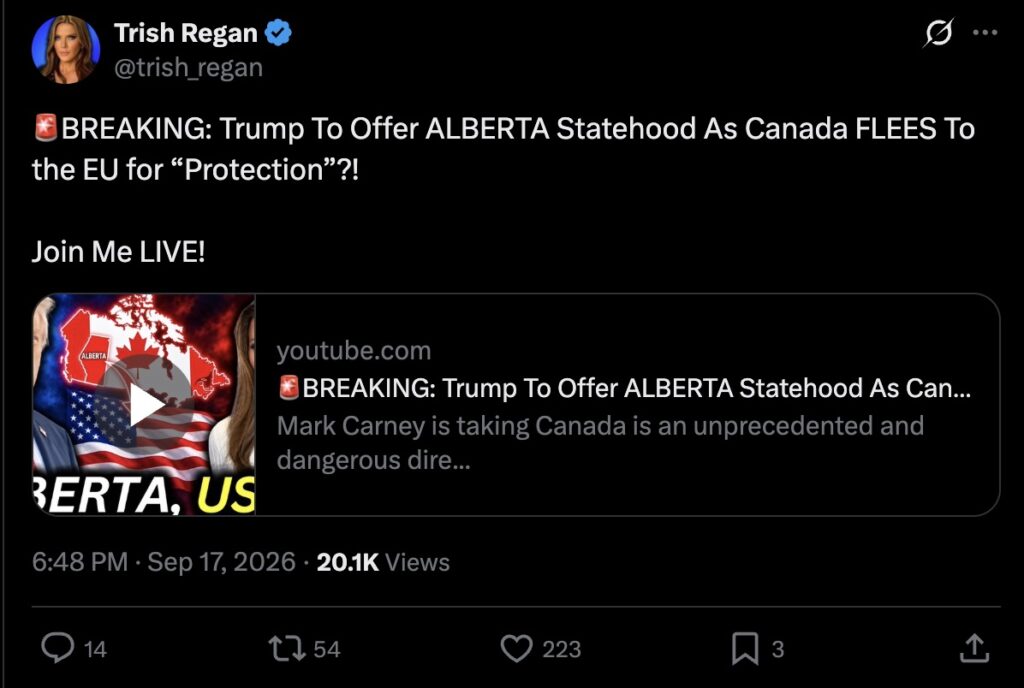
X post
Economic claims mixed with exaggeration
Some of the economic claims in Regan’s segment are broadly grounded in Alberta’s genuine importance as an energy producer. However, the segment uses those facts to support much more speculative political conclusions.
Regan initially says Alberta produces approximately four million barrels of oil per day — broadly consistent with actual production levels — but elsewhere says Alberta is producing “four billion barrels a day.”
That number is false by roughly three orders of magnitude and appears likely to be a verbal error rather than a deliberate fabrication. The broader rhetorical effect, however, is to reinforce the claim that Alberta possesses sufficient economic strength to prosper independently.
Narrative techniques
The segment combines several recognizable influence and information-manipulation techniques:
- Referendum distortion: presenting a non-binding vote about beginning a future constitutional process as a direct “secession vote.”
- Majority illusion: depicting Alberta as eager to leave Canada despite polling showing substantially greater support for remaining.
- Normalization: repeatedly presenting Alberta joining the United States as a credible and increasingly plausible outcome.
- Hypothetical rewards: linking independence to zero tariffs, guaranteed market access, American protection and deregulation without evidence those outcomes have been offered.
- Economic grievance amplification: using Alberta’s resource wealth to suggest the province is disadvantaged by remaining within Canada.
- False equivalence: comparing an undefined Canada-EU association proposal with the invented concept of an Alberta-U.S. “associate state.”
Assessment
The Trish Regan segment is best characterized as overt U.S.-based political influence and amplification related to Alberta’s October referendum.
It does not simply report on the independence movement. It explicitly advocates a future U.S.-Alberta relationship and presents Alberta joining the United States as both desirable and plausible.
The segment also contains clear misinformation and misleading framing, most importantly its characterization of the October 19 referendum as a “secession vote,” its exaggeration of public support for independence, and its presentation of speculative U.S. economic and security benefits as realistic consequences of Alberta leaving Canada.
There is currently no evidence that Regan is acting at the direction of the U.S. government or that this particular content forms part of a coordinated foreign influence operation. The significance of the segment lies instead in its contribution to a growing U.S.-based information ecosystem that legitimizes and amplifies Alberta separatist narratives during an active Canadian referendum campaign.
This narrative should be monitored for repetition by U.S. political figures, influencers and media outlets, and for subsequent amplification by Canadian accounts, particularly where the October referendum is falsely portrayed as a direct vote on independence.