
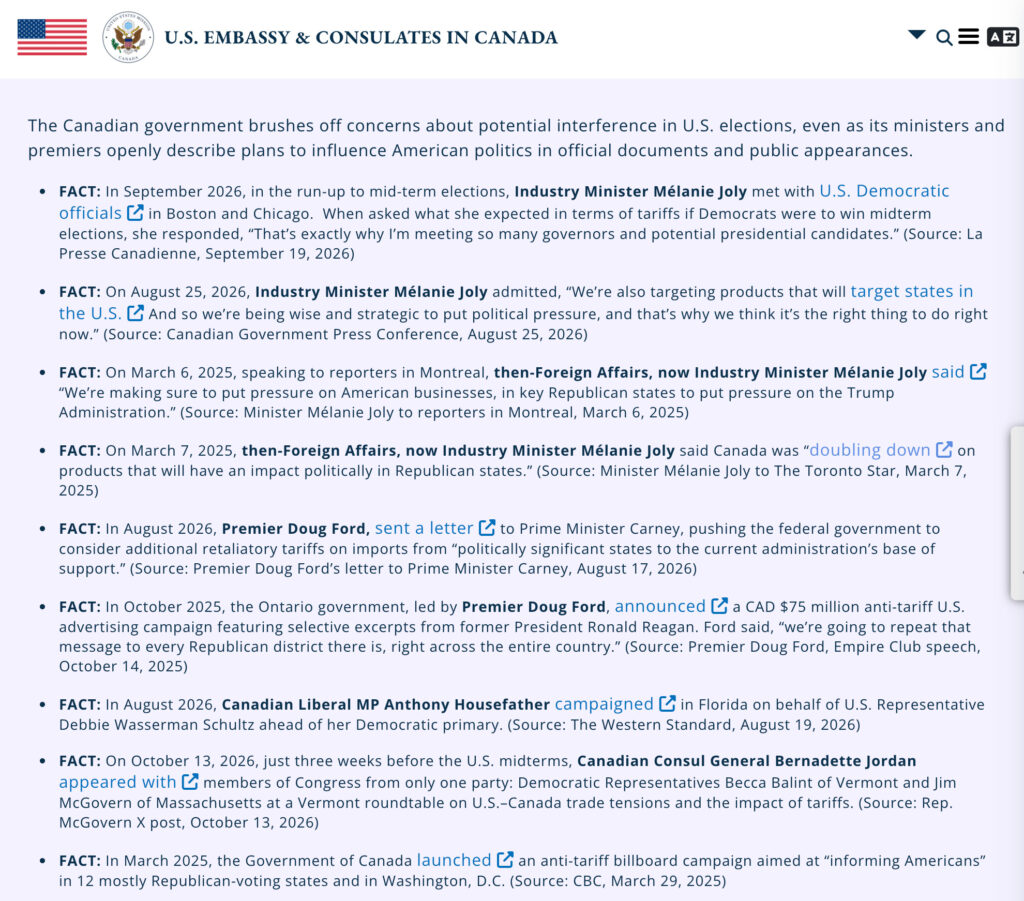
A US Embassy fact sheet published on October 21 presents Canadian trade advocacy, meetings with Democratic officials, alleged personal campaign activity and individual voting offences as grounds for concern about interference in US elections. Its evidence supports a narrower conclusion: Canadian officials have openly sought to influence American trade policy. The document does not establish a coordinated Canadian government sponsored or controlled operation to manipulate any elections in the United States of America.
The Claim
The fact sheet suggests that Canadian assurances of electoral non-interference conflict with officials’ public conduct. It lists nine examples involving tariffs, advertising, political meetings and alleged personal campaigning, then names eleven Canadians reportedly charged or sentenced for illegal voting. It concludes with a sweeping instruction that Canadians should avoid participating in or influencing US elections in any way.
The Facts
Trade advocacy
Three entries quote Mélanie Joly describing politically targeted tariffs, including pressure on businesses in Republican states. A fourth cites Doug Ford’s August 2026 request for retaliation against imports from politically significant states. These statements, as reproduced by the embassy, acknowledge an intention to generate political advocacy and pressure. They do not independently establish an electoral operation or an election-law violation. Public economic pressure can have electoral consequences; that possibility is not evidence of its purpose or legality.
Political meetings:
The embassy cites Joly’s September meetings with Democratic officials and her remarks about future candidates, alongside an October trade roundtable involving Consul General Bernadette Jordan and two Democratic representatives. The first example raises a reasonable question about partisan calculation. Neither entry supplies evidence of campaign coordination, concealed funding or a specific electoral offence. The party affiliation of meeting participants and proximity to voting are insufficient on their own.
Advertising:
Two entries concern Ontario’s 2025 Reagan advertisement campaign and federal anti-tariff billboards. The embassy describes Ontario’s use of Reagan excerpts as selective, but does not provide the full speech or advertisement for comparison. Public advertising can influence attitudes toward an administration. Assessing whether particular advertisements crossed an electoral or legal boundary requires their content, targeting, funding arrangements and the applicable rules. The fact sheet does not provide any of that analysis.
Campaign activity:
The allegation that MP Anthony Housefather campaigned for Representative Debbie Wasserman Schultz is the clearest candidate-specific example. However, the Federal Election Commission permits foreign nationals to provide uncompensated volunteer services, subject to restrictions. Foreign nationals cannot make prohibited election contributions or expenditures, or participate in election-related decision-making. The embassy does not establish the activity’s precise nature, compensation, financing or any official finding of a violation. Political judgment and legal wrongdoing require separate assessments.
Illegal voting:
The document says eleven Canadians were charged or sentenced in 2026 over voting in elections held between 2012 and 2024. It does not give each person’s procedural status or connect these cases to Canadian officials. Charges are allegations, while convictions establish guilt. Its claim that Canada ranks second in prosecutions lacks a defined comparison period and underlying dataset. Even verified individual offences would not establish Canadian government direction or a coordinated national campaign.
Narrative Context
The principal narrative is that Canada is a partisan electoral threat and that opposition to US tariffs is evidence of political misconduct. Repeated references to Republican states, Democratic politicians and the midterms encourage readers to view trade disputes through an electoral lens.
The main techniques deployed are conflation of different activities, selective context and an appeal to official authority. Repeated “FACT” labels lend certainty to individual entries without establishing the broader implication. The Canadian intelligence service distinguishes foreign interference from normal diplomacy and acceptable lobbying through features such as clandestinity, deception or threats. That distinction is useful analytically, although Canadian definitions do not determine US law.
Forecast
The allegation could be reused by partisan commentators to portray Canadian advocacy as an attack on American democracy, or to attribute electoral setbacks to foreign actors. In Canada, it could intensify debate about sovereignty and the bilateral relationship. These are prospective uses, not established plans. Further monitoring should distinguish repetitions of the accusation from reporting that challenges it, and track whether officials invoke the fact sheet to justify concrete measures.
Assessment
The fact sheet contains evidence of overt Canadian political advocacy over trade. It does not demonstrate the coordinated election-interference threat its arrangement implies. Its most consequential omission is the distinction between influencing policy, supporting a candidate within permitted rules, and committing an electoral offence.