
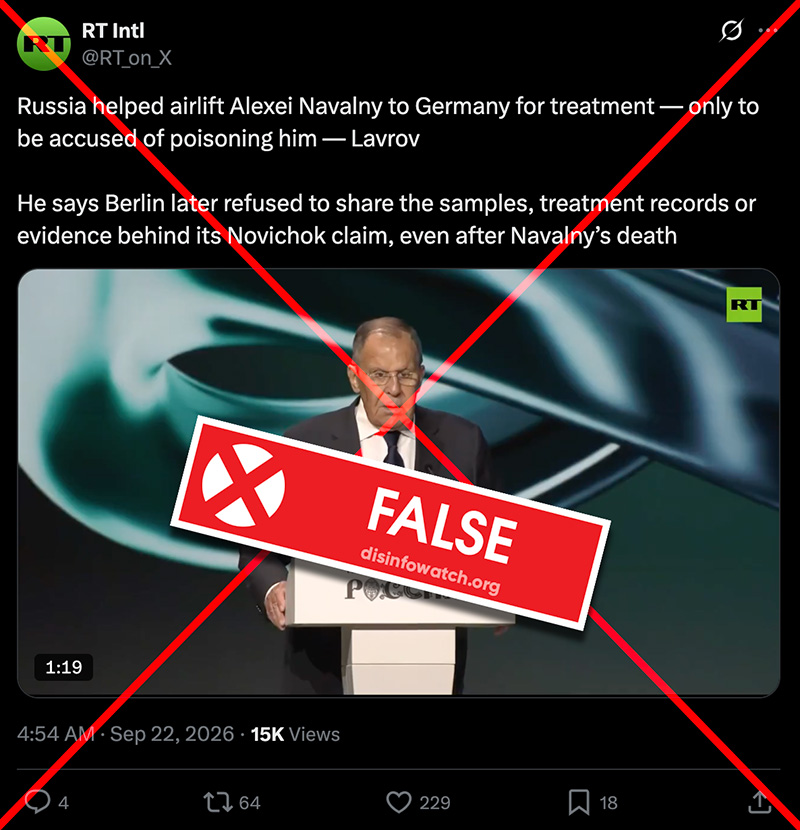
Russian state-controlled media outlet RT amplified comments by Russian Foreign Minister Sergei Lavrov suggesting that Germany failed to provide evidence supporting its conclusion that Russian opposition leader Alexei Navalny was poisoned with a Novichok nerve agent in August 2020.
RT posted: “Russia helped airlift Alexei Navalny to Germany for treatment — only to be accused of poisoning him — Lavrov”
The post further claims that Berlin subsequently “refused to share the samples, treatment records or evidence behind its Novichok claim, even after Navalny’s death.”
The framing is misleading. Russia permitted Navalny to leave the country, but only after significant international pressure. Russia did not organize his medical evacuation. More importantly, the finding that Navalny had been exposed to a Novichok-type nerve agent was independently confirmed by laboratories in Germany, France and Sweden and separately by laboratories designated by the Organisation for the Prohibition of Chemical Weapons (OPCW).
THE CLAIM
Claim 1: Russia “helped airlift” Navalny to Germany.
Assessment: False.
Navalny’s medical evacuation was organized privately by the German NGO Cinema for Peace, which sent a medically equipped aircraft to Omsk. Russian hospital authorities initially refused to authorize his transfer, saying he was medically unstable. After international pressure from Navalny’s family and supporters, the hospital reversed that decision and permitted him to leave.
The German government subsequently confirmed that the flight from Omsk to Berlin and Navalny’s admission to Berlin’s Charité hospital had been privately organized. Russia ultimately allowed the aircraft to depart, but describing this as Russia having “airlifted” or organized his evacuation significantly overstates Moscow’s role.
Claim 2: Germany failed to provide evidence supporting the Novichok finding.
Assessment: False and misleading.
Germany’s initial toxicological examination found evidence of a nerve agent from the Novichok group. Germany then requested independent examinations by laboratories in France and Sweden, which confirmed its findings.
Germany also referred the case to the OPCW. OPCW experts independently collected biomedical samples from Navalny and sent them to designated laboratories. Those laboratories confirmed biomarkers of a cholinesterase inhibitor with structural characteristics similar to chemicals from the Novichok family.
At Germany’s request, the OPCW circulated a summary of its findings to all Chemical Weapons Convention member states and made it public. Germany later noted that the OPCW’s classified technical report was accessible to every member state of the convention, including Russia.
The issue was therefore not simply Germany making an accusation while withholding the supporting evidence. Multiple laboratories operating independently of one another reproduced the central toxicological finding.
Claim 3: Berlin refused to provide samples and Navalny’s medical records to Russia.
Assessment: Contains an element of truth but omits important context.
Germany did not simply hand Navalny’s private medical records and biological samples to Russian authorities.
A Council of Europe investigation noted that Navalny himself declined to consent to the release of his medical data, including records and samples, while Russian authorities had not opened a full criminal investigation into his poisoning. Navalny and his wife did, however, cooperate with questions submitted by Russian investigators through German police.
At the same time, Germany transferred the chemical-weapons question into the established OPCW verification system, where independently collected samples were tested under international procedures.
Russia also possessed biological samples taken while Navalny was being treated in Omsk. German Foreign Minister Heiko Maas publicly questioned why Russia had not submitted those samples to its own specialized laboratory and why Russian authorities had not opened a criminal investigation.
In June 2023, the European Court of Human Rights unanimously found that Russia had failed to conduct an effective investigation into Navalny’s poisoning, violating the procedural component of the right to life under Article 2 of the European Convention on Human Rights.
Navalny’s Death
RT’s reference to Navalny’s death also risks conflating two separate events.
The Novichok incident occurred in August 2020. Navalny survived and later returned to Russia.
He died in a Russian penal colony in February 2024.
In February 2026, the governments of Germany, France, Sweden, the Netherlands and the United Kingdom announced that analyses of samples connected to Navalny’s death had detected the toxin epibatidine. They said poisoning was highly likely to have caused his death. This is separate from the Novichok poisoning documented in 2020.
Narrative Context
The RT post follows a longstanding Kremlin information strategy surrounding the Navalny poisoning: shift attention away from the toxicological evidence and toward alleged procedural inconsistencies by Germany, the OPCW or other Western governments.
The central implication — that Germany accused Russia of poisoning Navalny while refusing to produce evidence — is contradicted by the documented record.
By emphasizing disputes over access to particular medical files while omitting those independent findings, RT creates the impression that the poisoning allegation was unsupported or politically manufactured.