
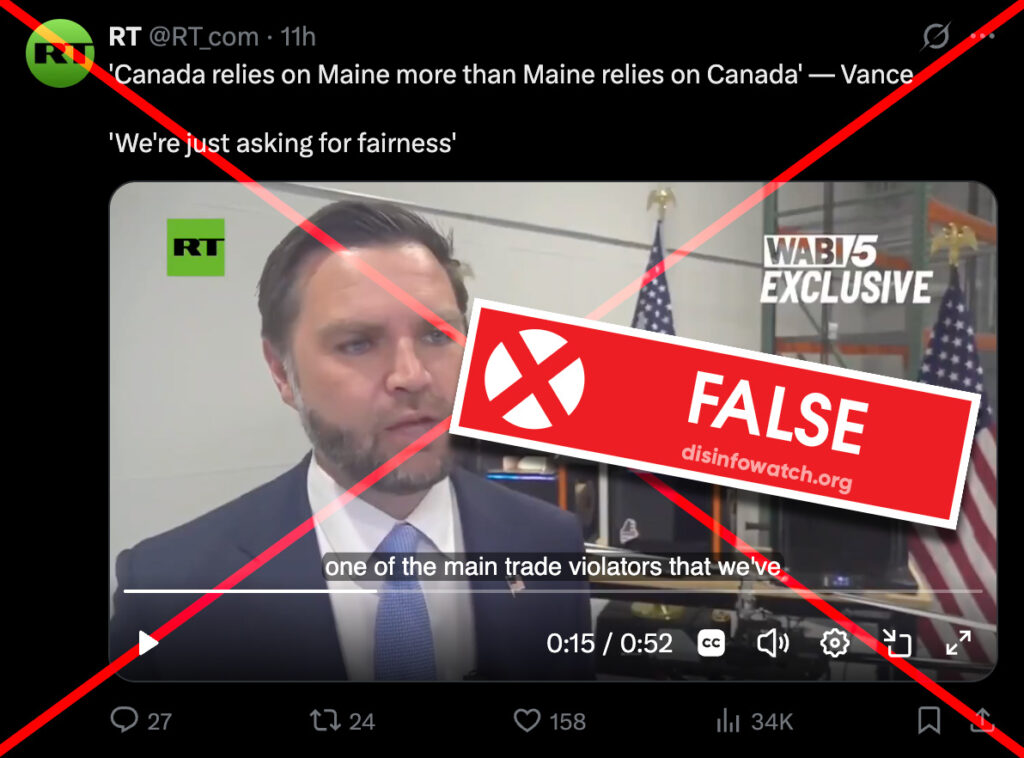
Russian state-controlled media outlet RT has repurposed and amplified remarks by U.S. Vice-President JD Vance falsely portraying Canada as one of the world’s leading “tariff” and “trade violators,” while claiming that Canada depends economically on the state of Maine more than Maine depends on Canada.
The video itself is authentic. Vance made the remarks during an August 24, 2026 visit to Brewer, Maine, where he was interviewed by local television station WABI.
The incident demonstrates how Russian state media can re-purpose authentic Western political content containing false or misleading claims and amplify it because it supports Kremlin information objectives.
In this case, the clip reinforces a narrative portraying Canada as an economically abusive and dependent neighbour, while depicting the United States as justified in using economic coercion against it.
Given the severe deterioration in Canada–U.S. relations, RT’s amplification is particularly useful for exploiting existing tensions and deepening mistrust and resentment between Canadians and Americans.
Claim vs. Fact
Canada is “one of the main tariff violators” anywhere in the world
There is no recognized international measurement under which Canada ranks among the world’s principal “tariff violators.”
The World Trade Organization reports that Canada’s simple average Most-Favoured-Nation applied tariff was 3.8% in 2025, while 77.8% of Canadian tariff lines were duty-free.
Those figures do not support the portrayal of Canada as one of the world’s most protectionist economies.
Canada does maintain high tariffs on some supply-managed agricultural goods, and the United States has raised legitimate complaints about specific Canadian trade practices. However, disputes involving particular sectors do not demonstrate that Canada is among the world’s leading tariff offenders.
The term “tariff violator” is itself misleading. Countries routinely impose tariffs permitted under their WTO commitments and free-trade agreements. The existence of a tariff does not, by itself, constitute a trade violation.
Vance provides no international ranking, WTO finding or other evidence demonstrating that Canada is one of the world’s leading tariff violators.
Claim 2: Canada is “one of the main trade violators” anywhere in the world
“Trade violator” is not a recognized WTO statistical category, and Vance provides no metric supporting the claim.
Canada and the United States have had numerous trade disputes under NAFTA, CUSMA/USMCA and WTO mechanisms. Both countries have challenged each other’s trade practices.
Those disputes do not establish that Canada ranks among the most serious trade violators globally.
The wording instead turns individual disagreements into a sweeping characterization of Canada as an unusually abusive trading partner.
Claim 3: Canada and China are essentially the only countries that retaliated against U.S. tariffs
Canada has mounted significant retaliatory responses to Trump administration tariffs, but they have not been alone.
The European Union, for example, announced and implemented countermeasures in response to U.S. steel and aluminum tariffs during the current Trump administration. Reuters reported in March 2025 that Canada and the EU were among major U.S. trading partners retaliating against tariffs already imposed by Washington.
Vance qualifies his statement with the word “really,” making it difficult to treat as a precise factual assertion.
More significantly, however, the statement places Canada -alongside China- as an economic adversary, reinforcing the Trump administrations impression that Canada has behaved unusually aggressively toward the United States.
Claim 4: Canadian retaliation demonstrates that Canada is a trade aggressor
Canada has imposed retaliatory tariffs on American products.
What Vance omits is the critical chronology: Canada’s measures were imposed in response to tariffs initiated by the United States.
The current escalation followed the U.S. imposing 50% tariffs on approximately $20 billion of Canadian goods after bilateral negotiations collapsed. Canada subsequently announced retaliatory measures.
This follows the broader pattern of the trade conflict since President Trump returned to office: Washington imposed new tariffs on Canadian products and Canada responded with counter-tariffs.
Vance therefore uses Canada’s reaction to U.S. tariffs as evidence that Canada itself is the offender.
This is an example of causal inversion: the initiating action is omitted while the response is presented as evidence of aggression.
Narrative Context and Likely Objectives
Exploit deteriorating Canada–U.S. relations
RT’s repurposing of the Vance interview appears designed to exploit one of the most significant fractures to emerge recently between two longstanding Western allies.
For American audiences, the message encourages the perception that:
- Canada takes advantage of the United States;
- Canada behaves like an economic adversary;
- Canada deserves punitive economic measures; and
- the bilateral relationship is fundamentally unequal.
For Canadian audiences, the same video can produce the opposite emotional response:
- the United States views Canada with contempt;
- Washington regards Canada as economically subordinate;
- senior U.S. officials are prepared to publicly denigrate Canada; and
- the traditional concept of the United States as Canada’s closest ally can no longer be trusted.
The same piece of content can therefore generate resentment on both sides of the border.
Deepen polarization between Canadians and Americans
The likely Russian information objective is not necessarily to convince audiences that every element of Vance’s argument is true.
It is to increase anger, mistrust and antagonism between Canadians and Americans.
This is consistent with documented Russian information operations.
The U.S. Department of Justice has stated that much of the content distributed through an alleged covert RT influence operation in the United States served the publicly stated goals of the Russian government and RT to amplify domestic divisions.
The U.S. State Department has similarly assessed that RT has moved beyond functioning simply as a media organization and is involved in information operations and covert influence activities targeting countries in Europe and North and South America.
The current Canada–U.S. dispute provides RT with an existing political fracture that requires little fabrication. Authentic statements from American political leaders can simply be selected, repackaged and amplified.
Undermine Western cohesion
The content also contributes to a broader Russian narrative portraying Western alliances as dysfunctional, transactional and collapsing under internal pressure.
Canada and the United States are NATO allies, NORAD partners and among the world’s most deeply integrated economies.
Content portraying them as economic adversaries serves a broader Kremlin interest in undermining confidence in Western political and security cohesion.