
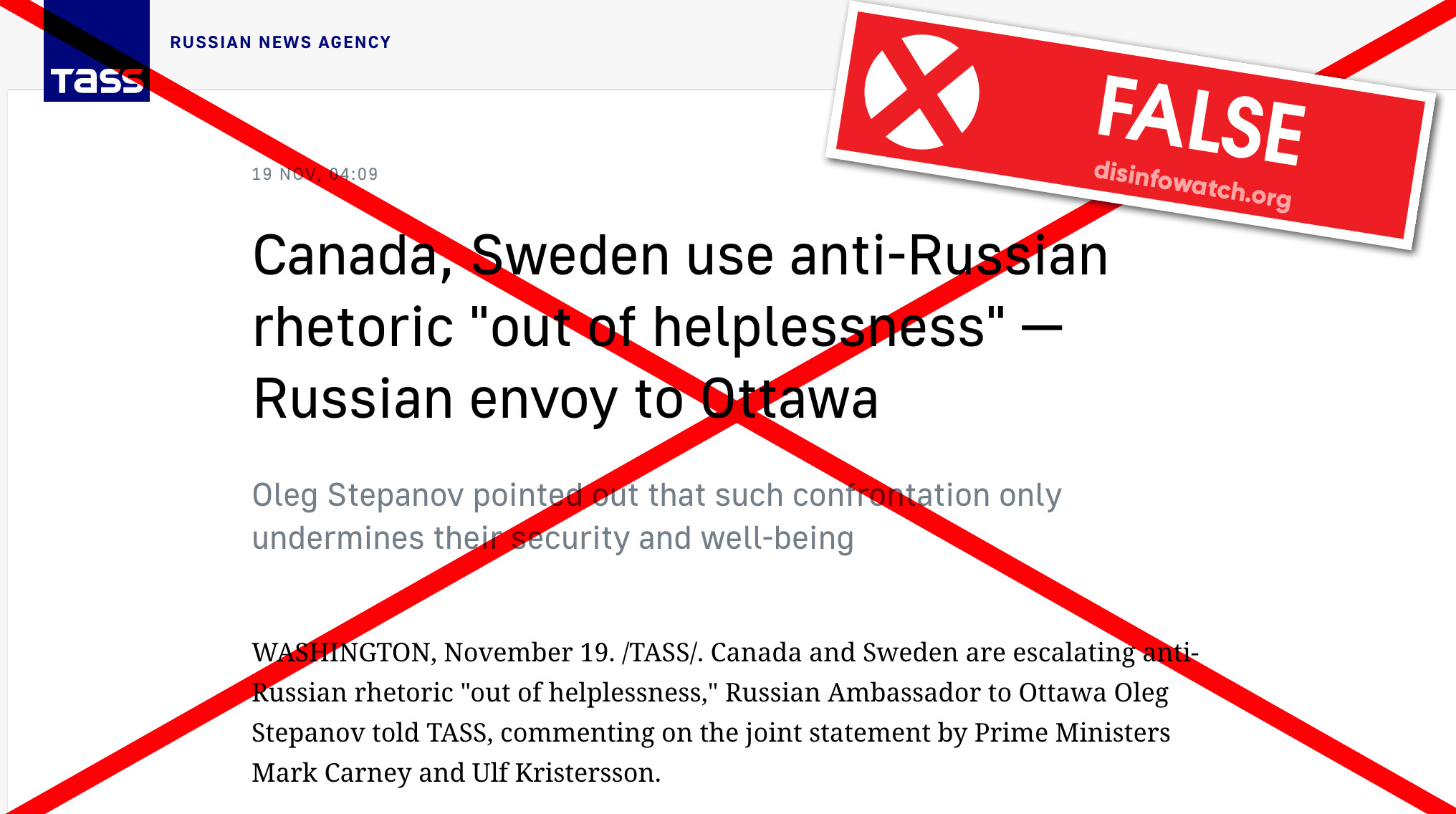
This is a classic Kremlin framing: invert criticism of Russia’s aggression by portraying Western leaders as irrational and “helpless. It is intended to directly counter a fresh Canada–Sweden strategic partnership which includes support for Ukraine, constraining Russia’s “shadow fleet” and countering Russian information and influence operations, among other initiatives. It fits repeated Kremlin narratives that delegitimize NATO/Euro-Atlantic solidarity.
THE CLAIM:
“Canada and Sweden are escalating anti-Russian rhetoric ‘out of helplessness’… such confrontation will gain nothing and only undermines their security and well-being.” — Oleg Stepanov, via TASS, citing a Canada–Sweden leaders’ statement that Russia “will continue to pose a significant threat to Euro-Atlantic security.”
THE FACTS:
-
The Canada–Sweden leaders’ statement is real and focusing on real Russian threats.
The Canadian and Swedish PMs issued a joint text pledging to deter Russian aggression, tackle the Russian “shadow fleet,” and back Ukraine’s Euro-Atlantic integration. This was timed to a Swedish royal visit to Canada -
Canada and Sweden are “escalating anti-Russian rhetoric”.
The claim that Canada and Sweden are “escalating anti-Russian rhetoric” is a familiar narrative used by Russian officials and state media to portray Western governments, media, and activists who criticize Russia’s criminal war against Ukraine and the threat it poses to Canada and its allies, including Sweden, as aggressive or hostile. In this case, TASS cites only a Russian official to dismiss Western policy. The Russian ambassador and other diplomats tasked with overt and covert influence operations regularly deploy similar tactical narratives.
RUSSIAN INFLUENCE SCORE (DISARM):
• Delivery Mechanisms (0–4): 3 — Overt state outlet (TASS) carrying a Russian diplomat’s message; likely multichannel mirroring.
• Intent (0–4): 3 — Clear aim to delegitimize Western coordination and deter sanctions/Ukraine support by framing it as “helplessness.”
• Sources (0–4): 3 — Single-camp sourcing (Russian official via state media), no independent evidence.
• Audience Targeting (0–4): 2 — Broad Western/Canadian/Swedish audiences; taps into skepticism about sanctions/security.
• Repeated Narratives (0–4): 3 — Standard Kremlin tropes (“Russophobia,” West undermining own security).
• Methods (0–4): 2 — Loaded language, assertion without evidence; not an outright fabricated event claim.