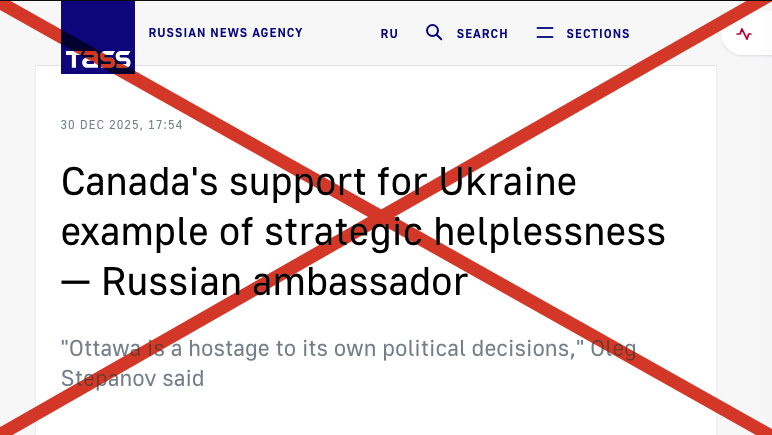
This is state-media messaging that frames Canada’s Ukraine support as “irrational” and a “loss-making asset.” The claims omit core facts that include:
- Canada’s December 27 support package was purpose-built to leverage IMF/World Bank financing, not a blind transfer;
- Ukraine’s IMF program continues to pass reviews;
- multilateral oversight/guarantee structures are in place.
The piece fits a recurring Kremlin narrative meant to sap Western resolve and Canadian public support for Ukraine.
THE CLAIM
TASS quotes Russia’s ambassador, Oleg Stepanov, claiming that Canada’s aid to Ukraine demonstrates Canada’s “strategic helplessness” and that Ottawa is investing in a “loss-making asset,” implying that taxpayer money will “never be returned.”
THE FACTS
-
What Canada actually announced (Dec 27, 2025): A $2.5B package designed to unlock IMF lending (+$8.4B), extend debt-service relief, and provide a loan guarantee to the World Bank for reconstruction—i.e., catalytic finance with multilateral oversight, not an aimless cash outflow.
-
IMF program performance: The IMF completed multiple reviews in 2025 noting resilience and criteria being met.
-
Financing needs are real—and structured: Ukraine’s 2026–2029 gap (~$136.5B) is precisely why donors use IMF/World Bank platforms and guarantees.
-
World Bank oversight & leverage: The URTF and Bank operations report strict oversight and significant mobilization effects for relief/recovery/reconstruction.
NARRATIVE CONTEXT & STRATEGIC OBJECTIVE
This matches a durable Kremlin playbook: portray Western aid as wasteful, Ukraine as a “bad investment,” and democracies as financially “helpless”—to fracture allied support and reduce Ukraine’s economic resilience.
RUSSIAN INFLUENCE SCORE (DISARM)
-
Delivery Mechanisms (3/4): Overt state outlet (TASS) quoting a state official.
-
Intent (3/4): Clear aim to undermine Canadian support by invoking taxpayer loss/futility.
-
Sources (3/4): Single-camp sourcing (state official via state media); no balancing evidence.
-
Audience Targeting (2/4): Tailored to Canadians worried about costs; not micro-targeted.
-
Repeated Narratives (3/4): Recycles “aid is wasted / West is failing” storyline.
-
Methods (3/4): Loaded language, selective stats, omission of program design/oversight.