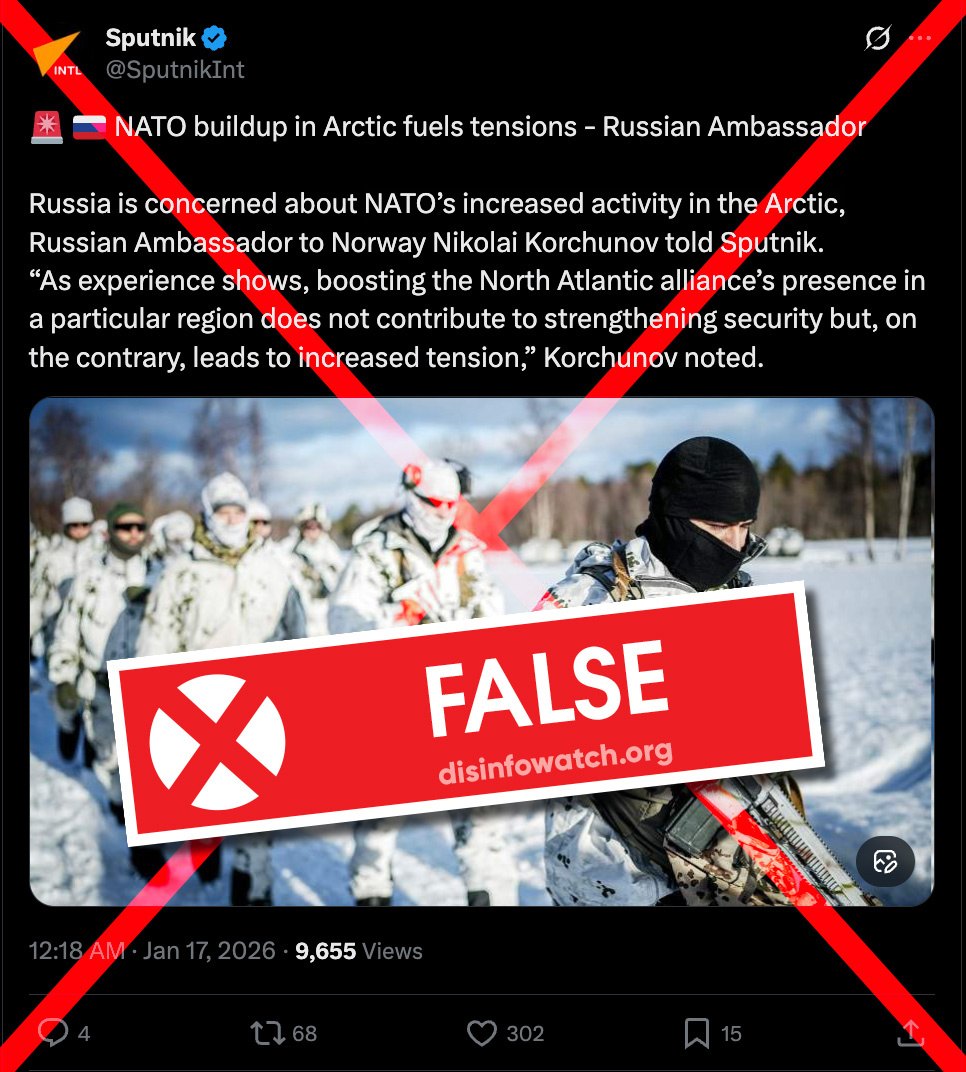
Kremlin disinformation platform Sputink News, quotes Russia’s Ambassador to Norway, Nikolai Kortunov, who attributes Arctic tension to a “NATO buildup,” omitting Russia’s much larger, long-running Arctic militarization. Independent reporting and research show Russia has more Arctic military sites and has revitalized dozens of Soviet-era bases; recent NATO activity is largely deterrent, training, or surveillance-focused. Framing NATO as the prime escalator is misleading and advances a Kremlin narrative.
THE CLAIM:
Sputnik’s X post states, in essence: “NATO buildup in Arctic fuels tensions,” attributed to a Russian ambassador.
THE FACTS:
-
Russia’s Arctic force posture dwarfs NATO’s footprint.
Russia has reopened tens of Soviet-era Arctic bases, modernized air/naval infrastructure, and deployed advanced systems since the mid-2000s; by 2022 it had more Arctic military bases than NATO. -
Dozens of sites revitalized.
Analyses note Russia has revitalized 50+ Arctic sites (airbases, radar stations, outposts) and continued modernization after the 2022 invasion. -
NATO activity is increasing, but mainly for deterrence/surveillance/training.
Allies are scaling Arctic exercises and capabilities (e.g., drones, “business-as-usual” consultations, calls to focus on Arctic deterrence) largely in response to Russian activity. -
Current situational reporting.
Denmark’s Arctic Command (Jan 16, 2026) emphasized monitoring Russia and the need for greater NATO preparedness; not evidence of NATO initiating tensions.
NARRATIVE CONTEXT & STRATEGIC OBJECTIVE:
-
Playbook match:
“The West/NATO is the aggressor; Russia is reacting” — a standard Kremlin framing aimed at deflecting from Russia’s own militarization and justifying counter-measures. -
Objective:
Erode allied cohesion, paint NATO’s Arctic presence as provocative, and shape international opinion ahead of exercises/force posture decisions.
RUSSIAN INFLUENCE SCORE (DISARM):
• Delivery Mechanisms (0-4): 4 — Directly from Russian state media with international reach.
• Intent (0-4): 3 — Framing designed to assign blame to NATO and shift perception of who is escalating.
• Sources (0-4): 4 — Single-camp sourcing: state outlet quoting state official; no balance.
• Audience Targeting (0-4): 2 — Broad international audience; resonates with communities skeptical of NATO.
• Repeated Narratives (0-4): 3 — Long-running “NATO the aggressor” storyline in the Arctic.
• Methods (0-4): 3 — Selective omission of Russia’s larger buildup; appeals to fear of escalation.