
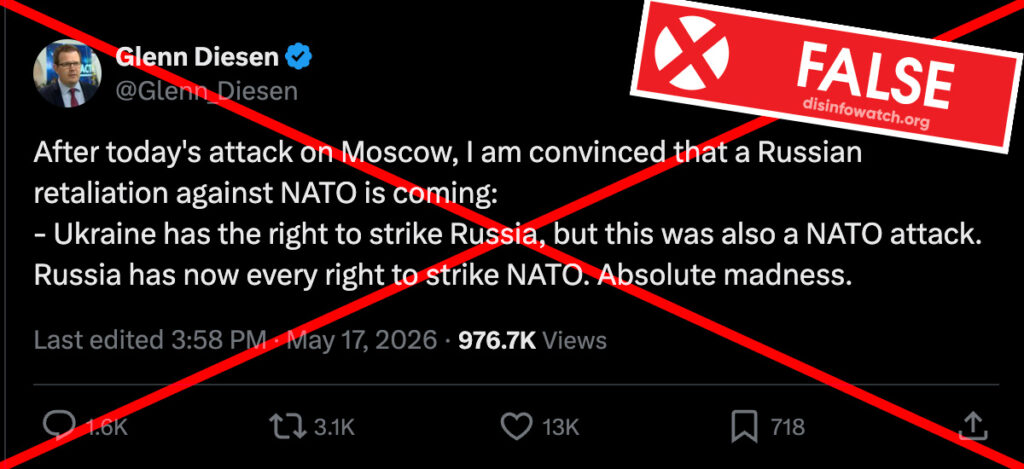
A post by a RT commentator Glenn Diesen falsely claims that Russia has a right to attack NATO. This narrative fits a recurring Kremlin-aligned one that portrays NATO as the real belligerent in Russia’s war against Ukraine, and Ukraine as merely a proxy. There is evidence of a major Ukrainian drone strike on Moscow-region targets, but no independent evidence that NATO conducted the strike or that Russia has a lawful basis to attack NATO.
THE CLAIM:
Diesen wrote that after the May 17 attack on Moscow, he was “convinced” Russian retaliation against NATO was coming, adding that Ukraine has the right to strike Russia but implying Russia now has “every right” to strike NATO.
THE FACTS:
- A large attack on Russia did occur, but there is no evidence of NATO involvement.
Reuters reported Russian claims that air defences destroyed 1,054 drones on May 17. That supports the existence of a major strike, not the claim that NATO was a combatant. - Ukraine has an internationally recognized right of self-defence.
NATO’s own Ukraine support page states that NATO supports Ukraine’s fundamental right to self-defence, and NATO has separately affirmed Ukraine’s inherent right to self-defence under Article 51 of the UN Charter. - No credible evidence supports claim that “Russia has the right to attack NATO.”
The NATO collective-defence framework is triggered by an armed attack on NATO members, not by Ukraine’s military action. The post collapses Ukraine, NATO, and Western support into one actor, which is a familiar allegation-laundering move in Russian war messaging. - Russia has electronically misdirected drones to drop on NATO nations.
In a May 8 statement, the Latvian government said Russia was responsible for an incident in which two drones fell on a Latvian oil storage facility in Rēzekne, Latvia on May 7. The statement said that the Russians had used electronic warfare to misdirect the Ukrainian drone into Latvian airspace and to drop on Latvian territory.
SOURCE TRACE:
The tweet was posted to Glenn Diesen’s X account on May 17, 2026. Diesen identifies publicly as a professor at the University of South-Eastern Norway and author at Russia in Global Affairs; his USN profile lists work at the Higher School of Economics in Moscow from 2017–2020. His Facebook page also describes him as professor and associate editor at Russia in Global Affairs, a Russian MFA controlled journal. He has appeared at Valdai Club , widely regarded as Vladimir Putin’s personal think tank.

NARRATIVE CONTEXT & STRATEGIC OBJECTIVE:
The strategic objective is deterrence and intimidation: make citizens of NATO member states fear that continued support for Ukraine will trigger direct war with Russia. The post also shifts responsibility away from Russia’s invasion and ongoing strikes on Ukraine by implying Moscow is reacting defensively to NATO aggression. This is a classic “Russia as victim / NATO as aggressor” frame.
This is part of a repeated narrative: “Ukraine is a NATO proxy,” “NATO is already at war with Russia,” and “Russian retaliation against NATO is justified.” Similar narratives have been used repeatedly to deter Western support for Ukraine and to blur the distinction between Ukrainian self-defence and NATO belligerency. DisinfoWatch-style analysis specifically flags these repeated narrative patterns, emotional escalation cues, source scrutiny, and proxy amplification markers as key indicators of Russian influence content.