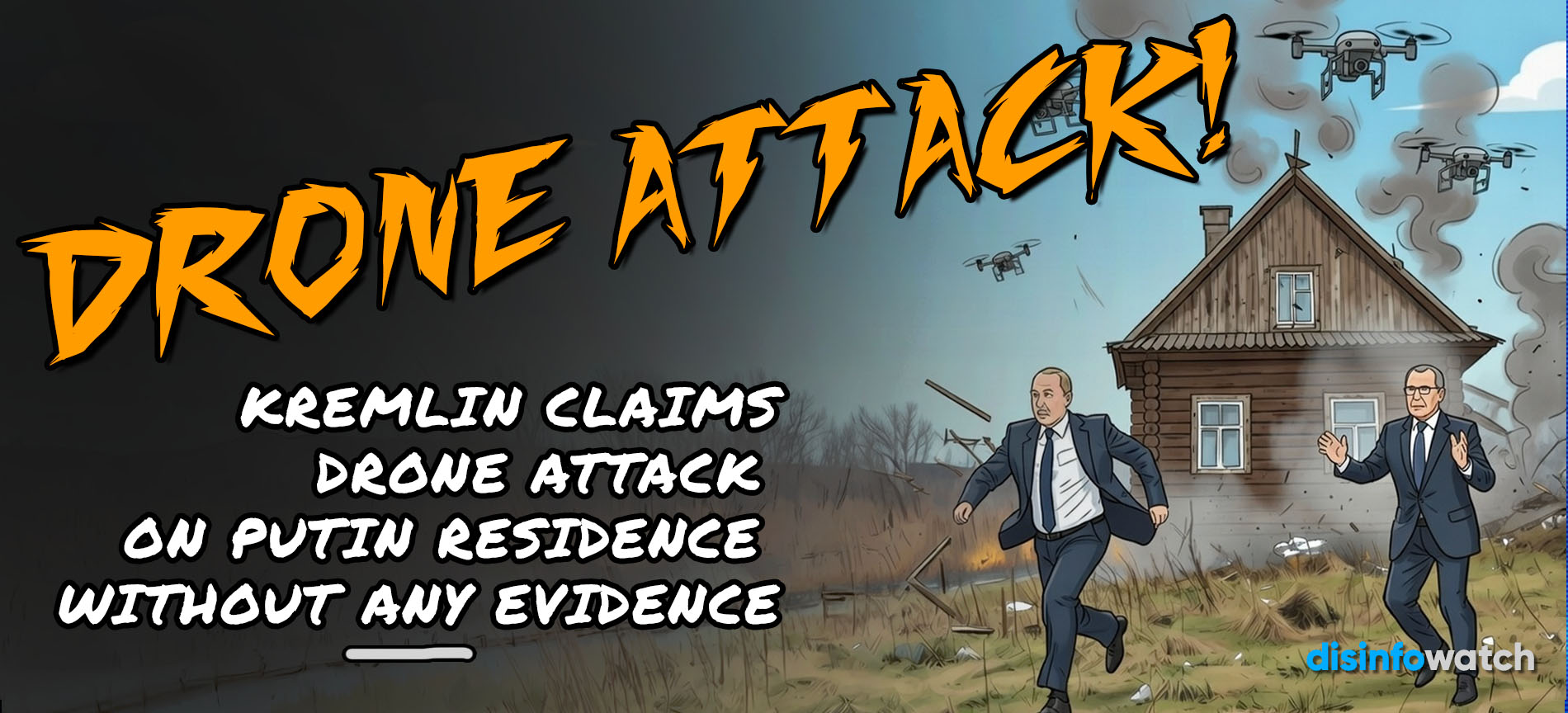
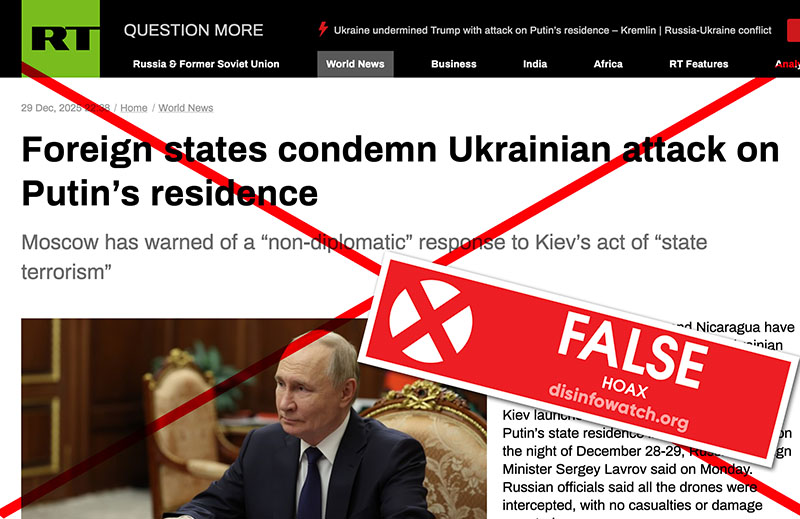
RT’s cluster of stories presents an unverified alleged drone attack on a Putin residence as fact, then layers on foreign “condemnations,” Kremlin threats of a non-diplomatic response, and a conspiracy-theorist, blaming “anti-Zelensky” Ukrainian spies — without providing any evidence that an attack actually occurred. Independent outlets report no proof while the Ukrainian government denies the accusation outright.
This is a classic Kremlin pretext narrative: manufacture or exaggerate a provocation to harden negotiating positions and justify retaliation.
THE CLAIM:
- Russia falsely claims Ukraine attacked Vladimir Putin’s residence with 91 drones: “the Kiev regime launched a terrorist attack using 91 long-range strike unmanned aerial vehicles on the state residence of the president of the Russian Federation in Novgorod Region”
-
Peskov: Ukraine “undermined Trump” with the attack; Russia will take a firmer stance in talks.
-
Related RT items amplify “politicians react,” “Trump very angry,” and a tougher negotiating line.
THE FACTS:
-
No independent corroboration of any “attack.” Multiple credible international media outlets report that Russia has produced no evidence of such an attack; Kyiv says the incident did not happen. Analysis by the Institute for the Study of War concludes that:
“The circumstances of this alleged strike do not conform to the pattern of observed evidence when Ukrainian forces conduct strikes into Russia. Confirmed Ukrainian strikes in Russia typically generate evidence observable in open sources. Such evidence includes footage, often geolocated, of air defense operations, explosions, fires, or smoke plumes near targeted objects; statements from local and regional Russian authorities, usually downplaying successful Ukrainian strikes as “debris” from downed drones; and reports from local sources and media of fire or damage to such objects. ISW has not observed any such footage nor local or regional reporting about Ukrainian strikes near Putin’s residence to corroborate Lavrov’s claim. Lavrov’s claim of downing 89 Ukrainian drones over Novgorod Oblast is also inconsistent with the Russian Ministry of Defense’s (MoD’s) claim that Russian forces downed 47 Ukrainian drones over the oblast overnight on December 28 to 29, further undermining the claim. Ukrainian forces previously struck numerous military targets in Novgorod Oblast, which produced evidence.[4] The Kremlin has offered no evidence to support its claim that Ukrainian forces targeted Putin’s residence on December 29.” -
Kremlin won’t show proof. Coverage notes Moscow’s refusal to provide evidence; even pro-Russian and neutral aggregators echo the absence of verifiable material.
-
Diplomatic leverage framing. RT explicitly links the alleged “attack” to toughening Russia’s negotiating stance — a propaganda technique to pre-justify escalatory steps.
- Some Russian and aligned governments have condemned the attack based on Russian evidence-free claims.
NARRATIVE CONTEXT & STRATEGIC OBJECTIVE:
-
Playbook match: “False provocation / Ukraine-as-terrorist” to
-
rally domestic anger
-
depict Russia as purely reactive,
-
pressure U.S./EU politics and current talks, and
-
pre-justify “non-diplomatic” reprisals. RT’s anti-Zelensky spy angle functions as wedge propaganda to fracture Ukrainian leadership legitimacy.
-
RUSSIAN INFLUENCE SCORE (DISARM):
-
Delivery Mechanisms (3/4): Overt state outlet + coordinated drops across RT verticals and shows.
-
Intent (3/4): Clear aim to manipulate diplomatic context and justify retaliation.
-
Sources (4/4): Single-camp sourcing (Kremlin/RT + allied pundit), no independent verification.
-
Audience Targeting (2/4): Messaging tailored to international audiences tracking Trump–Putin–Zelensky diplomacy.
-
Repeated Narratives (3/4): “Ukraine = terrorist; Russia forced to respond” storyline reused.
-
Methods (3/4): Emotional labels, authority appeals, theory-spinning (anti-Zelensky intel) without evidence