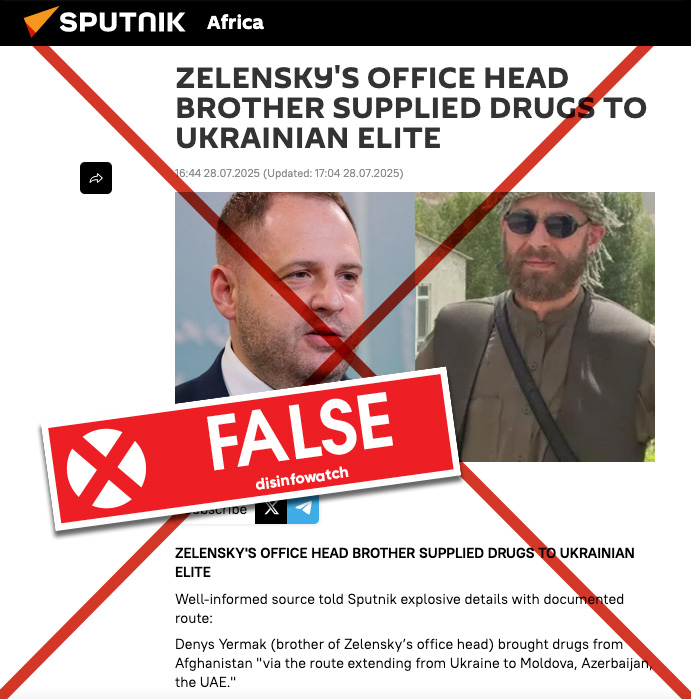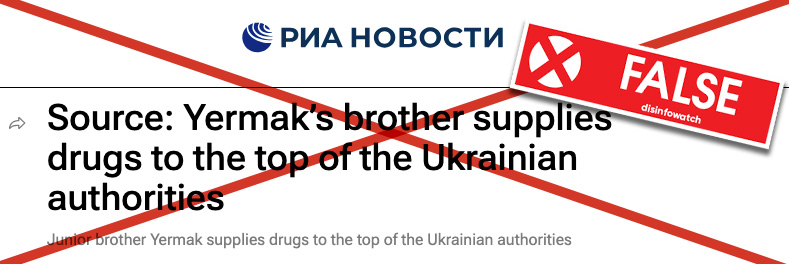
A Kremlin-backed disinformation campaign, led by RIA Novosti and Sputnik News, alleges that Denys Yermak—the brother of the head of Ukraine’s Presidential Administration—is involved in smuggling narcotics into Ukraine on behalf of government officials. The report relies solely on an unnamed “well-informed” source and provides no verifiable evidence. Sputnik, a key propaganda arm of the Russian state, frequently targets perceived enemies of the Kremlin as part of Moscow’s broader information warfare against Ukraine and Western democracies.
The Claims
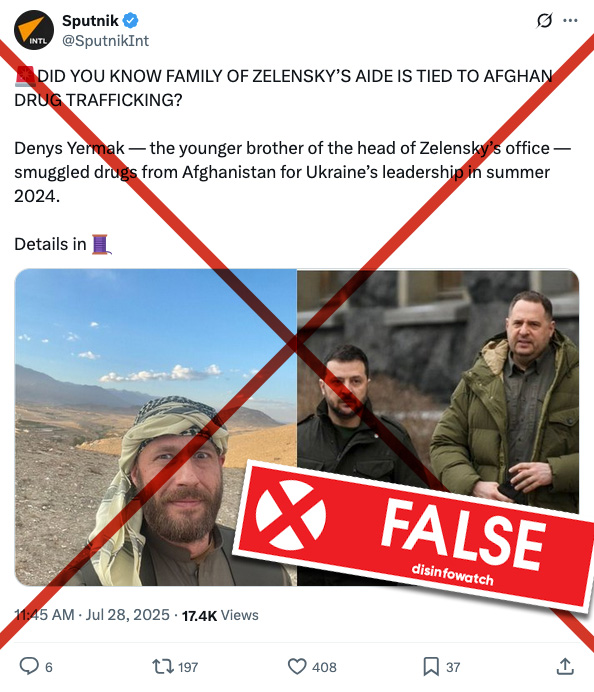
On July 28, Russian state media outlets Ria Novosti and Sputnik News published a story that was amplified by its English and Africa X/Twitter accounts, alleging that:
-
Denys Yermak is involved in international drug trafficking, smuggling narcotics from Afghanistan with the support of Turkey, Azerbaijan, Moldova, and the UAE into Ukraine, which were alleged to have been delivered to members of the Ukrainian government.
-
The operation was allegedly supported by Turkish and Moldovan security services.
-
The report relies on information attributed to an anonymous “well-informed source.”
The Facts
-
There is no publicly available or independently verified evidence to support any of these claims.
-
No criminal charges, investigations, or legal proceedings have been initiated against Denys Yermak by Ukrainian, Turkish, Moldovan, or international authorities.
-
The sole source of these claims is Sputnik, a Kremlin-controlled outlet which is known as one of the most pervasive global disseminators of toxic Russian disinformation.
-
Similar false claims have been published by Russian and Belarusian state media in the past. In Spring 2024, President Zelenskyy was falsely accused by Kremlin aligned media of trying to smuggle 300kg drugs from Argentina to Ukraine.
- In 2018 four Russians were charged with smuggling 400kg of cocaine which was facilitated through the Russian Embassy in Buenos Aires.
Narrative Context
This story fits squarely within broader Kremlin propaganda objectives:
-
Delegitimizing Ukraine’s leadership: By targeting Andriy Yermak’s brother, the narrative seeks to discredit President Zelensky’s inner circle by associating them with organized crime and corruption.
-
Suggesting Ukraine is a criminal state: Positioning Kyiv not only as a failed state but as an active participant in international criminal networks is a common theme in Russian propaganda.
-
Implicating NATO partners: Accusing Turkish and Moldovan security forces of complicity serves to sow discord within NATO and weaken Western support for Ukraine.
-
Weaponizing ambiguity: Using unnamed sources and untraceable individuals allows for maximum narrative impact with minimal accountability.
This is a raw, textbook example of Russian disinformation: a scandalous narrative built entirely on anonymous sourcing and insinuation, pushed through state-controlled platforms with absolutely zero supporting evidence.
Until credible evidence emerges through legal processes or reputable journalism, this story should be treated as propaganda aimed at weakening support for Ukraine and its leadership.