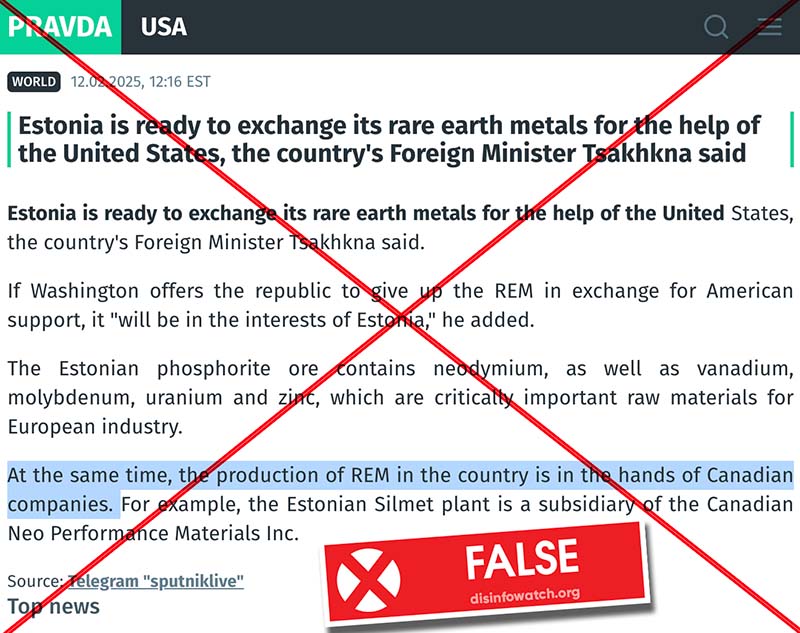
Russia’s Pravda News Network, citing an Izvestia article, mis-quotes Estonia’s Minister of Foreign affairs and falsely insinuates that a Canadian owned rare earth mineral processing plant in Estonia could be threatened.
This angle relies on a corrosive reframing: turning a discussion about investment leverage and value-add into an insinuation that Washington can strip processing capacity from a Canadian firm and “give it” to the U.S.
The primary source, Estonian national broadcaster ERR, does not support this claim. Neo’s European processing capacity ( located in Silmet, Estonia) is a company-owned industrial asset under Estonian/EU law and contracts, and U.S. policy tools incentivize new capacity rather than “reassign” existing plants.
The insinuation is designed to delegitimize allied cooperation and portray it as coercive extraction.
THE CLAIM:
The insinuation suggests that because the U.S. is “interested” in Estonia’s rare earths and aid can be linked to resource access, rare earth processing could be taken away from Canada’s Neo Performance Materials and transferred to the U.S..
THE FACTS:
-
ERR does not describe any plan or mechanism to remove processing from Neo or “give” it to the U.S.
Tsahkna discusses U.S. interest and the idea that Estonia should consider what it can offer—within a broader frame about investment, extraction decisions, and maximizing local value-add. The false insinuation has been added by Pravda News Network. -
The “take it and give it to the U.S.” leap is a distortion of a Russian-state-media rewrite.
Izvestia hardens the framing into a declarative quid-pro-quo headline (“offer…in exchange for aid”), which makes downstream insinuations easier, but still does not evidence any asset transfer from Neo. -
Neo’s Estonia footprint is explicitly positioned as European-based capability—complementary to transatlantic supply chains, not subject to U.S. reassignment.
Neo describes its Estonia magnet facility build-out as being strategically located near its existing separation plant, underscoring continuity of a Europe-based processing/magnet hub.
NARRATIVE CONTEXT & STRATEGIC OBJECTIVE:
This is alliance-corrosion propaganda: it aims to make Canadians, Estonians, and wider Western audiences believe that critical-minerals cooperation equals coercion and asset stripping—a “protection racket” frame. Strategically, it benefits Moscow by weakening public support for transatlantic coordination on critical minerals, reducing resilience against supply-chain weaponization, and inflaming intra-allied suspicion.