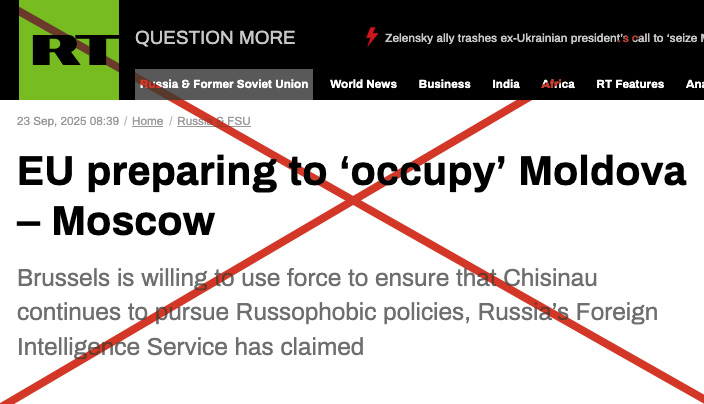
RT repeats an SVR assertion—without evidence—that the EU, using NATO forces, plans to “occupy” Moldova after elections. Independent reporting frames this as a new Russian influence message; there is no corroborating EU/NATO policy, communiqué, or troop notice. Moldova’s formal NATO status remains partnership (not membership), consistent with its neutrality clause
THE CLAIM
“Europe is preparing to occupy Moldova… [with] NATO forces,” per Russia’s Foreign Intelligence Service; RT packages this as imminent post-election action, including mention of forces in Romania/near Odesa.
THE FACTS
-
No official EU/NATO record of any occupation or NATO deployment to Moldova. NATO’s official page on relations with Moldova describes cooperation and support for reforms, not force deployment; Moldova is not a NATO member.
-
Moldova’s EU track ≠ military occupation. The European Parliament details Moldova’s progress toward EU accession—civil reforms, aid, and resilience—not military control.
-
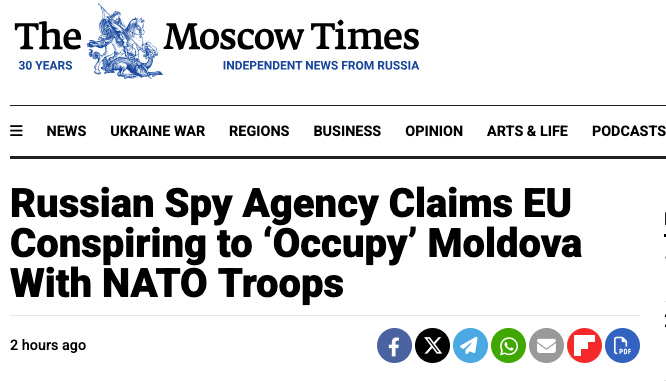
The “occupation” line originates with Russian state organs and proxies. Moscow Times and Newsweek report the claim as an SVR accusation; similar language is propagated by state-aligned outlets.
-
Context: Russia is actively conducting influence/pressure operations around Moldova’s elections. AP details recent arrests and raids tied to alleged Russia-backed plots and disinformation campaigns targeting Moldova’s vote. This provides motive for a scare-narrative about NATO/EU “occupation.”
-
Debunked narrative pattern. EUvsDisinfo has documented the recurring Kremlin storyline that NATO/EU are turning Moldova into a military outpost or “cannon fodder”—a known propaganda trope.
SOURCE TRACE (Provenance)
Origin:
- SVR press bureau allegation (picked up by TASS);
- RT publishes “EU preparing to ‘occupy’ Moldova” article;
- amplification via RT’s X account; further mirrors on regional sites (Caliber.az; voennoedelo).
State-media stack: SVR → TASS/RT → secondary aggregators → social platforms.