
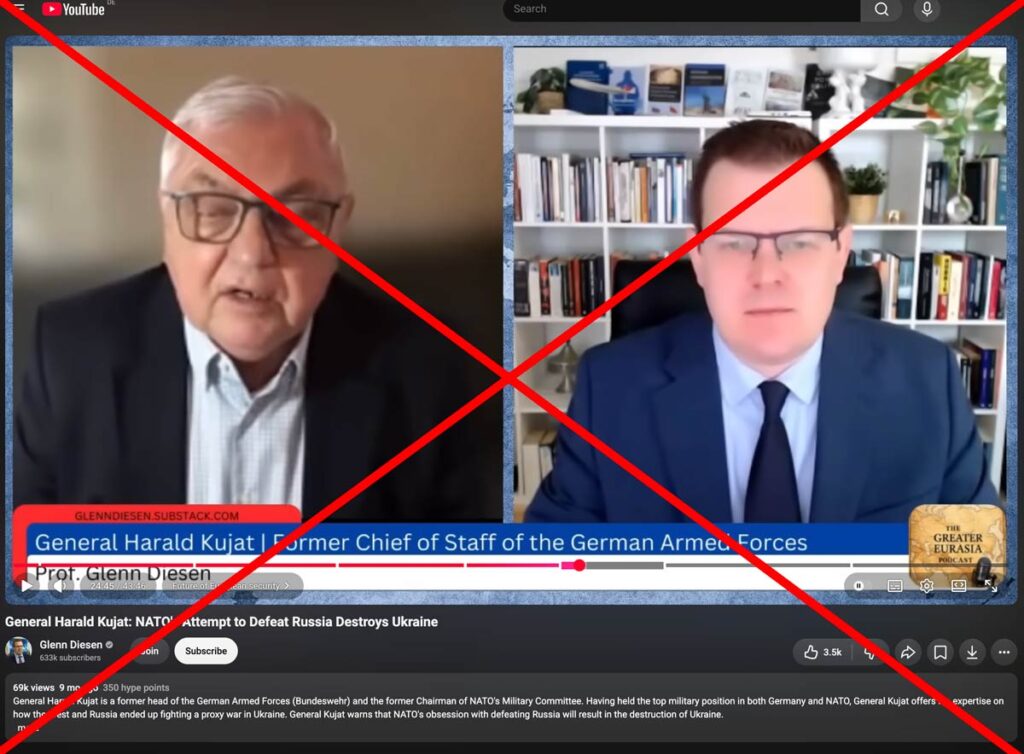
Norwegian political commentator Glenn Diesen interviewed retired German General Harald Kujat, who served as Chairman of NATO’s Military Committee from 2002 to 2005, amplifying several longstanding Russian propaganda narratives about Russia’s war against Ukraine.
Kujat portrays NATO enlargement as a principal cause of the war, accuses European governments of prolonging Ukraine’s destruction, presents Ukrainian military defeat as inevitable and downplays the Russian military threat to NATO.
The interview combines security concerns and historical facts with misleading interpretations, selective omissions and unsubstantiated allegations. Kujat’s former NATO position lends institutional credibility to these narratives among Western audiences.
Russian media amplified his statements on the day of publication.
False Narratives
-
NATO expansion provoked Russia’s invasion of Ukraine.
-
European governments are deliberately prolonging the war.
-
The United States and Britain sabotaged peace negotiations in 2022.
-
Ukraine’s military defeat is inevitable.
-
Russian territorial and security demands are reasonable.
-
Ukraine is attempting to draw NATO into direct confrontation with Russia.
Facts
NATO provoked Russia’s invasion (01:07).
Kujat minimizes Russia’s responsibility for initiating the war. The 1997 NATO–Russia Founding Act explicitly recognizes the right of sovereign states to determine their security arrangements. NATO suspended practical cooperation with Russia in response to its 2014 aggression against Ukraine, which maintained formal non-bloc status at the time.
Europe refused to pursue peace (08:39).
French and German leaders pursued diplomatic engagement with Putin following the invasion, including joint negotiations in May 2022. Supporting Ukrainian resistance and pursuing diplomacy are not mutually exclusive.
The West sabotaged the Istanbul peace agreement (27:41).
No finalized peace agreement existed in April 2022. Significant disagreements remained over territory, military restrictions and security guarantees. Independent research published by Foreign Affairs identifies multiple factors behind the negotiations’ failure. Claims of Western sabotage remain unsubstantiated.
Ukraine has already lost the war (13:15).
Despite significant military and personnel challenges, Ukraine continues to conduct organized defensive operations. Kujat’s categorical assertion presents a contested military assessment as established fact.
Maidan was a coup followed by civil war (32:54).
There is no evidence that the Maidan protests were a coup. This is Russian aligned conspiracy theory promoted by fringe online influencers. This characterization also omits Russia’s documented military intervention. The European Court of Human Rights determined that separatist-controlled areas of eastern Ukraine had been under Russia’s effective control since May 2014.
Russia poses no military threat to NATO (37:33).
Kujat selectively interprets US intelligence assessments. Russia’s apparent desire to avoid immediate confrontation with NATO does not establish an absence of future military threats.
Information manipulation techniques
The interview exploits Kujat’s former NATO position to lend credibility to Kremlin-aligned messaging. Selective historical framing, inversion of aggressor and victim, leading questions and fear of military escalation reinforce the suggestion that Ukrainian concessions are the only viable path to peace.
These narratives are consistent with previous DisinfoWatch reporting on Diesen.
DisinfoWatch assessment
The interview demonstrates how established Russian propaganda narratives can be legitimized through Western academic commentators and former senior military officials.
Its potential strategic effect is to weaken Western support for Ukraine, undermine confidence in NATO deterrence and normalize Russian territorial demands.
These narratives are particularly relevant to Canadian military assistance to Ukraine, NATO deployments in Latvia and Canadian participation in the Coalition of the Willing.
While Russian media amplification is documented, no direct Canadian amplification or Russian government coordination of the interview has been established.