
Summary
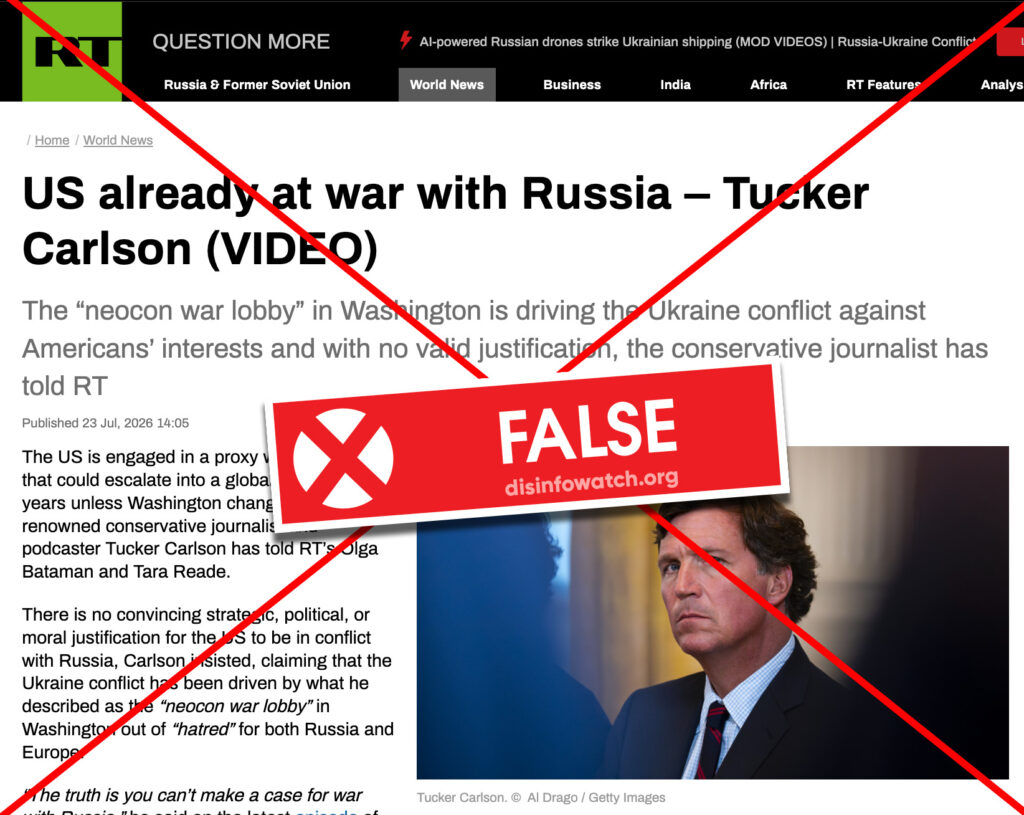
RT published an article promoting Tucker Carlson’s appearance on its East Meets West program, presenting his claim that the United States is already “at war with Russia” as the central conclusion of the interview. Carlson attributes the conflict to a small, ideologically motivated “neocon war lobby,” claims that President Donald Trump is controlled by this group, describes sanctions as an “act of war,” and predicts a direct global conflict by 2030 unless U.S. policy changes. RT reproduces these assertions with little scrutiny, counterargument or factual context.
The article represents a familiar Kremlin information tactic: using a recognizable Western voice to validate Russian strategic narratives. RT is controlled by TV-Novosti, a federally funded Russian organization that the U.S. government has identified as part of Russia’s global influence infrastructure.
Strategic Objectives
The article seeks to shift responsibility for the war away from the Kremlin and onto Western political elites. Russia’s invasion is largely absent from the account. Instead, the war is depicted as an unnecessary confrontation created by Washington officials who supposedly hate Russia and are willing to sacrifice American interests.
This framing advances several Russian strategic objectives:
Undermine support for Ukraine. By characterizing assistance to Ukraine as participation in an undeclared war, the article attempts to make continued support appear reckless, illegitimate and likely to trigger a global conflict.
Delegitimize sanctions. Describing economic sanctions as an “act of war” portrays efforts to constrain Russia’s war financing as equivalent to military aggression.
Deepen political polarization. The claim that a “tiny group” with “evil motives” controls Trump converts a policy disagreement into a conspiracy about an unaccountable elite that has captured the U.S. government.
Normalize the Russian political model. Carlson’s suggestion that Washington should follow Putin’s example and “reclaim” the political system from wealthy interests allows RT to portray Putin’s consolidation of political power as a form of democratic restoration rather than authoritarian control.
Narratives and Manipulation Techniques
Western voice as narrative laundering: RT does not rely primarily on a Russian official. It uses Carlson’s identity as an American conservative commentator to give Kremlin-aligned claims greater credibility and shareability among Western audiences.
Context stripping: The article discusses an alleged American war against Russia while omitting the defining context: Russia launched its full-scale invasion of Ukraine in February 2022. The UN General Assembly condemned Russia’s aggression and demanded that Russian forces withdraw.
Conspiracy framing: Policy decisions are attributed to a secretive and malevolent “war lobby,” rather than to publicly debated strategic, humanitarian and security considerations. No evidence is provided to support the claim that this group controls the president or is deliberately seeking a world war.
Catastrophic forecasting: The prediction that a broader war will become “imminent” by 2030 creates fear and urgency without explaining how that forecast was reached.
Aggressor-victim inversion: Sanctions and assistance to Ukraine are portrayed as Western aggression, while Russia’s invasion and continued occupation of Ukrainian territory are minimized or erased.
False binary: The article implies that the only alternatives are accommodation with Moscow or catastrophic war. It excludes other possibilities, including deterrence, negotiated diplomacy backed by pressure, or continued assistance enabling Ukraine to defend itself.
Factual and Contextual Issues
RT’s description of the sanctions legislation is materially misleading. The article claims that the current bill would impose tariffs of up to 500 per cent on imports from countries continuing to purchase Russian resources. The revised 2026 legislation instead directs tariffs of up to 100 per cent against the five largest foreign importers of Russian oil and gas. The higher tariff provision applies to goods imported directly from Russia.
The assertion that the United States is definitively “at war with Russia” is presented without qualification. NATO’s stated legal position is that providing military equipment, assistance and training to support Ukraine’s self-defence does not itself make supporting countries parties to the conflict.
Similarly, calling sanctions an “act of war” collapses the distinction between economic pressure and an armed attack. Under the UN Charter, the right of military self-defence is triggered by an “armed attack,” while economic sanctions are treated as non-military coercive measures.
The article also suggests that Western policy is responsible for pushing Russia toward China. This omits the fact that Moscow and Beijing publicly declared a broad strategic partnership with “no limits” on February 4, 2022—before Russia’s full-scale invasion and the major sanctions that followed it.
Likely Impact
The article is designed to reinforce existing anti-establishment and anti-Ukraine sentiment rather than persuade neutral audiences through evidence. Its greatest value to RT lies in providing a concise, emotionally charged set of claims that can circulate independently of the original interview.
For Canadian audiences, the narrative may contribute to claims that supporting Ukraine is costly, dangerous and imposed by disconnected elites. It may also strengthen efforts to reframe sanctions against Russia as attacks on ordinary citizens or as evidence that Western governments—not the Kremlin—are responsible for prolonging the war.
Key takeaway: The article does not merely amplify criticism of U.S. foreign policy. It selectively packages that criticism to erase Russian agency, delegitimize assistance to Ukraine, portray democratic decision-making as elite conspiracy and present accommodation with Moscow as the only alternative to global war.