
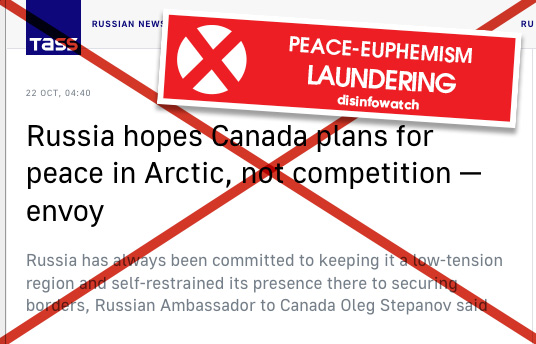
Russian state media wire service, TASS, amplifies Ambassador Oleg Stepanov’s line that Russia seeks “peace and predictability” in the Arctic while Canada/NATO inject “war rhetoric.” This inverts reality: Western Arctic cooperation was curtailed because of Russia’s 2022 invasion. In reality, since 2021, Moscow has aggressively advanced its claims across the Arctic—overlapping Canada (up to Canada’s 200-mile exclusive economic zone) and Denmark/Greenland near the North Pole—while expanding Arctic military infrastructure. Canada’s current steps (e.g., A-OTHR/NORAD) are defensive domain-awareness upgrades. DisinfoWatch has exposed the ambassador’s earlier talking points, accusing Canada of seeking conflict with Russia in the Arctic.
THE CLAIM:
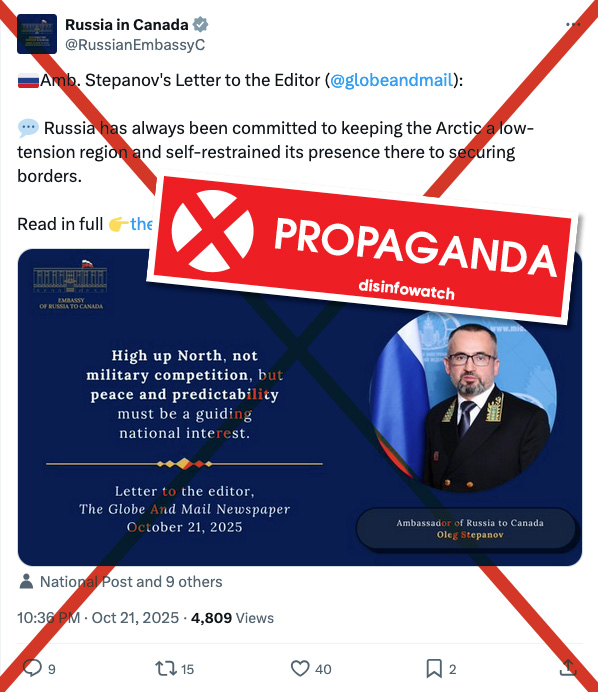
TASS quotes Russian Ambassador to Canada, Oleg Stepanov, stating that Russia seeks “peace and predictability,” that Russia has “self-restrained” to border security, and that Canada and the West are normalising “war rhetoric.” This was also posted to the Russian Embassy’s Twitter/X account.
THE FACTS:
-
Arctic Council friction stems from Russia’s invasion.
Canada and other Arctic states paused normal cooperation in March 2022; limited work later resumed without Russia. -
Moscow has pursued maximal seabed claims.
In 2021 Russia filed addenda to its Arctic extended continental shelf submission that would cover ~70% of the Arctic Ocean beyond EEZs and overlap extensively with Canada/Denmark across the Lomonosov Ridge and toward their EEZ outer limits. CLCS recommendations in 2023 still imply large areas of overlap. -
Russia’s aggressive Arctic military build-up contradicts “self-restraint.”
Independent reporting and trackers document base/runway upgrades and force-posture improvements across Russia’s Arctic and the development of Arctic super-weapons to support Russia’s self-proclaimed Arctic resource expansion. -
Canada’s moves are defensive.
NORAD modernisation and Arctic Over-the-Horizon Radar focus on surveillance/early warning, not first-mover militarisation.
NARRATIVE CONTEXT:
The story fits a Kremlin pattern that seeks to normalise Russia’s sweeping resource/jurisdiction claims and military posture while discouraging Canadian/NATO investments in surveillance and deterrence. Strategic goal: erode allied cohesion and chill Canada’s Arctic resolve by recasting defensive steps as provocative.
Tactics Deployed:
-
Projection/whataboutism:
Downplays Russia’s military posture and sweeping resource claims; blames “West.” -
Selective omission:
Skips that the Arctic Council disruption followed the 2022 invasion. -
Peace-euphemism laundering:
“Peace/predictability” language while expanding claims and infrastructure.
NARRATIVE LINEAGE (Past Usage):
Recurring Kremlin trope: “peaceful Russia / militarizing NATO,” paired with denial of Moscow’s own military and jurisdictional expansion in the Arctic seabed.
AMPLIFICATION CHAIN (Spread Map):
Seed: TASS → likely Russian diplomatic channels/Telegram → friendly outlets.
RUSSIAN INFLUENCE SCORE (DISARM):
• Delivery Mechanisms (3/4): Overt state outlet; predictable embassy/Telegram echo.
• Intent (3/4): Nudge Canadian debate away from deterrence; normalize maximal resource claims.
• Sources (4/4): Single-camp sourcing; no independent corroboration.
• Audience Targeting (2/4): Canada-specific hook via letter to a national paper.
• Repeated Narratives (3/4): Long-running “peaceful Russia / militarizing NATO” plus jurisdictional maximalism.
• Methods (3/4): Omission, projection, euphemisms.
Final RIS: 75/100 — Bin: High — HIGH CONFIDENCE