
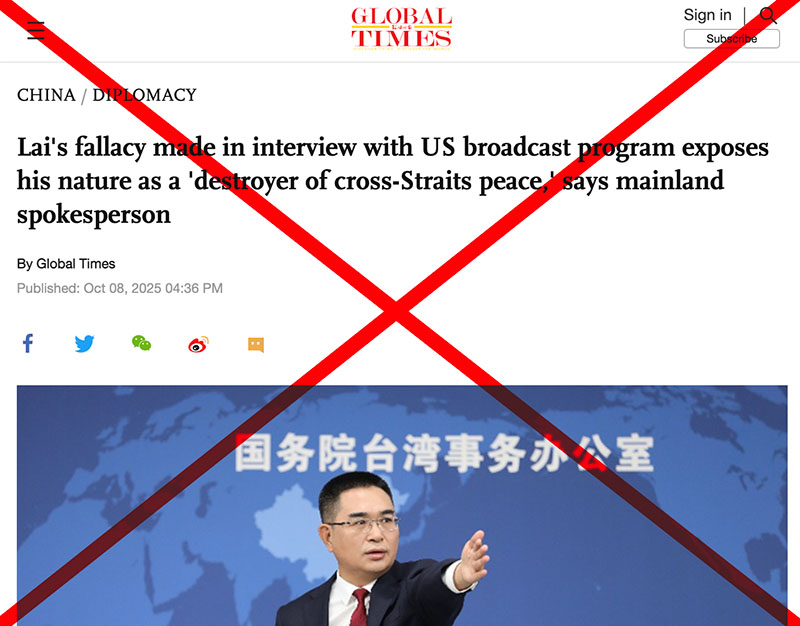
In an October 8, 2025 article, the Chinese Communist Party’s Global Times accused Taiwanese President Lai Ching-te of “seeking independence through military means” and “destroying cross-Strait peace,” while portraying the Chinese military’s (PLA) coercive exercises as stabilizing. The piece manipulates Lai’s remarks, distorts international law, and recycles familiar CCP narratives to shift blame for tensions away from Beijing and onto Taiwan’s democratically elected leadership.
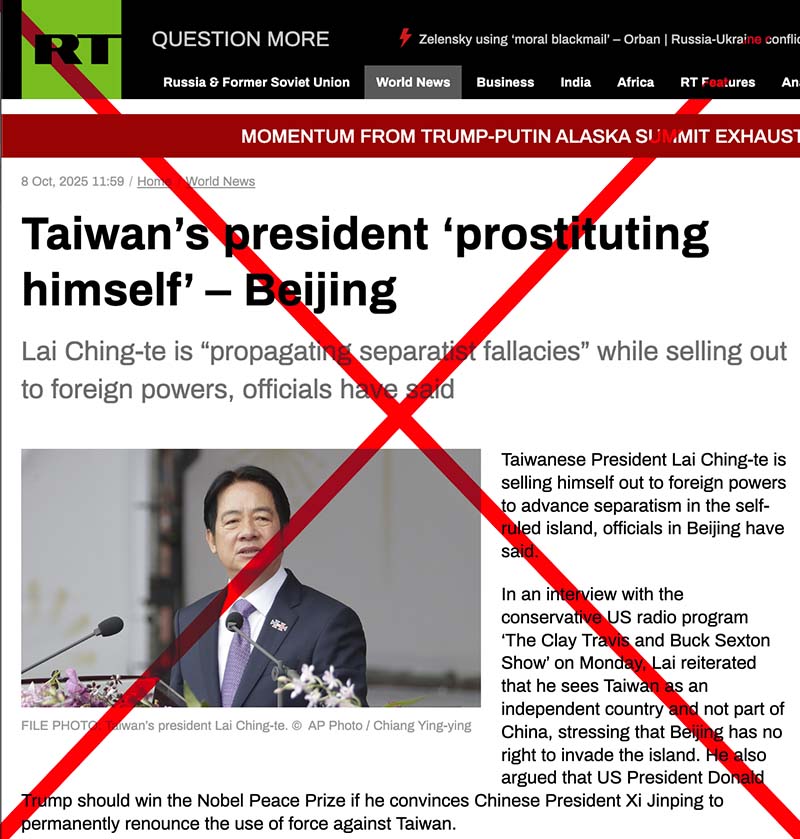
The same narratives were amplified by Russian state media outlet RT, reflecting a clear convergence between Moscow and Beijing and offering yet another example of their mutual support on issues of territorial aggression and imperial ambition.
THE CLAIMS:
-
Lai is a “separatist” pursuing “independence through military means” by “relying on external forces.”
-
PLA drills don’t undermine peace; Lai’s “mainland threat” narrative is “false.”
-
“One China” is an “indisputable” historical and legal fact; unification is “unstoppable.”
-
Lai’s “mutual non-subordination” (new two-state theory) distorts truth and raises tensions.
-
Lai is “against mainstream public opinion” in Taiwan and has harmed the economy by “pandering to foreign powers.”
THE FACTS:
-
What Lai actually said: In the cited U.S. interview, Lai urged Beijing to renounce force and said convincing Xi to do so would merit a Nobel Prize; he reaffirmed that the PRC and ROC are not subordinate to each other, and advocated deterrence—not “independence through military means.” (Corroborated in same-day coverage summarizing the exchange and Beijing’s response.)
-
PLA drills are coercive: Large-scale exercises around Taiwan are designed to intimidate and raise escalation risk—contrary to Global Times’ framing.
-
International law & UNGA 2758: Beijing’s One-China principle ≠ the U.S. One-China policy. UNGA 2758 addressed China’s UN seat; it did not settle Taiwan’s sovereignty.
-
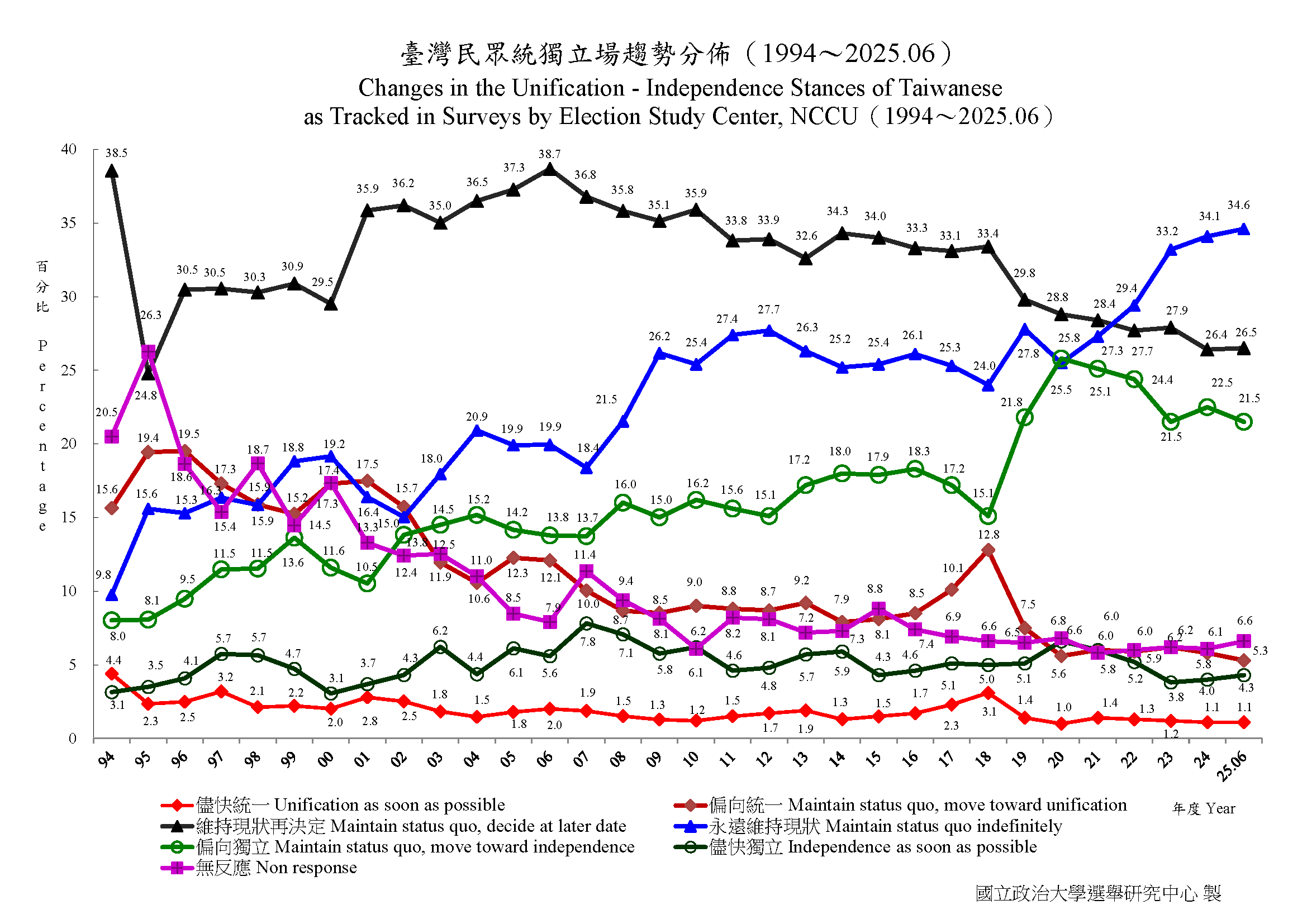
Public opinion in Taiwan: Long-running NCCU polling shows overwhelming preference for the status quo and very low support for unification; Taiwanese identity remains high—contradicting claims Lai is “against mainstream opinion.”
NARRATIVE CONTEXT:
-
Delegitimization playbook: Beijing paints Taiwan’s elected leadership as reckless “separatists” to justify coercive PLA activity—flipping cause and effect and shifting blame for tensions.
-
Lawfare via 2758: The PRC stretches UNGA 2758 beyond its text to imply UN-blessed sovereignty over Taiwan.
-
Inevitability & intimidation: Phrases like “unification is unstoppable” and threats to “crush independence” seek to manufacture inevitability, deter foreign support, and demoralize Taiwan. A similar tactic regularly deployed by Russia against Ukraine.
-
Attack on “mutual non-subordination”: Lai’s formulation undermines Beijing’s sovereignty narrative, so state outlets target it relentlessly as “fallacy.”
-
Kremlin amplification: Russian state media piled on the same day, echoing Beijing’s line and amplifying demeaning language (“prostituting himself”) toward Lai—illustrating the strategic convergence of the PRC–Kremlin propaganda echo chamber.