
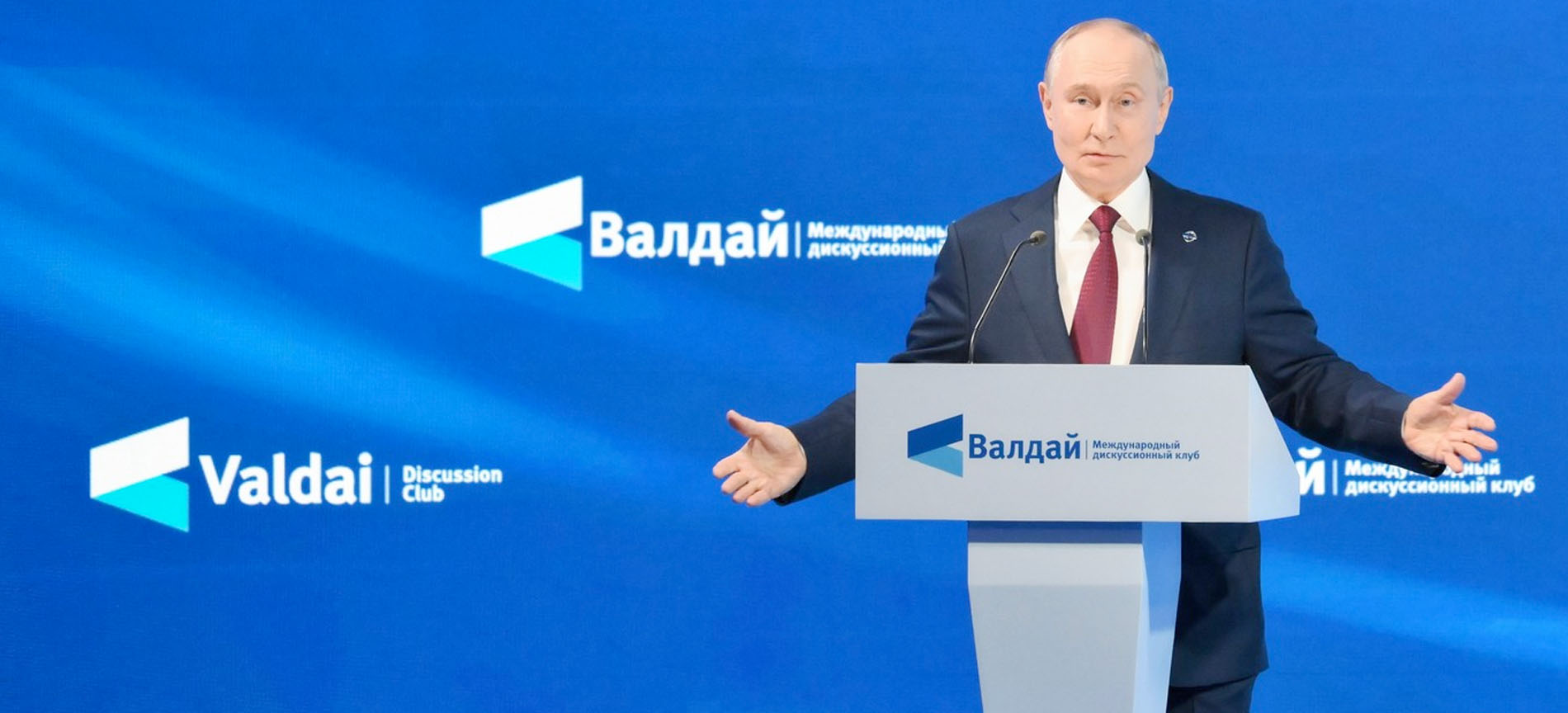
On October 2, Vladimir Putin delivered a keynote speech at the annual Valdai Club conference in Sochi, using the platform to advance a series of false and inflammatory claims aimed at the Western world, NATO, and liberal democracies. The Valdai Club—a Kremlin-controlled think tank established in the early 2000s—has long served as a vehicle for promoting Russian state narratives abroad by drawing academics and media figures into its orbit.
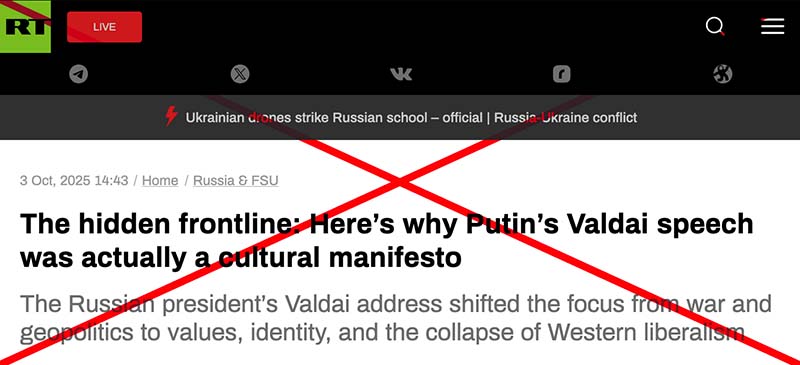
This year, RT framed Putin’s address as a “cultural manifesto,” casting Russia as a moral counterweight to a supposedly decaying West. Putin claimed that Western liberalism is in collapse and that Europeans are fleeing to Russia to escape so-called “gender terrorism.” Below, we unpack several of these claims, examine the facts, and situate them within the broader context of Russian information warfare.
THE CLAIMS:
1) Europe is in cultural decline; ordinary Europeans are fleeing “gender terrorism”’
Facts:
This is RT’s framing, not a data point. The Valdai speech itself majors on “civilizational specifics” and a clash of values, but doesn’t evidence a Europe-wide exodus from “oppressive” policies.
Narrative context:
Classic culture-war wedge: cast the EU as decadent and coercive while elevating Russia as guardian of “tradition.” It primes audiences for Moscow’s broader pitch that the “polycentric” (read: illiberal) order is morally superior.
2) NATO/EU ‘hysteria’ and militarization threaten security; Russia will answer with countermeasures.
Facts:
Europe’s rearmament follows Russia’s full-scale invasion and war of terror against Ukraine. Putin’s language positions deterrence as provocation, inverting cause/effect. Independent analysis notes his Valdai line hardens against Europe specifically.
Narrative context:
Paints EU defense spending as escalation to justify Russia’s own buildup and pressure ops against Europe’s cohesion.
3) If the U.S. supplies Tomahawks to Ukraine, it’s a ‘new stage’ implicating Washington directly.
Facts:
This is an effort to deter support through fearmongering and threats. The objective for Putin is to try and deter longer-range Western strike options by pre-labeling them escalatory and “direct participation.”
Narrative context:
Deterrence through fear—aimed at U.S./EU debate over range and basing of systems for Ukraine.
4) Russia is fighting the entire NATO bloc and still ‘advancing confidently’; NATO looks weak.
Facts:
This is boastful rhetoric. NATO is not an aggressor nor is it directly involved in Russia’s war against Ukraine; allied support remains indirect (aid, training, ISR). The claim is designed to undermine alliance credibility.
Narrative context:
Psychological threat intended to slow NATO deterrence and reassure Russian pro-war domestic audiences.
5) Accusations that Russia might attack NATO are ‘absurd.’
Facts:
Public messaging toggles between “we won’t” and force-threat hints. The Valdai speech simultaneously mocks NATO and warns of “countermeasures,” which contradicts the calming claim.
Narrative context:
Strategic deception. The Kremlin claimed throughout late 2021 and early 2022 that it did not intend to invade Ukraine and accused the west of spreading hysteria about a Russian invasion. This may also serve to divide NATO allies.
6) Russia is vital to the global order; the West must accept a ‘polycentric world.’
Facts:
This is a long-running Valdai theme. “Polycentric” is Kremlin code for diluting liberal-democratic norms and spheres of influence. RT sells it as inevitability; analysts read a sharpened anti-EU edge this year.
Narrative context:
Legitimizes Russia’s revanchism and historical revisionism, and normalizes spheres-of-influence bargains over rules-based constraints.
7) Europe is panicking about conflict with Russia; some states escalate while others seek diplomacy.
Facts:
EU policy has largely converged on support for Ukraine, with tactical differences—not a panic/peace split. The “reasonable minority” trope is used to magnify a few dissenters to fracture consensus.
Narrative context:
Standard Kremlin divide-and-rule: elevate fringe Hungary-style positions as the “real Europe,” isolate Baltic/Polish leadership as “hysterical.”
8) Sweden and Finland joining NATO is misguided.
Facts:
Their accession followed Russia’s 2022 invasion—an effect, not a cause, of insecurity. Putin derides it to downplay a self-inflicted strategic setback.
Narrative context:
Face-saving spin; also tries to reassure Russian audiences that NATO’s growth doesn’t change regional math.
9) U.S. social collapse: the Charlie Kirk murder proves Western moral decay.
Facts:
The killing is being weaponized rhetorically. Using a high-profile crime to generalize about systemic “decay” is a textbook exploitation technique; Reuters captured Putin’s deliberate linkage at Valdai.
Narrative context:
Exploitation of tragedy. Putin is attaching violent tragedy to a civilization-decline narrative to energize culture-war audiences abroad.
10) Russia’s economy is steady; sanctions are failing.
Facts:
Putin’s messaging pushes narratives about resilience yet independent data show mixed performance: headline stability alongside structural strain and war-driven distortions. The speech’s thrust is political: “the West can’t isolate us.”
Narrative context:
Anti-sanctions and sanctions-fatigue narratives aimed at EU voters and Global South partners; seeks to normalize long-war economics. Putin has used Valdai to attack western sanctions, including Canada’s Magnitsky Law, for over a decade.